
Red Hat
Red Hat Solutions on Google Cloud
Red Hat solutions on Google Cloud work together to speed cloud migration and enhance cloud operations so you can focus on business innovation.
Overview
Optimized for Google Cloud
Red Hat Enterprise Linux images are optimized to include drivers and configurations to benefit from Google Cloud infrastructure innovations (such as gVNIC for 200 Gbps bandwidth and jumbo frames or Hyperdisk Extreme with up to 500,000 IOPS). They use Red Hat Update Infrastructure deployed on Google Cloud's planet-scale, high performant, and highly reliable network, are thoroughly tested for Google Cloud, and include Compute Engine guest environment.
Integrated support
Red Hat Enterprise Linux comes with integrated support. With a valid Google Cloud support pack, cases involving Red Hat Enterprise Linux can be filed directly to Google Cloud Customer Care. You need not switch back and forth from Google Cloud to Red Hat to resolve issues and can rely on a single point of contact for support.
Migrate on-prem workloads to the cloud
Red Hat solutions enable customers to easily migrate existing on-prem workloads to Google Cloud by leveraging the familiarity of Red Hat Enterprise Linux, Red Hat OpenShift, and Red Hat Ansible Automation Platform—which are designed to support seamless operations across on-prem and cloud environments.
BYOS
Leverage your existing subscriptions with Red Hat and bring your own subscriptions (BYOS) to save on license costs for your Red Hat deployments such as Red Hat Enterprise Linux, Red Hat OpenShift, or Red Hat Ansible Automation Platform in Google Cloud.
Procure from Google Cloud
You can procure Red Hat subscriptions from Google Cloud to optimize costs and draw down your existing Google Cloud spend commitments.
How It Works
Deploy your enterprise workloads with confidence in Google Cloud with Red Hat solutions.
Deploy your enterprise workloads with confidence in Google Cloud with Red Hat solutions.
Red Hat Enterprise Linux
Red Hat Enterprise Linux on Google Cloud provides an enterprise-grade platform for migration of on-prem workloads or for building new applications- creating a consistent foundation for hybrid environments.
Benefit from the familiarity of Red Hat Enterprise Linux optimized for Compute Engine VMs with integrated support and the security, scalability, and simplicity of Google Cloud.
Bring your own subscription (BYOS) or buy subscriptions directly from Google Cloud with cost optimization options such as committed usage discounts.

Additional resources
Red Hat Enterprise Linux on Google Cloud provides an enterprise-grade platform for migration of on-prem workloads or for building new applications- creating a consistent foundation for hybrid environments.
Benefit from the familiarity of Red Hat Enterprise Linux optimized for Compute Engine VMs with integrated support and the security, scalability, and simplicity of Google Cloud.
Bring your own subscription (BYOS) or buy subscriptions directly from Google Cloud with cost optimization options such as committed usage discounts.
Red Hat Enterprise Linux for SAP
SAP certifies Google Cloud and Red Hat Enterprise Linux (including High Availability and Update Services) for production deployments of SAP applications and databases, including SAP S/4HANA—delivering faster time to value, greater operational efficiencies, extended version support, and high levels of security for cloud-based deployments.
Bring your own subscription (BYOS) or buy subscriptions directly from Google Cloud with cost optimization options such as committed usage discounts.
Additional resources
SAP certifies Google Cloud and Red Hat Enterprise Linux (including High Availability and Update Services) for production deployments of SAP applications and databases, including SAP S/4HANA—delivering faster time to value, greater operational efficiencies, extended version support, and high levels of security for cloud-based deployments.
Bring your own subscription (BYOS) or buy subscriptions directly from Google Cloud with cost optimization options such as committed usage discounts.
Red Hat Enterprise Linux Extended Lifecycle Support (ELS) Add-On
Google Cloud and Red Hat provide a differentiated capability to manage legacy workloads. When your Red Hat Enterprise Linux version reaches end of maintenance, you have the option to access extended support, with critical impact security and selected urgent priority bug fixes for two additional years. You can onboard into the offering minimizing disruptions, as appending the ELS Add-On does not require to re-provision running VMs.
Additional resources
Google Cloud and Red Hat provide a differentiated capability to manage legacy workloads. When your Red Hat Enterprise Linux version reaches end of maintenance, you have the option to access extended support, with critical impact security and selected urgent priority bug fixes for two additional years. You can onboard into the offering minimizing disruptions, as appending the ELS Add-On does not require to re-provision running VMs.
Self-managed Red Hat OpenShift
Red Hat OpenShift on Google Cloud is an application platform that provides users with a consistent hybrid cloud foundation for building and scaling containerized applications—whether migrating existing workloads to the cloud or building new experiences for customers.
Benefit from the familiarity of Red Hat OpenShift with the security, performance, scalability, and simplicity of Google Cloud.
Use existing contracts bringing your own subscription (BYOS), or procure Red Hat OpenShift from Google Cloud via Marketplace.
Additional resources
Red Hat OpenShift on Google Cloud is an application platform that provides users with a consistent hybrid cloud foundation for building and scaling containerized applications—whether migrating existing workloads to the cloud or building new experiences for customers.
Benefit from the familiarity of Red Hat OpenShift with the security, performance, scalability, and simplicity of Google Cloud.
Use existing contracts bringing your own subscription (BYOS), or procure Red Hat OpenShift from Google Cloud via Marketplace.
Red Hat OpenShift Dedicated
Red Hat OpenShift Dedicated on Google Cloud is a turnkey application platform managed by Red Hat and backed by global 24x7 site reliability engineers (SREs). Red Hat OpenShift Dedicated allows organizations to build, deploy and scale applications quickly and focus on their business, not managing infrastructure.
Use existing contracts to bring your own subscription (BYOS), or procure Red Hat OpenShift Dedicated from Google Cloud via Marketplace.
Additional resources
Red Hat OpenShift Dedicated on Google Cloud is a turnkey application platform managed by Red Hat and backed by global 24x7 site reliability engineers (SREs). Red Hat OpenShift Dedicated allows organizations to build, deploy and scale applications quickly and focus on their business, not managing infrastructure.
Use existing contracts to bring your own subscription (BYOS), or procure Red Hat OpenShift Dedicated from Google Cloud via Marketplace.
Red Hat Ansible Automation Platform
Red Hat Ansible Automation Platform on Google Cloud is an end-to-end automation platform to configure systems, deploy software, and orchestrate advanced workflows. It includes resources to create, manage, and scale across the entire enterprise.
Use existing contracts bringing your own subscription (BYOS), or procure Red Hat Ansible Automation Platform from Google Cloud via Marketplace.
Additional resources
Red Hat Ansible Automation Platform on Google Cloud is an end-to-end automation platform to configure systems, deploy software, and orchestrate advanced workflows. It includes resources to create, manage, and scale across the entire enterprise.
Use existing contracts bringing your own subscription (BYOS), or procure Red Hat Ansible Automation Platform from Google Cloud via Marketplace.
Benefits of OpenShift: Accelerate time to value
OpenShift delivers a production-ready application platform with all the necessary out-of-the-box features to consistently manage containers, virtual machines and AI-enabled workloads. By consolidating diverse workloads into a single application platform, OpenShift eliminates the friction of managing distinct infrastructure silos. Developers can utilize automated CI/CD pipelines, serverless capabilities, and pre-configured developer workspaces to bypass the operational overhead of setup and configuration. This allows teams to push code to production faster, minimizing the cycle time from idea to deployment.
Additional resources
OpenShift delivers a production-ready application platform with all the necessary out-of-the-box features to consistently manage containers, virtual machines and AI-enabled workloads. By consolidating diverse workloads into a single application platform, OpenShift eliminates the friction of managing distinct infrastructure silos. Developers can utilize automated CI/CD pipelines, serverless capabilities, and pre-configured developer workspaces to bypass the operational overhead of setup and configuration. This allows teams to push code to production faster, minimizing the cycle time from idea to deployment.
Benefits of OpenShift: Gain hybrid cloud flexibility
OpenShift provides a consistent experience across on-premise, Google Cloud, and edge environments, giving DevOps teams the flexibility to choose where to run applications. This hybrid capability also simplifies governance and compliance across a scattered estate. Because the operational experience is identical regardless of the physical location, administrators can enforce security policies and manage clusters from a unified interface. This ensures that as your footprint expands into the cloud or to the edge, your management overhead remains predictable and controlled.
Additional resources
OpenShift provides a consistent experience across on-premise, Google Cloud, and edge environments, giving DevOps teams the flexibility to choose where to run applications. This hybrid capability also simplifies governance and compliance across a scattered estate. Because the operational experience is identical regardless of the physical location, administrators can enforce security policies and manage clusters from a unified interface. This ensures that as your footprint expands into the cloud or to the edge, your management overhead remains predictable and controlled.
Benefits of OpenShift: Focus on innovation
Red Hat OpenShift Dedicated is a fully managed application platform that unlocks business value by providing out-of-the-box compliance and security features. It simplifies operations by offboarding upgrades, monitoring, and patching to Red Hat SREs, allowing DevOps teams to focus on building and scaling applications that add more value to your business rather than the burden of ongoing platform or resource management. By reducing the need for active maintenance, the platform enables organizations to upskill internal talent and train teams on modern environments that seamlessly integrate cloud tooling and services.
Additional resources
Red Hat OpenShift Dedicated is a fully managed application platform that unlocks business value by providing out-of-the-box compliance and security features. It simplifies operations by offboarding upgrades, monitoring, and patching to Red Hat SREs, allowing DevOps teams to focus on building and scaling applications that add more value to your business rather than the burden of ongoing platform or resource management. By reducing the need for active maintenance, the platform enables organizations to upskill internal talent and train teams on modern environments that seamlessly integrate cloud tooling and services.
Benefits of OpenShift on Google Cloud: Workload migration
Bring your workloads to OpenShift on Google Cloud to reduce infrastructure costs and benefit from Google Cloud’s reliability and security.
Reduce infrastructure costs: Google Cloud’s on-demand/ flexible resourcing enables you to dynamically right-size your cluster worker node pools and storage to optimally meet the dynamic resource requirements of your applications. In addition, Google Cloud and Red Hat have collaborated to integrate Google’s differentiated infrastructure capabilities to optimally run containerized workloads (such as custom machine types and storage pools) to enable further infrastructure cost optimizations for your OpenShift clusters.
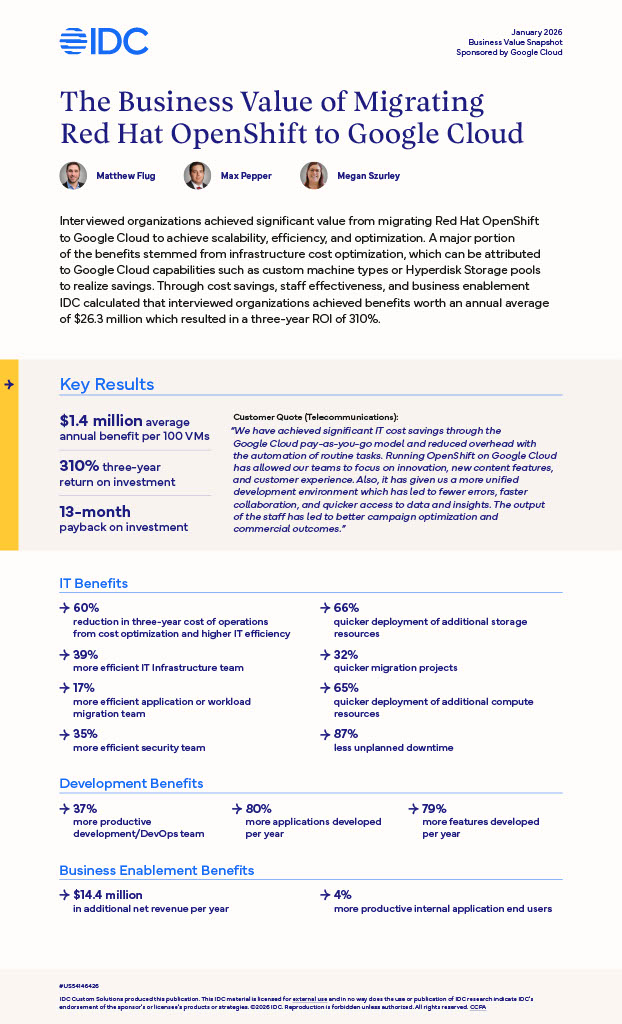
IDC study: According to an IDC study, customers have achieved significant value from migrating to Red Hat OpenShift on Google Cloud to benefit from its scalability, efficiency, and optimization. Interviewed organizations achieved benefits worth an annual average of $26.3 million which resulted in a three-year ROI of 310%. A major portion of the benefits stemmed from infrastructure cost optimization, which can be attributed to Google Cloud capabilities such as custom machine types or Hyperdisk Storage pools to realize savings.
Turbocharge your applications with AI: By migrating your workloads to Google Cloud you can leverage Google Cloud’s industry-leading AI technology to drive business innovation. This includes not only access to the full spectrum of Google Cloud AI capabilities, but also purpose-built OpenShift-native integrations to key AI capabilities. You can easily turn existing APIs, applications and Databases deployed in OpenShift into secure and governed agentic tools by exposing them as MCP servers with Enterprise-grade governance through the MCP capability of API hub in Apigee hybrid for OpenShift and through Google Cloud’s MCP Toolbox for Databases. In addition, you can integrate vector embeddings, high-performance vector search, and natural language into Google Cloud’s AlloyDB omni for OpenShift, a PostgreSQL-compatible database that runs anywhere.
Request a free migration assessment: Our team would be happy to work with you to analyze your environment and produce a migration assessment, including estimates of your infrastructure cost savings opportunities. To request a free migration assessment, reach out to your Google Cloud technical account management team.
Additional resources
Bring your workloads to OpenShift on Google Cloud to reduce infrastructure costs and benefit from Google Cloud’s reliability and security.
Reduce infrastructure costs: Google Cloud’s on-demand/ flexible resourcing enables you to dynamically right-size your cluster worker node pools and storage to optimally meet the dynamic resource requirements of your applications. In addition, Google Cloud and Red Hat have collaborated to integrate Google’s differentiated infrastructure capabilities to optimally run containerized workloads (such as custom machine types and storage pools) to enable further infrastructure cost optimizations for your OpenShift clusters.
IDC study: According to an IDC study, customers have achieved significant value from migrating to Red Hat OpenShift on Google Cloud to benefit from its scalability, efficiency, and optimization. Interviewed organizations achieved benefits worth an annual average of $26.3 million which resulted in a three-year ROI of 310%. A major portion of the benefits stemmed from infrastructure cost optimization, which can be attributed to Google Cloud capabilities such as custom machine types or Hyperdisk Storage pools to realize savings.
Turbocharge your applications with AI: By migrating your workloads to Google Cloud you can leverage Google Cloud’s industry-leading AI technology to drive business innovation. This includes not only access to the full spectrum of Google Cloud AI capabilities, but also purpose-built OpenShift-native integrations to key AI capabilities. You can easily turn existing APIs, applications and Databases deployed in OpenShift into secure and governed agentic tools by exposing them as MCP servers with Enterprise-grade governance through the MCP capability of API hub in Apigee hybrid for OpenShift and through Google Cloud’s MCP Toolbox for Databases. In addition, you can integrate vector embeddings, high-performance vector search, and natural language into Google Cloud’s AlloyDB omni for OpenShift, a PostgreSQL-compatible database that runs anywhere.
Request a free migration assessment: Our team would be happy to work with you to analyze your environment and produce a migration assessment, including estimates of your infrastructure cost savings opportunities. To request a free migration assessment, reach out to your Google Cloud technical account management team.
Benefits of OpenShift on Google Cloud: Integrated Google Cloud technology
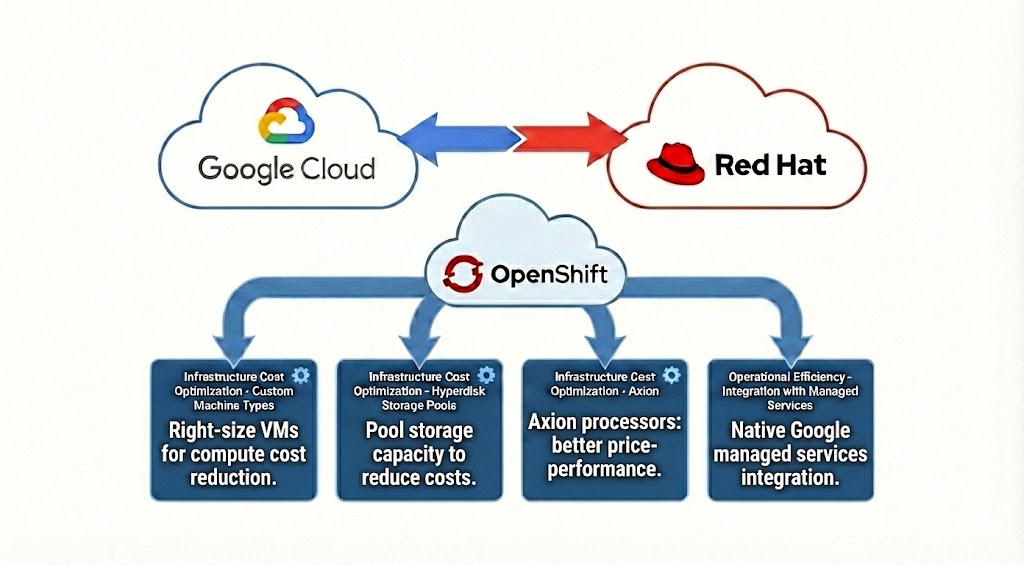
Google Cloud and Red Hat have collaborated to integrate Google’s proprietary technology into OpenShift to enable customers to reduce infrastructure costs and increase operational efficiency.
Infrastructure Cost Optimization - Custom Machine Types: A key driver of OpenShift clusters infrastructure costs is worker node pools, their sizing and associated utilization. To optimize this variable, it is very important to right-size the machine instances you are using for your worker nodes. In Google Cloud (unlike in other cloud providers), if predefined VM sizes (cpu, ram) don't meet your needs, you can create a VM instance with custom virtualized hardware settings with specific number of vCPUs and amount of memory. This typically enables significant reductions in the amount of compute infrastructure (vcpu, ram) that is required to operate your OpenShift clusters, producing substantial cost savings. Google and Red Hat have collaborated to integrate this capability natively within OpenShift.
Infrastructure Cost Optimization - Hyperdisk Storage Pools: Hyperdisk (Google Cloud’s managed block storage service) provides Storage Pools with capacity pooling, a capability that enables it to implement Thin Provisioning (unlike other cloud providers). In this way, block Storage provisioning for your OpenShift workloads across your PersistentVolumes (PVs) and PersistentVolumeClaims (PVCs) can be pooled in a way that the “buffer capacity” you’d typically allocate for each PV/ PVC doesn’t add up to independent storage provisioning, but instead the “buffer capacity” is shared across a single pool across your various PVs/ PVCs. This typically enables significant reductions in the amount of storage infrastructure that is required to operate your OpenShift clusters (specially for stateful workloads), producing substantial savings. Google and Red Hat have collaborated to integrate this capability natively within OpenShift.
Infrastructure Cost Optimization - Axion: Axion is Google Cloud’s family of custom Arm-based processors for general purpose computing, powering the C4A and N4A instance families. You can get up to 65% better price-performance than other instances available on Google Cloud for a range of general purpose workloads like Java and MySQL. Google Cloud data centers are 1.5X more efficient than the industry-average. Axion reduces consumption even more, using up to 60% less energy than other CPUs on Google Cloud. For applications where it’s practical to port from x86 to arm (such as large scale-out applications), this typically enables significant reductions in infrastructure costs. Google and Red Hat have collaborated to integrate this capability natively within OpenShift, including ability to operate mixed-architecture clusters, and Axion-based worker nodes.
Infrastructure Cost Optimization - bare metal instances: Google Cloud Compute Engine bare metal instances (such as bare metal shapes in C3 machine family) are integrated with OpenShift Virtualization, enabling customers to deploy VM-based workloads on OpenShift, while providing with the flexibility to customize overcommit levels in your bare metal instance based worker nodes, which can help you optimize infrastructure costs for workloads with compute resource demands that dynamically change over time. Google and Red Hat have collaborated to integrate this capability natively within OpenShift.
Operational Efficiency - Integration with Managed Services: Google and Red Hat have collaborated to natively integrate a range of Google Cloud managed services natively with OpenShift; ranging from Cloud Monitoring to block storage with Hyperdisk and file storage with Filestore, to secure secret handling with Secret Manager and Certificate Management with Google’s Certificate Authority Service. This enables customers to move from relying on self-managed solutions (as typically deployed on-prem for each of these areas) which require to take substantial responsibilities for monitoring, patching and other tasks with a heavy operational burden, to managed services where Google takes on those operational tasks, freeing you to focus on innovation and business value, significantly improving operational efficiency as part of a migration to the cloud.
Additional resources
Google Cloud and Red Hat have collaborated to integrate Google’s proprietary technology into OpenShift to enable customers to reduce infrastructure costs and increase operational efficiency.
Infrastructure Cost Optimization - Custom Machine Types: A key driver of OpenShift clusters infrastructure costs is worker node pools, their sizing and associated utilization. To optimize this variable, it is very important to right-size the machine instances you are using for your worker nodes. In Google Cloud (unlike in other cloud providers), if predefined VM sizes (cpu, ram) don't meet your needs, you can create a VM instance with custom virtualized hardware settings with specific number of vCPUs and amount of memory. This typically enables significant reductions in the amount of compute infrastructure (vcpu, ram) that is required to operate your OpenShift clusters, producing substantial cost savings. Google and Red Hat have collaborated to integrate this capability natively within OpenShift.
Infrastructure Cost Optimization - Hyperdisk Storage Pools: Hyperdisk (Google Cloud’s managed block storage service) provides Storage Pools with capacity pooling, a capability that enables it to implement Thin Provisioning (unlike other cloud providers). In this way, block Storage provisioning for your OpenShift workloads across your PersistentVolumes (PVs) and PersistentVolumeClaims (PVCs) can be pooled in a way that the “buffer capacity” you’d typically allocate for each PV/ PVC doesn’t add up to independent storage provisioning, but instead the “buffer capacity” is shared across a single pool across your various PVs/ PVCs. This typically enables significant reductions in the amount of storage infrastructure that is required to operate your OpenShift clusters (specially for stateful workloads), producing substantial savings. Google and Red Hat have collaborated to integrate this capability natively within OpenShift.
Infrastructure Cost Optimization - Axion: Axion is Google Cloud’s family of custom Arm-based processors for general purpose computing, powering the C4A and N4A instance families. You can get up to 65% better price-performance than other instances available on Google Cloud for a range of general purpose workloads like Java and MySQL. Google Cloud data centers are 1.5X more efficient than the industry-average. Axion reduces consumption even more, using up to 60% less energy than other CPUs on Google Cloud. For applications where it’s practical to port from x86 to arm (such as large scale-out applications), this typically enables significant reductions in infrastructure costs. Google and Red Hat have collaborated to integrate this capability natively within OpenShift, including ability to operate mixed-architecture clusters, and Axion-based worker nodes.
Infrastructure Cost Optimization - bare metal instances: Google Cloud Compute Engine bare metal instances (such as bare metal shapes in C3 machine family) are integrated with OpenShift Virtualization, enabling customers to deploy VM-based workloads on OpenShift, while providing with the flexibility to customize overcommit levels in your bare metal instance based worker nodes, which can help you optimize infrastructure costs for workloads with compute resource demands that dynamically change over time. Google and Red Hat have collaborated to integrate this capability natively within OpenShift.
Operational Efficiency - Integration with Managed Services: Google and Red Hat have collaborated to natively integrate a range of Google Cloud managed services natively with OpenShift; ranging from Cloud Monitoring to block storage with Hyperdisk and file storage with Filestore, to secure secret handling with Secret Manager and Certificate Management with Google’s Certificate Authority Service. This enables customers to move from relying on self-managed solutions (as typically deployed on-prem for each of these areas) which require to take substantial responsibilities for monitoring, patching and other tasks with a heavy operational burden, to managed services where Google takes on those operational tasks, freeing you to focus on innovation and business value, significantly improving operational efficiency as part of a migration to the cloud.
Benefits of OpenShift on Google Cloud: Flexible billing options
Purchase via Google Cloud Marketplace to access pay-as-you-go pricing, leveraging your existing committed spend. If already running OpenShift on-prem, easily bring your existing subscriptions to Google Cloud.
With both Managed OpenShift (OpenShift Dedicated) as well as Self-Managed OpenShift (OpenShift Container Platform) offerings available in Google Cloud Marketplace, you can leverage your procurement processes (and potentially committed spend with Google Cloud) to pay for your required Red Hat OpenShift subscriptions.
If you are already running OpenShift on-prem, you can re-use existing subscriptions (part of your existing enterprise agreements with Red Hat) when you migrate existing subscriptions to Google Cloud. This mechanism is referred to as “Bring your Own Subscription” (BYOS).
Additional resources
Purchase via Google Cloud Marketplace to access pay-as-you-go pricing, leveraging your existing committed spend. If already running OpenShift on-prem, easily bring your existing subscriptions to Google Cloud.
With both Managed OpenShift (OpenShift Dedicated) as well as Self-Managed OpenShift (OpenShift Container Platform) offerings available in Google Cloud Marketplace, you can leverage your procurement processes (and potentially committed spend with Google Cloud) to pay for your required Red Hat OpenShift subscriptions.
If you are already running OpenShift on-prem, you can re-use existing subscriptions (part of your existing enterprise agreements with Red Hat) when you migrate existing subscriptions to Google Cloud. This mechanism is referred to as “Bring your Own Subscription” (BYOS).