
Identified over 2 million unique users across brands with a new first-party customer data platform (CDP)
Boosted CTR by 230% with personalized homepage content recommendations
Improved ad performance by 33% using first-party data clusters for campaign segmentation
Unified cross-domain customer data for the first time in the company’s 100-year history
Built a privacy-first, low-cost personalization system aligned with audience growth and data protection regulations
To unify fragmented user data across 12 media brands, Diários Associados built a scalable, privacy-first customer data platform with Google Cloud. The company now delivers more personalized content and ad experiences, reshaping how it understands and serves each reader.
To unify fragmented user data across 12 media brands, Diários Associados built a scalable, privacy-first customer data platform with Google Cloud. The company now delivers more personalized content and ad experiences, reshaping how it understands and serves each reader.
Diários Associados is one of Brazil’s largest and oldest media groups, reaching 60 million monthly readers across 12 regional news brands. But operating as a decentralized network came with a major limitation: no way to understand the audience as a whole.
“Our main challenge was understanding who our readers really were, regardless of where they were coming from,” says Mayara Souza, head of audience, product, and marketing. “Each brand functioned like its own island, which made it impossible to create strategies that worked across the group.”
The company relied heavily on an external Data Management Platform (DMP) and third-party cookies for ad personalization. With growing uncertainty around browser support and stricter privacy regulations, this setup became a risk to the business model. “We didn’t have a clear picture of how cookie deprecation would impact our campaigns, and we had no alternative in place,” Souza explains.

At the same time, Diários Associados needed a solution that could scale to hundreds of millions of monthly interactions, without forcing a complete overhaul of existing systems. That meant finding something affordable and flexible enough to integrate with their CMS and tech stack.
Google Cloud quickly stood out. Native integrations with tools like Google Analytics, BigQuery, and Ad Manager offered a smoother path to implementation. “It wasn’t just about the tech. The Google Cloud team made us feel supported,” says Souza. “They brought in Plexus, who really understood the realities of a media business like ours. That changed everything.”
With the right partner and platform, Diários Associados was ready to move from fragmented data to a scalable, first-party audience strategy.
We needed something robust, but with a cost-benefit fit for the realities of our business. Google Cloud supported us from day one, technically and strategically, and we felt our vision was truly heard and embraced. That made a big difference in our ability to move forward with confidence.
Mayara Souza
Head of Audience, Product, and Marketing, Diários Associados
Activating a first-party data strategy with BigQuery, Firestore, and Cloud Run
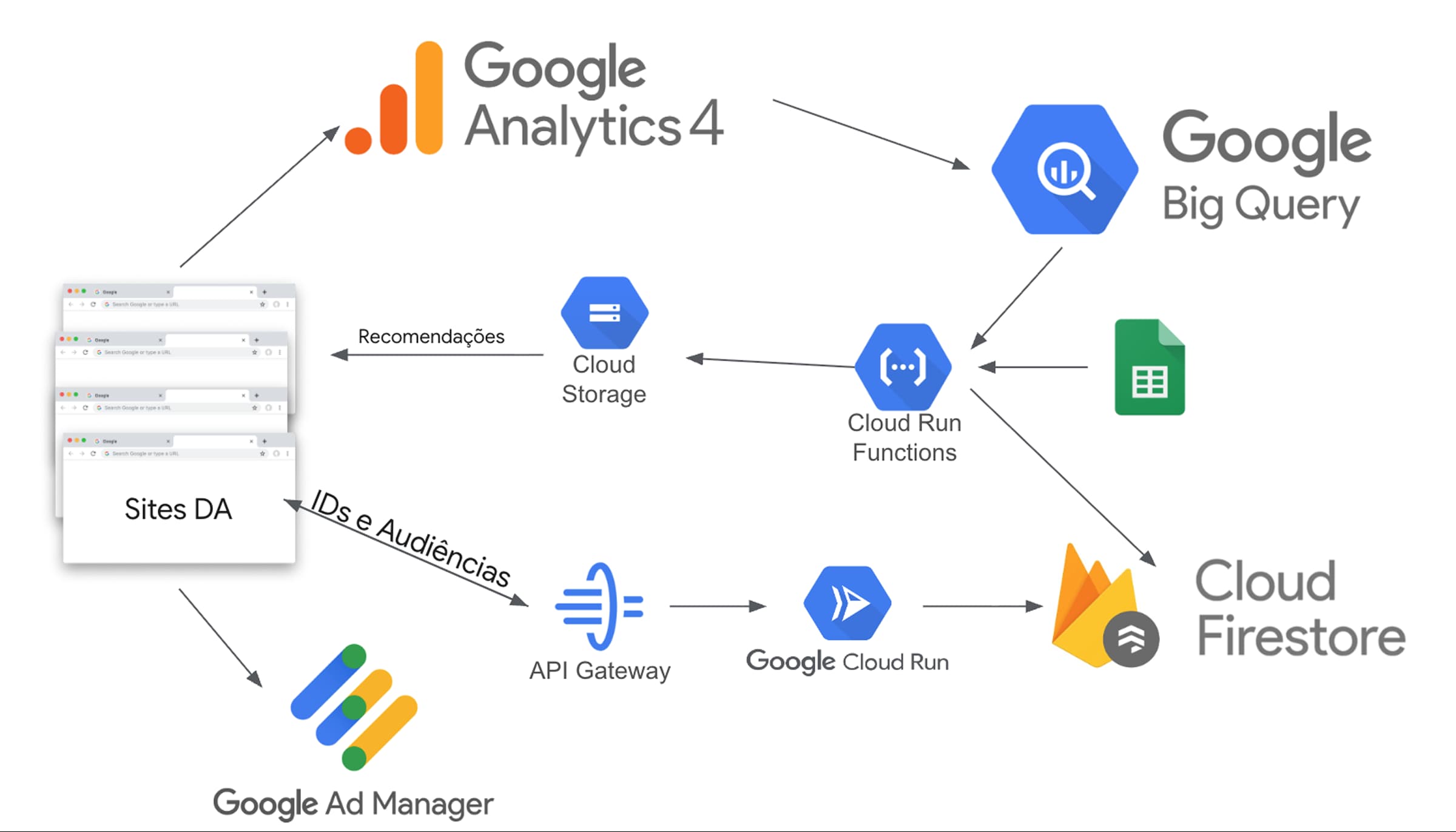
We were able to build our own CDP using the Google Cloud stack, without needing a pre-packaged third party DMP . Now, we can activate this intelligence in real time and personalize the reader experience much more precisely.
Mayara Souza
Head of Audience, Product, and Marketing, Diários Associados
The solution starts by generating a unique ID for every user who visits any of the group’s 12 domains. These IDs are tracked and enriched over time using Firestore, which logs behavioral data across visits, browsers, and devices. With Cloud Run, the company created APIs that automatically generate and manage these IDs, handle real-time tracking, and trigger data clustering functions based on navigation patterns.
“For each new visitor, we assign a hashed ID and begin building a behavioral profile from their very first interaction,” says Souza. “Even if we don’t know who the person is yet, we can track their journey across sites and start understanding their preferences.”
All of this data is centralized in BigQuery, which handles massive volumes of event data, hundreds of millions of interactions per month, across brands like Correio Braziliense and Estado de Minas.
The team then uses BigQuery to run queries, extract insights, and build audience clusters. These clusters feed into both editorial and advertising strategies.
For example, if a reader frequently engages with content about a particular soccer team, that user might be tagged in a “sports enthusiast” cluster. That data then flows into Google Ad Manager for targeted campaign delivery, or into the editorial CMS for personalized content recommendations.
“We’ve created our own audience data layer, which we call DA.ID.,” Souza explains. “It lets us match anonymous traffic with meaningful context and serve relevant stories or ads based on what we know.”
One real-world application is homepage personalization. On Estado de Minas, users with an interest in health topics are now shown more medical and wellness content. An A/B test comparing this tailored experience with a manually curated homepage showed a 230% increase in click-through rate (CTR) for personalized recommendations. “We’re focusing heavily on recirculation,” says Souza. “Once a reader lands on one article, we want them to read one more, and then another. That’s how we build long-term value.”
Importantly, this setup is entirely cookie-independent and privacy-first. It helps Diários Associados reduce dependence on third party DMPs, protect against browser changes, and future-proof their monetization model under Brazilian data privacy law and similar regulations.
This new platform gives Diários Associados a complete view of its audience for the first time, connecting behavior across brands and making real personalization possible. “For the first time in our 100-year history, we’re understanding our readers as a unified audience, not just as isolated visitors to individual sites,” says Souza.

Turning first-party insights into measurable editorial and business impact
The same data platform also powers more precise ad targeting. Instead of selling impressions based on third-party data, the commercial team can now offer segments based on real user behavior. In early testing, campaigns using this first-party segmentation delivered a 33% higher CTR compared to non-personalized versions.
Internally, the shift has driven a culture change across the organization. Editorial teams now consult user data clusters to inform content strategy, while sales teams explore new formats and packages based on behavioral signals. “We’re seeing teams that didn’t typically work with data start to embrace it as part of their daily process,” Souza says.
Today, more than 2 million users have been mapped and clustered within the system, with over 20% already tagged into defined audience profiles. The team is now focused on increasing that number, and improving the depth of each profile. That means expanding from URL-based clustering to semantic content analysis, and eventually layering in user-declared data through a redesigned login experience.
“We’re just getting started,” Souza says. “Our next steps are about increasing granularity, improving predictive power, and making sure every team, from editorial to commercial, can use this data to serve the reader better.”
We’re now seeing teams that didn’t typically work with data start to embrace it daily. Editorial uses audience clusters to plan content. Commercial segments ads by behavior. This has changed how we work, not just technically, but culturally. It’s a mindset shift we couldn’t have done without this foundational platform.
Mayara Souza
Head of Audience, Product, and Marketing, Diários Associados
Diários Associados is one of Brazil’s largest media groups, reaching 60 million monthly readers across 12 regional news brands.
Industries: Media and Entertainment
Location: Brazil
Products: Google Cloud, BigQuery, Cloud Run, Firestore
About Google Cloud partner — Plexus
Plexus is a digital consultancy helping media companies build and modernize data products with scalable cloud-based solutions.