Five AI trends shaping the healthcare and life sciences industry in 2026
Explore what’s coming next in agentic AI for healthcare and life sciences
Explore what’s coming next in agentic AI for healthcare and life sciences
Get the report
- (+1)
- Afganistán
- Albania
- Alemania
- Andorra
- Angola
- Anguila
- Antigua y Barbuda
- Antártida
- Arabia Saudí
- Argelia
- Argentina
- Armenia
- Aruba
- Australia
- Austria
- Azerbaiyán
- Bahamas
- Bangladés
- Barbados
- Baréin
- Belice
- Benín
- Bermudas
- Bielorrusia
- Bolivia
- Bosnia y Herzegovina
- Botsuana
- Brasil
- Brunéi
- Bulgaria
- Burkina Faso
- Burundi
- Bután
- Bélgica
- Cabo Verde
- Camboya
- Camerún
- Canadá
- Catar
- Chad
- Chequia
- Chile
- China
- Chipre
- Ciudad del Vaticano
- Colombia
- Comoras
- Congo
- Corea del Sur
- Costa Rica
- Croacia
- Curazao
- Côte d’Ivoire
- Dinamarca
- Dominica
- Ecuador
- Egipto
- El Salvador
- Emiratos Árabes Unidos
- Eritrea
- Eslovaquia
- Eslovenia
- España
- Estados Unidos
- Estonia
- Esuatini
- Etiopía
- Filipinas
- Finlandia
- Fiyi
- Francia
- Gabón
- Gambia
- Georgia
- Ghana
- Gibraltar
- Granada
- Grecia
- Groenlandia
- Guadalupe
- Guam
- Guatemala
- Guayana Francesa
- Guinea
- Guinea Ecuatorial
- Guinea-Bisáu
- Guyana
- Haití
- Honduras
- Hong Kong
- Hungría
- India
- Indonesia
- Irak
- Irlanda
- Isla Bouvet
- Isla Norfolk
- Isla de Navidad
- Isla de la Ascensión
- Islandia
- Islas Caimán
- Islas Cocos
- Islas Cook
- Islas Feroe
- Islas Georgia del Sur y Sandwich del Sur
- Islas Heard y McDonald
- Islas Malvinas (Islas Falkland)
- Islas Marianas del Norte
- Islas Marshall
- Islas Pitcairn
- Islas Salomón
- Islas Turcas y Caicos
- Islas Vírgenes Británicas
- Islas Vírgenes de EE. UU.
- Islas menores alejadas de EE. UU.
- Israel
- Italia
- Jamaica
- Japón
- Jordania
- Kazajistán
- Kenia
- Kirguistán
- Kiribati
- Kuwait
- Laos
- Lesoto
- Letonia
- Liberia
- Libia
- Liechtenstein
- Lituania
- Luxemburgo
- Líbano
- Macao
- Macedonia del Norte
- Madagascar
- Malasia
- Malaui
- Maldivas
- Mali
- Malta
- Marruecos
- Martinica
- Mauricio
- Mauritania
- Mayotte
- Micronesia
- Moldavia
- Mongolia
- Montenegro
- Montserrat
- Mozambique
- Myanmar (Birmania)
- México
- Mónaco
- Namibia
- Nauru
- Nepal
- Nicaragua
- Nigeria
- Niue
- Noruega
- Nueva Caledonia
- Nueva Zelanda
- Níger
- Omán
- Pakistán
- Palaos
- Palestina
- Panamá
- Papúa Nueva Guinea
- Paraguay
- Países Bajos
- Perú
- Polinesia Francesa
- Polonia
- Portugal
- Puerto Rico
- Reino Unido
- República Centroafricana
- República Democrática del Congo
- República Dominicana
- Reunión
- Ruanda
- Rumanía
- Rusia
- Samoa
- Samoa Americana
- San Bartolomé
- San Cristóbal y Nieves
- San Marino
- San Martín
- San Pedro y Miquelón
- San Vicente y las Granadinas
- Santa Elena
- Santa Lucía
- Santo Tomé y Príncipe
- Senegal
- Serbia
- Seychelles
- Sierra Leona
- Singapur
- Sint Maarten
- Somalia
- Sri Lanka
- Sudáfrica
- Sudán del Sur
- Suecia
- Suiza
- Surinam
- Svalbard y Jan Mayen
- Sáhara Occidental
- Tailandia
- Taiwán
- Tanzania
- Tayikistán
- Territorio Británico del Océano Índico
- Territorios Australes Franceses
- Timor-Leste
- Togo
- Tokelau
- Tonga
- Trinidad y Tobago
- Turkmenistán
- Turquía
- Tuvalu
- Túnez
- Ucrania
- Uganda
- Uruguay
- Uzbekistán
- Vanuatu
- Venezuela
- Vietnam
- Wallis y Futuna
- Yemen
- Yibuti
- Zambia
- Zimbabue
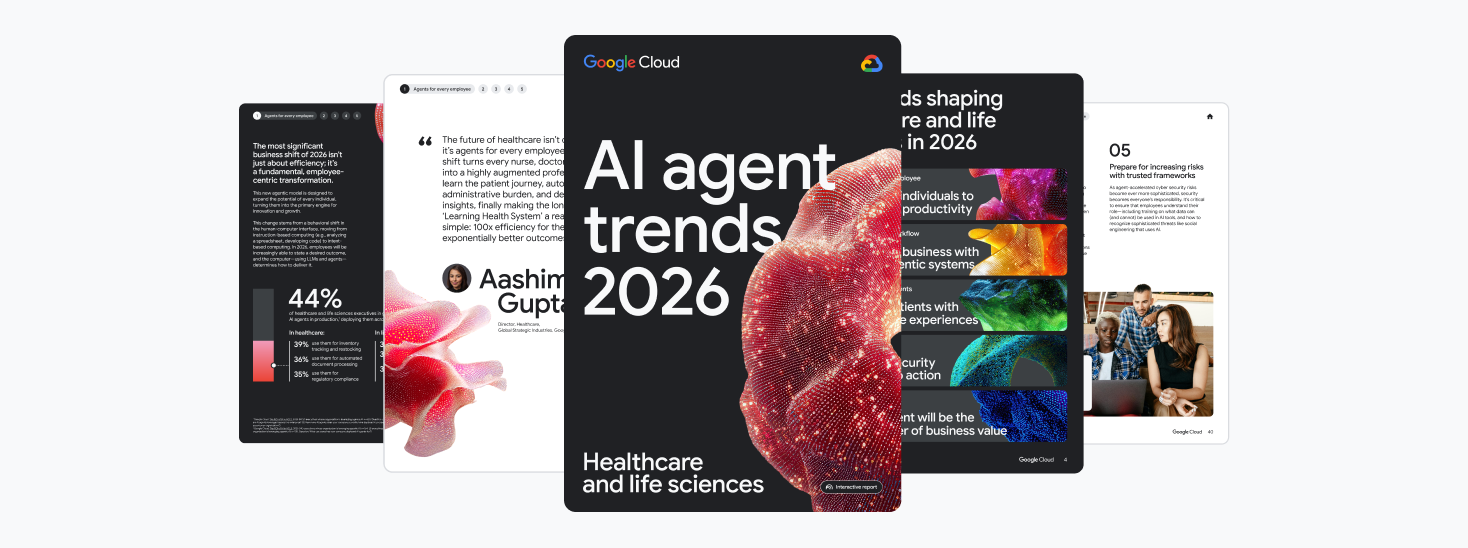
In healthcare and life sciences, the conversation has moved beyond simple administrative automations to intelligent, grounded agentic systems. Today’s AI agents don't just summarize notes—they reason across EMR data, assist researchers in hypothesis generation, and automate high-friction operational workflows under clinician oversight.
Based on a global survey of 605 healthcare and pharma executives, this report outlines the strategies driving clinical efficiency, accelerated R&D, and improved patient outcomes in 2026.
- 44% of healthcare & life sciences leaders have active AI agents in production.
- 35% of life sciences & 34% of healthcare organizations run 10+ agents.
- 90% auto-remediation of routine security & compliance tasks across sensitive PHI systems.
In this report, we explore five key AI agent trends shaping business in 2026:
Agents for every employee: Empowering clinicians, nurses, and researchers to achieve peak productivity through intent-based computing. 44% of HCLS organizations deploy production agents across mission-critical areas, including inventory restocking (39%), automated document processing (36%), and regulatory compliance (35%).
Agents for every workflow: Accelerating clinical operations and drug discovery with interconnected multi-agent systems. Over a third of enterprises (35% in life sciences, 34% in healthcare) have deployed more than 10 AI agents in production, using systems like Google’s AI co-scientist to orchestrate research, literature synthesis, and clinical development.
Agents for your patients: Replacing one-way appointment reminders with proactive, empathetic care navigation. 44% of healthcare executives deploy agents for patient experience, automating prior authorizations, resolving billing discrepancies, and dynamically adapting clinical schedules before patients experience friction.
Agents for security & compliance: Evolving from alert overload to automated containment in PHI environments. With 82% of leaders concerned about alert fatigue obscuring critical breaches, agentic defense delivers 90% auto-remediation of tier-1 analyst tasks, a 95% reduction in manual workloads, and 10x faster threat containment.
Agents for scale: Unlocking the "Learning Health System" through strategic workforce upskilling. 82% of executives agree that training teams to supervise and guide AI agents is vital to reducing clinician burnout and achieving 100x operational efficiency, with 71% already realizing measurable value from enablement programs.
To see what these trends might mean for your business, get your copy of the report now.