What is agentic video understanding?
Last updated: 10/13/2026
Agentic video understanding is an approach to video analysis where an AI model actively decides which parts of a video it needs to examine to answer a question or complete a task. Instead of processing a video in the same way from beginning to end, the model can navigate through it, focus on relevant moments, and gather additional visual or audio information as needed.
This is useful because video can contain a lot of information. A one-hour video can include thousands of frames, an audio track, spoken dialogue, on-screen text, and events that unfold over time. But a model may only need a small portion of that information to answer a particular question.
For example, if you ask, "What were the speaker's three main arguments?", the model may primarily need the transcript and a few relevant sections of the video. If you instead ask, "What changed on the chart when the presenter discussed revenue?", the model may need to locate that discussion and inspect the corresponding visual frames more closely.
Agentic video understanding allows the model to make those decisions dynamically, based on what it is trying to understand.
How does agentic video understanding work?
Traditional video understanding often starts by converting a video into information that a multimodal model can process. A system might sample frames at regular intervals, process the audio or transcript, and provide that information to the model as context.
This approach can work well, particularly for shorter videos. But it treats the video largely the same regardless of the question being asked.
Agentic video understanding adds another step: the model can decide how to explore the video based on the task.
A simplified process might look like this:
- Understand the question: The model determines what information it needs from the video
- Navigate the video: It identifies potentially relevant portions of the timeline
- Gather information: It examines the transcript, audio, or visual frames it needs
- Reason about what it finds: The model evaluates whether it has enough information to answer the question
- Explore further if needed: It can inspect additional moments or gather more detail before producing a response
In other words, the model is not just reasoning about the video content. It's also reasoning about how to examine the video.
Consider a two-hour sporting event. If the question is "When did the player leave the game with an injury?", processing every frame at the same level of detail may be unnecessary. An agentic system could use available context to locate likely moments, inspect those sections more closely, and gather the visual and audio information needed to answer the question.
Agentic versus static video understanding
The main difference between static and agentic video understanding is how information from the video is selected for the model.
Feature | Static video processing | Agentic video processing |
Processing strategy | Follows a predefined strategy, sampling frames at a fixed rate and processing them with audio regardless of the question. | Adapts its approach to the question, navigating the timeline and selectively retrieving relevant information. |
Long video scalability | Requires processing substantially more information, even when the answer depends on only a few moments. | Highly effective for long videos by focusing context on specific moments instead of exhaustive processing. |
Best use cases | Shorter videos, latency-sensitive applications, or tasks requiring consistent inspection across the entire clip. | Long recordings (meetings, lectures, sporting events), or tasks requiring targeted investigation of specific details. |
What is agentic video understanding used for?
Agentic video understanding is particularly useful when developers need to analyze long-form video or locate specific information within a larger recording. Common use cases include:
Meetings and presentations
Meetings and presentations
Find where a topic was discussed, summarize key decisions, or connect spoken discussion to information shown on screen.
Lectures and educational content
Lectures and educational content
Answer questions about specific concepts, locate examples, or summarize sections of a long lesson.
Media and entertainment
Media and entertainment
Find scenes, events, dialogue, or visual details across longer videos.
Sports
Sports
Locate important events and analyze what happened before or after a particular moment.
Video archives
Video archives
Search large recordings for specific people, objects, actions, topics, or events.
Research and analysis
Research and analysis
Compare information across different portions of a video without processing every moment at the same level of detail.
What are the benefits of agentic video understanding?
The ability to selectively explore a video can change both how much information a model needs to process and how it reasons about long-form content. Some of the main benefits include:
- More efficient video processing: The model can focus on relevant information instead of placing uniformly sampled content from the entire video into context.
- Better use of context: Long videos can contain far more information than is relevant to a particular question. Selective exploration leaves more room for the information that matters.
- More targeted analysis: The model can inspect specific moments more closely when a question depends on visual or temporal details.
- Flexible multimodal reasoning: Different questions may require different combinations of transcript, audio, and visual information.
- Support for longer videos: Selective processing becomes increasingly useful as video duration increases and exhaustive processing becomes more expensive.
There are tradeoffs. Dynamically exploring a video requires the model to perform additional reasoning and retrieval steps before answering. For short videos where most of the content is relevant, that extra work may provide less benefit. Applications also need to consider whether their task requires broad understanding of the entire video or targeted investigation of particular moments.
How does Gemini support agentic video understanding?
The Gemini API supports both static and agentic approaches to video processing.
With static processing, Gemini extracts video frames at a fixed rate and places them into the model context along with audio information. This can work well for many video understanding tasks, including summarization, description, question answering, and identifying information at specific timestamps.
With agentic video understanding, supported Gemini models can instead dynamically navigate the video timeline. The model can selectively inspect the transcript, frames, and audio it needs based on the prompt, and adjust how it examines the video as it works toward an answer.
For example, imagine giving Gemini a long lecture and asking, "What are the three main arguments presented?" Rather than loading uniformly sampled visual information from the entire lecture into context, the model can navigate through the video and retrieve the information it determines is relevant to the question.
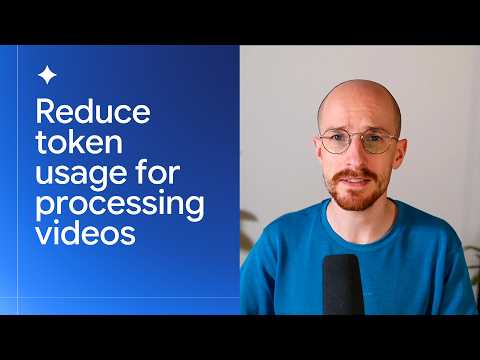
This can significantly reduce the amount of video information that needs to be processed. For long-form content, Google has found that agentic video processing can use up to 88% fewer tokens than static processing while also improving response quality.
The tradeoff is that navigating the video requires additional reasoning and tool calls. For short videos, particularly those under five minutes, static processing may offer lower time to first token. Static processing can also be preferable when an application needs consistent frame-level inspection across an entire clip.
Developers can choose the processing approach based on the task, and can use different processing modes for different videos within the same request. This makes it possible to use static processing when exhaustive inspection is useful and agentic processing when selective exploration is a better fit.
Get started with agentic video understanding
Developers can use agentic video understanding through the Gemini API by providing a video as input and selecting agentic processing on supported Gemini models.
Videos can be provided through supported file inputs or other video sources, and applications can combine video with natural-language prompts to summarize content, answer questions, locate relevant moments, or perform more detailed analysis.
For long videos or more complex tasks, Gemini also supports streaming and background execution so applications can handle the additional processing required for multi-step video analysis.
Other related products and services include:
 Google AI StudioA web-based prototyping environment and API suite for developers building with Google multimodal models. It features an agentic video processing mode that enables models to dynamically navigate video timelines, selectively load visual frames, transcripts, or audio, and process complex, long-form content efficiently instead of using fixed frame-rate sampling.
 Gemini platformEnterprise platform for developing and deploying AI agents. It integrates agentic video understanding to permit businesses to analyze lengthy video repositories, locate specific visual events, and extract actionable insights through dynamic tool interactions and adaptive video scrubbing.
- Agent Studio in Gemini platformA console dedicated to the creation and configuration of specialized AI agents for enterprises. It supports models featuring agentic video capabilities, enabling developers to integrate tools that allow agents to interact directly with video media alongside other enterprise datasets.
Take the next step
Start building on Google Cloud with $300 in free credits and more than 20 always free products.
Need help getting started?
Contact salesWork with a trusted partner
Find a partnerContinue browsing
See all products