Automatic scaling and seamless peak management with GKE
CPU performance and cost optimization through flexible machine choice
Simplified operations using managed services and native security/compliance controls in Google Cloud
Continuous improvement of performance and operational efficiency
Ability to serve more customers in dedicated, secure, and highly performant environments
Timefold automates and optimizes team, task, and resource scheduling using specialized AI models. Powered by Google Cloud, the platform benefits from an elastic, secure infrastructure capable of handling massive computing volumes.
Timefold automates and optimizes team, task, and resource scheduling using specialized AI models. Powered by Google Cloud, the platform benefits from an elastic, secure infrastructure capable of handling massive computing volumes.
In most companies, scheduling still relies heavily on manual processes, whether it involves organizing nursing shifts, assigning field technicians, managing transport crew rotations, allocating factory tasks, or optimizing vehicle fleets. A manager assigns tasks one by one, factoring in skills, availability, regulatory constraints, or travel distances.
Even when assisted by software solutions, the logic often remains the same: a manager builds the schedule incrementally, adjusting each assignment as they go. "As a result, the final schedule is often acceptable, but rarely optimal. Some constraints compete with each other and are not prioritized optimally," explains Geoffrey De Smet, CTO and co-founder of Timefold. "It's precisely to address this issue that we use AI to optimize scheduling, recalculating the entire problem by integrating all constraints simultaneously to achieve the best possible solution." And to say the least, Timefold's approach is clearly a game-changer: "On average, our clients see a 25% reduction in travel time for their field operations. On large fleets, this represents around $4,000 saved per vehicle per year. And when you multiply that figure by tens of thousands of vehicles, you're quickly talking about hundreds of millions of dollars... not to mention the reduction in CO2 emissions," notes Geoffrey De Smet.

Optimizing scheduling to unlock operational performance
Founded in Belgium in 2022 by Geoffrey De Smet and Maarten Vandenbroucke, Timefold capitalizes on over twenty years of expertise in the field of scheduling solvers. Today, this expertise forms the foundation of a SaaS platform dedicated to companies facing complex optimization challenges. At the heart of the solution, an optimization engine solves combinatorial problems whose complexity grows exponentially with the number of variables and constraints.
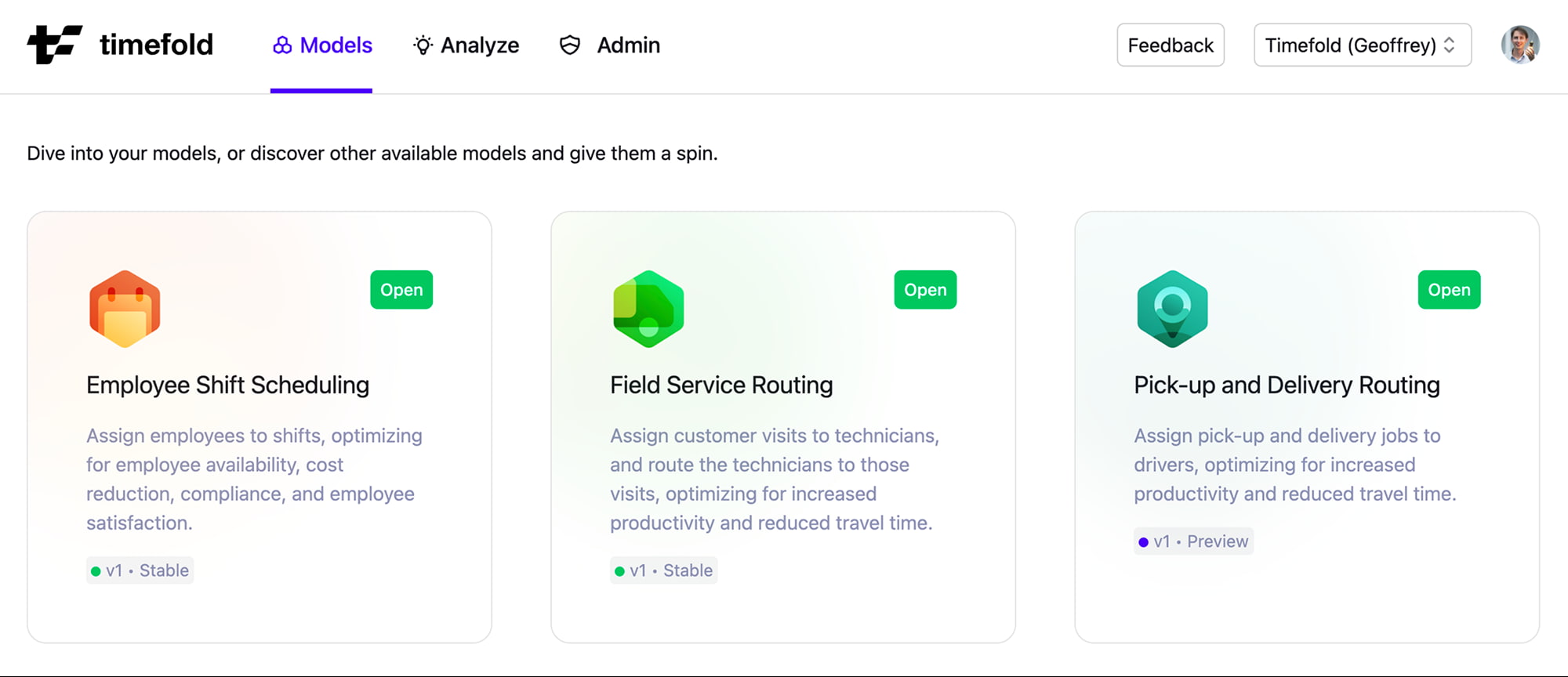
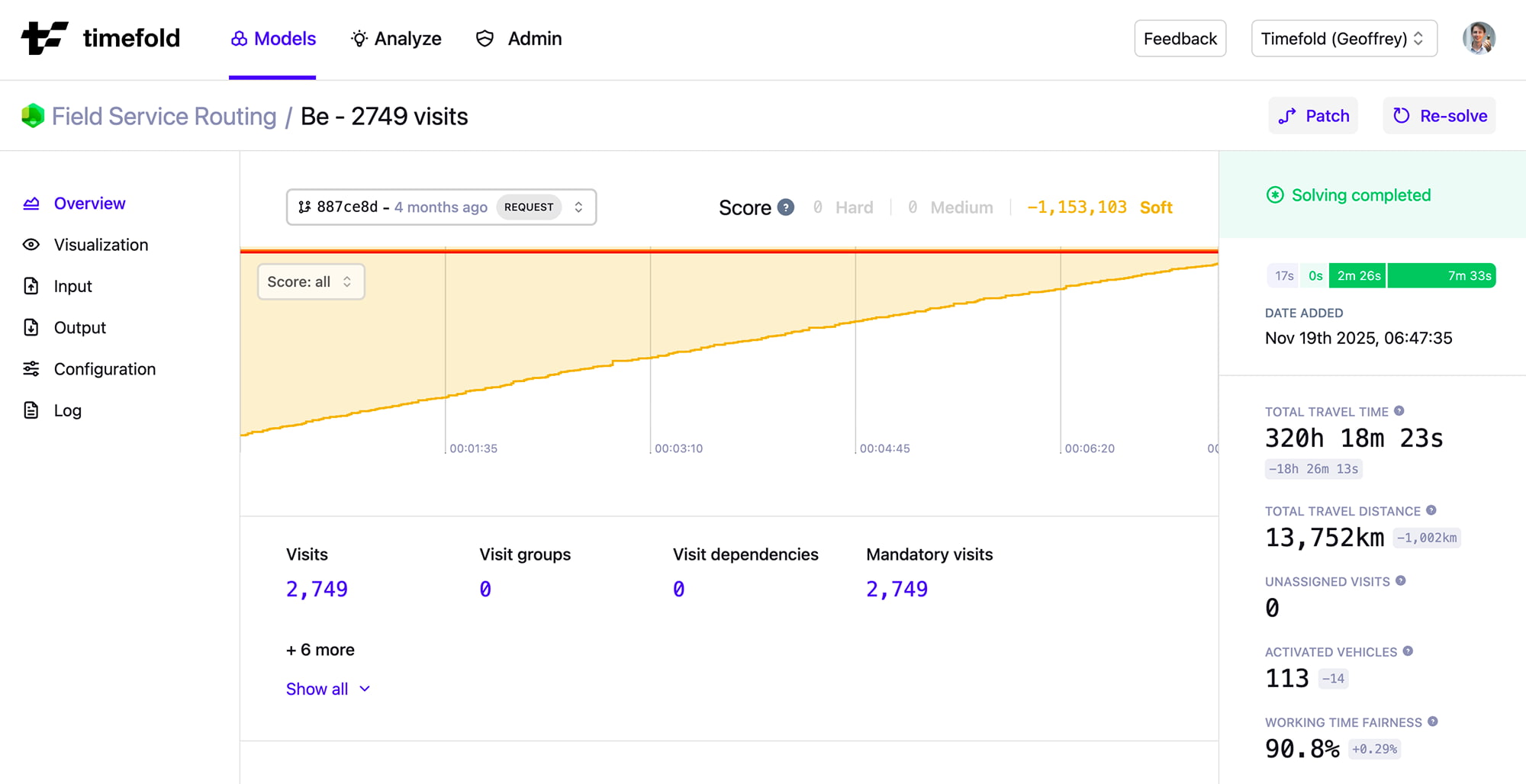
Using custom-developed AI models, Timefold models all parameters (skills, availability, labor rules, legal constraints, cost objectives, or service quality), then calculates the optimal solution by integrating all these dimensions simultaneously. Today, the company works with players in field services, transportation, retail, and manufacturing. Some clients integrate Timefold's APIs into the core of their business software, while others use the platform directly to optimize their own internal systems. Every week, the platform processes over two million tasks and helps schedule the activities of more than 100,000 employees worldwide. "The gains are not just operational and financial," adds Geoffrey De Smet. "Some clients have cut their number of planners in half while improving the quality of their schedules. By incorporating more individual constraints and preferences, we also contribute to better employee satisfaction."
Scaling confidently with Google Cloud
To process client data in real time, Timefold must ingest large volumes of information and run intensive calculations heavily dependent on CPU performance. "Our workloads are very CPU-bound," confirms Jenne De Bleser, Security & Site Reliability Engineer at Timefold. "We need high-performance machines and the ability to quickly adjust configurations as needed. Furthermore, depending on demand, we sometimes need to double our processing capacity. The infrastructure has to keep up immediately." In other words, Timefold must combine computing power and elasticity with administrative simplicity. "Like any young company, our resources are limited.
Beyond this agility, the global visibility provided by the Google Cloud console also greatly simplifies our day-to-day operations. Autoscaling, automatic updates, native integration of monitoring and alerts, as well as instant cost transparency, reduce the time spent on operations and allow us to focus on continuously improving the platform rather than managing infrastructure.
Jenne De Bleser
Security and Site Reliability Engineer, Timefold

Our priority is to dedicate them to innovation and growth, not to operating a complex infrastructure," highlights Geoffrey De Smet. "Google met all our criteria, with the added bonus of a more transparent and advantageous cost structure." To absorb sometimes sudden variations in demand, Timefold opted from the start for a microservices architecture orchestrated by Kubernetes, allowing them to finely adjust the resources allocated to each component. "With GKE, this adjustment is fully automated, which saves us from having to intervene constantly and guarantees stable performance for our clients," notes Jenne De Bleser.
The flexibility of Google Cloud's compute infrastructure also allows the company to precisely choose the most suitable machine types for each use case. "Our algorithms are highly sensitive to processor performance. Google Cloud offers great agility in this area, allowing us to quickly switch to the most efficient machines depending on the nature of the problems to be solved, which helps us optimize both performance and costs," he continues. "Beyond this agility, the global visibility provided by the Google Cloud console also greatly simplifies our day-to-day operations. Autoscaling, automatic updates, native integration of monitoring and alerts, as well as instant cost transparency, reduce the time spent on operations and allow us to focus on continuously improving the platform rather than managing infrastructure."
Meeting customer requirements while simplifying operations
Security was another decisive factor in choosing Google Cloud. As a SaaS platform handling sensitive operational data, Timefold needed to rely on an infrastructure that met the security standards required by its clients. ISO 27001:2022 and SOC 2 certified, Google Cloud offers a high level of compliance, particularly regarding the GDPR.
"To win over enterprise clients, these security standards are essential," explains Jenne De Bleser. "The fact that Google Cloud is already certified and natively integrates advanced controls—including granular access management, encryption key restriction, and centralized logging—acts as a real accelerator and considerably simplifies our daily work." At the same time, Google Cloud supports Timefold's international expansion by meeting the growing demands for data localization. "A large portion of our clients require their data to remain hosted in their home country," Geoffrey De Smet points out. "Thanks to Google Cloud's global presence, we can quickly deploy dedicated environments and comply with these constraints without adding complexity to our architecture." Timefold already operates distinct environments in Europe and the United States, and plans to gradually expand its presence to other regions.
Our ambition is clear: to solve increasingly complex scheduling problems at a massive scale, and to go even further in the value we bring to our customers. With Google Cloud, we have an infrastructure capable of supporting this ambition over the long term and a service ecosystem rich enough to sustain our pace of innovation.
Geoffrey De Smet
CTO and co-founder, Timefold
For certain key accounts, the company also deploys dedicated, fully isolated clusters to meet strict governance or environment separation requirements. Google Cloud's flexibility allows these specific infrastructures to be provisioned quickly without complicating overall operations or multiplying operational overhead.
Building the future of scheduling with Google Cloud
Building on this technological foundation, Timefold is accelerating. The company continues to enrich its optimization models to address increasingly complex use cases. It is also exploring new ways to simplify the integration of its solutions for developers. While its scheduling engine still relies on its heuristic technology, Timefold is now exploring the benefits of generative AI to enhance the user experience. Its Timefold Copilot project allows users to converse in natural language with an existing schedule and simulate different scenarios: anticipating a surge in activity, testing hiring hypotheses, or identifying the optimal location for a new technician. Internally, the teams also use Gemini to accelerate certain development and analysis processes.
"Our ambition is clear: to solve increasingly complex scheduling problems at a massive scale, and to go even further in the value we bring to our customers. With Google Cloud, we have an infrastructure capable of supporting this ambition over the long term and a service ecosystem rich enough to sustain our pace of innovation," concludes Geoffrey De Smet.
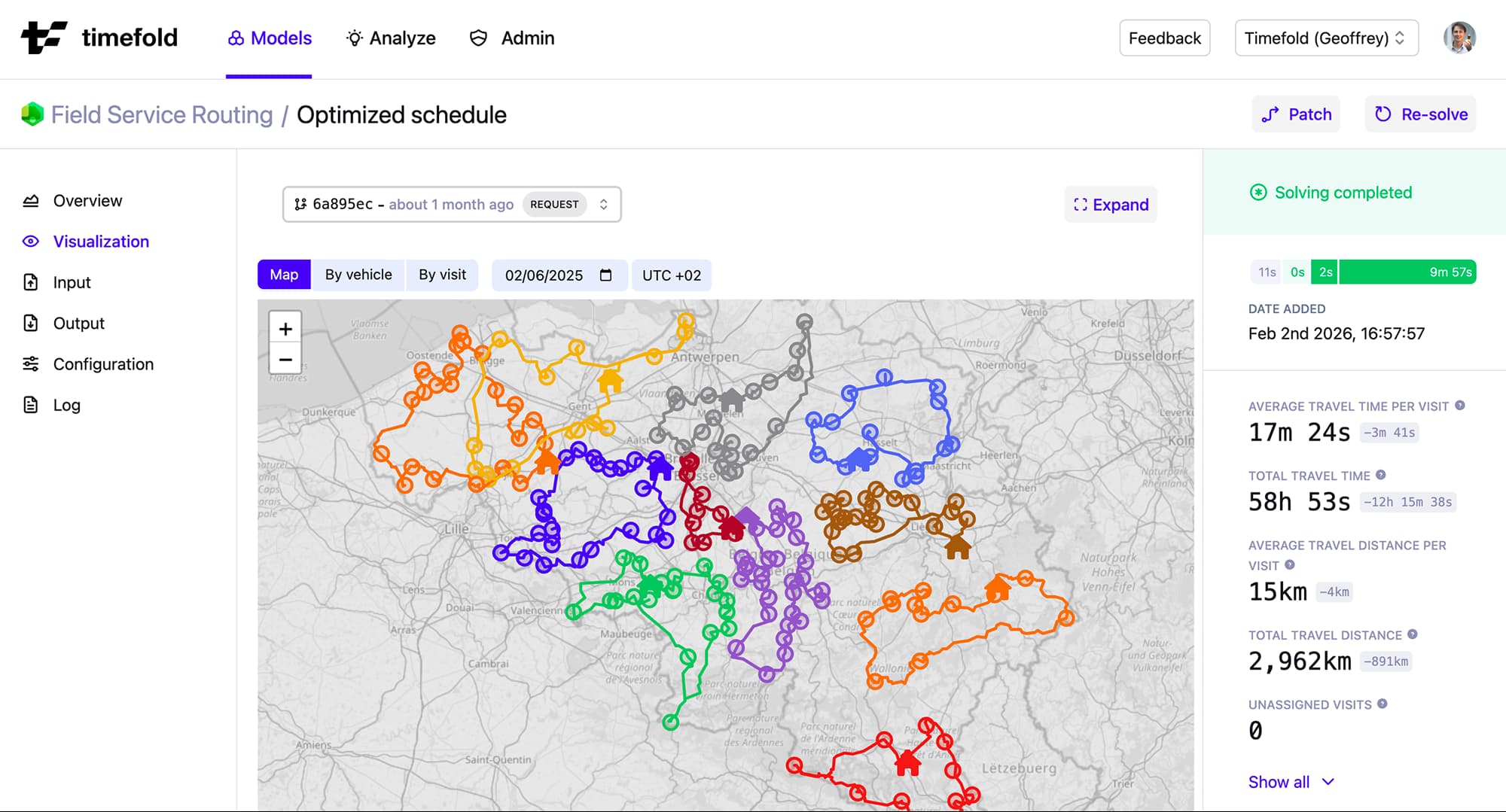
Founded in Belgium in 2022, Timefold specializes in operational scheduling optimization using artificial intelligence. The company develops a SaaS platform that automates the assignment of tasks, teams, and resources at scale, whether for field technician routing, retail shift scheduling, or industrial sequencing. It already supports major international groups such as Lufthansa, Deutsche Bahn, NEC, and ADP.
Industries: IT, Technology
Location: Belgium
Products: Google Kubernetes Engine (GKE), Compute Engine, Cloud Storage, Artifact Registry, Cloud Monitoring, Cloud Logging, Identity and Access Management (IAM)