
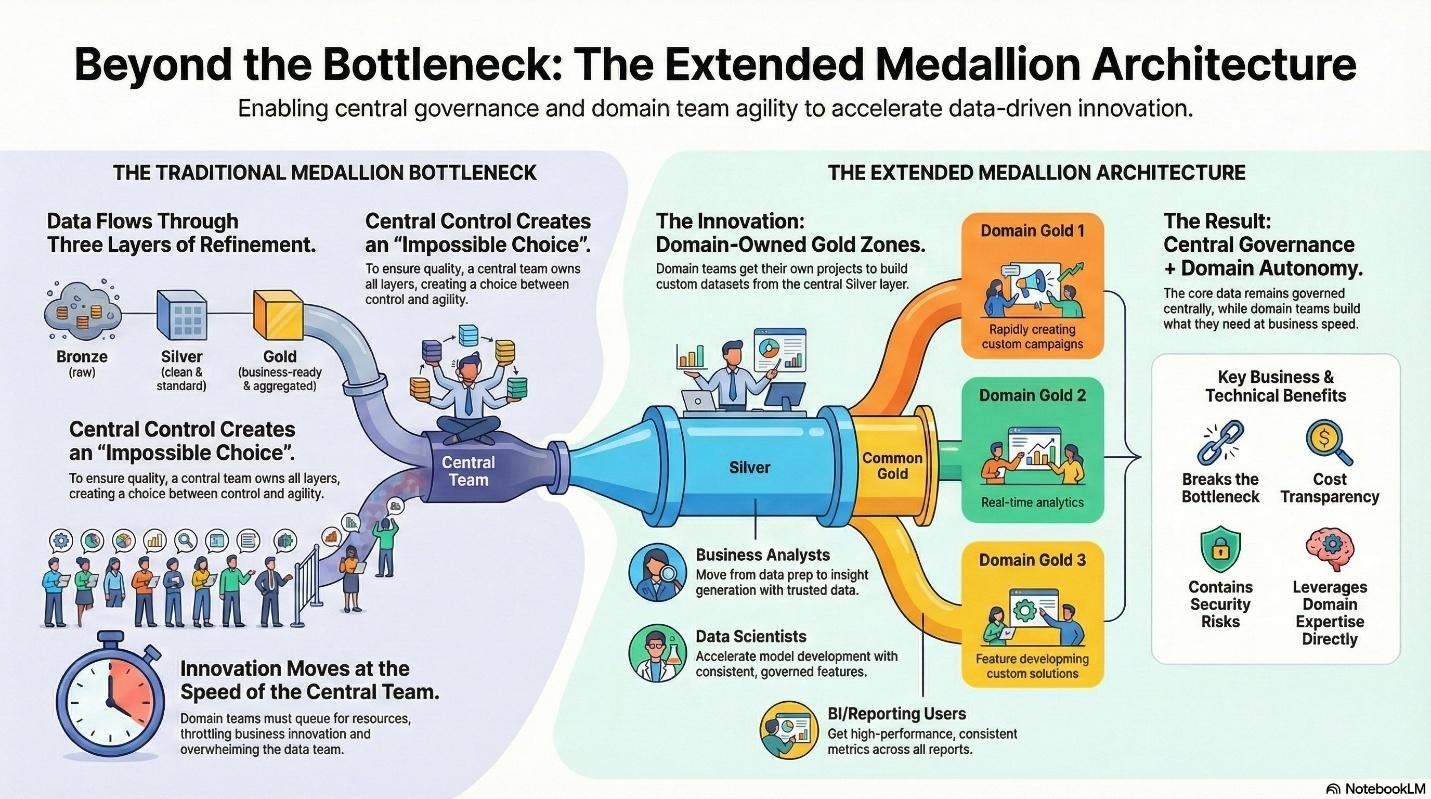
Eliminates central data engineering bottlenecks to accelerate time-to-insight
Secures external data sharing and limits blast radius through project-level isolation
Delivers high-performance, trustworthy metrics across BI, ML, and reporting
Enables clear cost attribution and independent compute scaling for domain teams
Builds on a well understood canonical data model, while allowing for domain-specific specialisations
IG Group created the Extended Medallion Architecture on Google Cloud to balance central governance and domain agility. Domain teams build data products autonomously while a central team ensures security, quality, and enterprise data standards.
IG Group created the Extended Medallion Architecture on Google Cloud to balance central governance and domain agility. Domain teams build data products autonomously while a central team ensures security, quality, and enterprise data standards.
Overcoming the central data engineering bottleneck
Organisations face an impossible choice: maintain central control and accept that domain teams cannot move at business speed, or grant access and risk ungoverned proliferation of datasets, data models with uncertain data quality.
Jonathan King
Head of Architecture, IG Group
Modern enterprises generate data at unprecedented volumes, but data teams often spend up to 80% of their time on data cleansing, preparation, and discovery due to the complexity of source-system data. The traditional Medallion Architecture addresses this by refining data across Bronze, Silver, and Gold zones. However, to maintain accuracy and quality, these layers are typically owned by a central data engineering team. This central control creates a significant bottleneck that throttles organisational agility. Domain teams with urgent analytical needs are forced to queue for resources, and innovation becomes limited by central bandwidth. Organisations face an impossible choice: maintain central control at the expense of agility, or grant domain teams access to the central gold zone, risking ungoverned proliferation of datasets and data chaos.
Empowering domain autonomy with the
Extended Medallion Architecture
To solve this dilemma, IG created the Extended Medallion Architecture to introduce a structural innovation: domain-specific gold zone projects that are completely separate from the core lakehouse infrastructure. Deployed on Google Cloud, the architecture leverages BigQuery's serverless analytical power and decoupled storage-compute architecture, alongside dbt for robust transformation pipelines. While the central data engineering team retains ownership of the Bronze, Silver, and Common Gold zones to maintain the canonical model and enterprise-wide data quality, domain teams are given their own dedicated gold zone projects. These domain projects do not just copy data; instead, they read from the centrally governed Silver and Common Gold zones through IAM access controls and perform domain-specific transformations. This approach provides domain teams with complete ownership over their data models and analytics without impacting core pipelines. Dataplex integrates with BigQuery to index and organize the metadata, providing search functionality, lineage visibility, and a unified governance layer across the entire platform.
The creation & adoption of this architecture depends on SLA-based big data storage and retrieval, a comprehensive data catalogue, the ability to segregate compute and query capacity and a powerful and flexible scripting / data manipulation language. BigQuery serves as the primary data store for all medallion layers. Its serverless nature and decoupled storage/compute architecture enable the rapid, cost-effective, and scalable transformations required to move data between zones. The use of BigQuery avoids complex, expensive ETL infrastructure.
Jonathan King
Head of Architecture, IG Group
Delivering secure, governed data
at the speed of business
By separating concerns between central governance and domain innovation, the new architecture significantly improves agility, security, cost accountability, and system performance. Workload encapsulation within domain-specific Google Cloud projects ensures that heavy analytical or ML workloads consume the domain's allocated BigQuery slots, preventing contention with critical data engineering pipelines. This project-level isolation also creates natural containment boundaries for security incidents and external integrations, reducing the blast radius and keeping the core lakehouse protected. Furthermore, domain-specific projects bear their own compute and storage costs, providing clear per-domain cost visibility and enabling straightforward chargeback models. The result is "Ready Data"—discoverable, accessible, trustworthy, and usable—for business analysts, data scientists, and ML applications across the entire organization.
Adoption of this architecture has delivered significant improvements in time-to-insight, cost attribution, and accelerated innovation. Most importantly, it breaks free from the false choice between control and agility.
Jonathan King
Head of Architecture, IG Group
IG Group Holdings plc ("IG") is a FTSE 100 financial technology company operating at the intersection of retail trading, technology, and capital markets. Through its trusted brands—IG, tastytrade, Freetrade and Independent Reserve—the Group serves over 1.3 million customers worldwide, providing leveraged trading, stock trading and investments, and cryptocurrency trading using its proprietary platforms.
Industry: Financial Services
Location: United Kingdom
Products: BigQuery, Cloud Storage, Knowledge Catalog, Managed Service for Apache Airflow, Looker, Gemini platform