
30 percent increase in reservations through digital reservation systems
Significant reduction in no-shows through automated reminder messages
Improved menu profitability, with some restaurants reporting several thousand euros in additional revenue after six months of menu optimization
DISH Digital Solutions, a subsidiary of Metro AG, utilizes Google Cloud to create a data-rich ecosystem that enables small restaurants to compete effectively in the digital age while delivering personalized insights to Metro AG's hospitality customers.
DISH Digital Solutions, a subsidiary of Metro AG, utilizes Google Cloud to create a data-rich ecosystem that enables small restaurants to compete effectively in the digital age while delivering personalized insights to Metro AG's hospitality customers.
Cooking up a digital strategy for gastronomy
In an age where digital presence can make or break a restaurant's success, small and medium-sized eateries often find themselves at a disadvantage. While large chains invest in sophisticated digital systems, independent restaurateurs — passionate about food but frequently lacking technical expertise — struggle to keep pace. This digital divide was precisely what DISH Digital Solutions, a subsidiary of Metro AG, set out to address when it was founded in 2015.
"The core idea behind DISH was to help smaller restaurants become more successful through digital tools, while simultaneously enabling Metro to build closer customer relationships through data," explains Dr. Volker Glaeser, CEO DISH Digital Solutions. "By embedding ourselves in restaurant work processes, we gain precise information about how things operate, where the problems lie, and what works well."
Today, with over 380,000 restaurants and registered customers across 16 European countries, DISH has evolved from an experimental innovation unit into a strategic digital powerhouse reshaping the gastronomy sector, and Google Cloud has been the technological foundation supporting this journey from the outset.
The restaurant industry has traditionally lagged in digital adoption. Many small restaurant owners, often trained as chefs rather than business operators, focus on creating excellent dining experiences rather than implementing technology solutions.
The core idea behind DISH was to help smaller restaurants become more successful through digital tools, while simultaneously enabling Metro to build closer customer relationships through data. By embedding ourselves in restaurant work processes, we gain precise information about how things operate, where the problems lie, and what works well.
Dr. Volker Glaeser
CEO, DISH Digital Solutions
This gap was widening as consumer expectations for digital interactions grew faster than restaurants could keep pace with.
"The average restaurateur isn't a business graduate," notes Glaeser. "Typically, they're someone who trained as a chef, passionate about cooking and serving guests beautiful dishes. They're rarely early adopters of innovation."
Metro AG recognized this challenge and saw an opportunity to support their restaurant customers while gaining valuable data insights by creating DISH (initially called Hospitality Digital). The company began by experimenting with various tools, including a website builder and a reservation system, before acquiring the Dutch market leader, Eijsink, and its point-of-sale (POS) system, “booq”, to expand into the heart of restaurant operations.
However, in its early phase, DISH operated in technological silos, with teams working independently and creating disconnected prototypes. Data insights were fragmented, limiting Metro's ability to derive valuable customer intelligence. In 2020, under the leadership of CEO Dr. Volker Glaeser, DISH initiated a strategic shift that placed value creation, digitization, and data analytics at the center of its operations.
"We moved from testing many different prototypes to focused solutions that connected our tools and prioritized what matters most," says Glaeser. "This meant digitizing the entire restaurant process and making data usable for both the customer and Metro."

A recipe for transformation with Google Cloud
From the outset, DISH chose to build its IT infrastructure on Google Cloud to ensure flexible scaling and reliability for its growing customer base. This foundation became even more critical as the company transitioned from disparate innovations to an integrated suite of restaurant solutions.
Vertex AI has been a game-changer for our department. It has helped us accelerate innovation and streamline our machine learning development processes while achieving significant cost savings in ML operations.
Dr. Olaf Maecker
Vice President Artificial Intelligence and Automation, METRO.digital
The transformation began with the modernization of DISH's data infrastructure. Under Maecker's leadership while working at DISH, the Data Insights department implemented a hybrid data lake and data warehouse architecture, utilizing BigQuery as its centerpiece. Data from various DISH products, including websites, reservation systems, ordering tools, and POS terminals, flows into this central repository, creating a single source of truth for analysis.
"We pour all our data into Google's system, specifically BigQuery, structure it with standardized data pipelines, and then place it in a data warehouse that serves as our single point of truth," explains Maecker. "Most components we use come from Google, spanning data processing, API management, and machine learning with Vertex AI."
The technical architecture leverages several Google Cloud products:
- BigQuery: Serves as both a data lake and an analytical data warehouse, providing fast query performance and significant cost savings for analytics operations
- Cloud Composer: A managed workflow orchestration platform that substantially improved data processing pipelines and freed resources for strategic tasks
- Vertex AI: Enabled DISH to migrate its machine learning models to a fully managed platform, accelerating innovation while reducing costs.
"Vertex AI has been a game-changer for our department," says Olaf Maecker, Vice President Artificial Intelligence and Automation, METRO.digital. "It has helped us accelerate innovation and streamline our machine learning development processes while achieving significant cost savings in ML operations."
The data architecture enables DISH to collect, process, and analyze vast amounts of restaurant operational data while ensuring business continuity for its customers. For critical systems like POS terminals, DISH implemented an edge computing approach with mini-servers at each restaurant, ensuring operations continue even during internet outages, a must-have for busy restaurants where payment processing cannot fail.

GenAI: A new ingredient in the digital menu
As DISH continues to evolve its platform, generative AI has become a crucial component of its strategy. The company is exploring use cases that can help small restaurant owners compete more effectively with larger chains.
One of the most successful AI applications is "Menu Engineering," which utilizes AI to analyze a restaurant's menu and sales data, recommending pricing adjustments and menu restructuring. The system identifies which dishes are underperforming and suggests optimizations.
"With Menu Engineering, we've seen remarkable results," Olaf Jordt, Head of Knowledge Operations, shares. "In nearly 3,000 projects over the past 2-3 years, we've helped restaurants increase their contribution margin by an average of €2 per main dish. Considering that a typical main course costs €15-16, that's an enormous improvement."
DISH is now developing an "Advanced Replenishment" system that integrates with POS terminals to monitor sales data and automatically alert restaurant owners when inventory levels are low. Using historical data and AI, the system predicts when supplies will be depleted, enabling one-click ordering to replenish stock before shortages occur.
With Menu Engineering, we've seen remarkable results. In nearly 3,000 projects over the past 2-3 years, we've helped restaurants increase their contribution margin by an average of €2 per main dish. Considering that a typical main course costs €15-16, that's an enormous improvement.
Olaf Jordt
Head of Knowledge Operations, DISH Digital Solutions
Looking toward the future, DISH is developing AI agents that can proactively provide actionable insights based on a restaurant's operational data. "We envision sending push notifications through our app with specific, data-driven recommendations," explains Maecker. "For example, 'Today it's sunny, there's an event nearby: combine espresso with cheesecake for higher sales.' Eventually, we want to evolve this into an interactive chat assistant that restaurateurs can query for deeper insights."
A full-course digital transformation
The business impact of DISH's cloud-based approach has been substantial for both restaurants and Metro AG. For restaurants, digitization has created measurable improvements.
Customers who adopt digital tools purchase approximately 10 percent more from Metro. We can use data to provide customized offerings. When a sales representative visits a restaurant, they don't come with random offers but with suggestions tailored precisely to the restaurant's needs, such as ingredients for dishes on their menu that they're not currently buying from Metro.
Dr. Volker Glaeser
CEO, DISH Digital Solutions
One of the most transformative elements has been the integration with Google Search and Google Maps. "This is a huge success story for restaurateurs," Glaeser emphasizes. "By being visible in the Google My Business box on the right side of search results, they gain immediate visibility regardless of their SEO ranking. Most users don't scroll past the first page of search results, but these restaurants appear right at the top."
This integration enables potential customers to make reservations directly through Google Search or Maps without leaving to visit the restaurant's website. For small restaurants that lack professional SEO resources or digital marketing budgets, this integration levels the playing field against larger competitors. Restaurants using this integration have reported substantial increases in reservations and revenue.
For Metro AG, the data insights gathered through DISH have transformed customer relationships.
"Customers who adopt digital tools purchase approximately 10 percent more from Metro," reveals Glaeser. "We can use data to provide customized offerings. When a sales representative visits a restaurant, they don't come with random offers but with suggestions tailored precisely to the restaurant's needs, such as ingredients for dishes on their menu that they're not currently buying from Metro."
This data-driven approach extends to what DISH calls "Whitespace Offerings," where AI analyzes a restaurant's menu to identify ingredients they're not currently purchasing from Metro, creating targeted sales opportunities. The result is increased customer loyalty and higher sales per customer.
Looking ahead: The next course
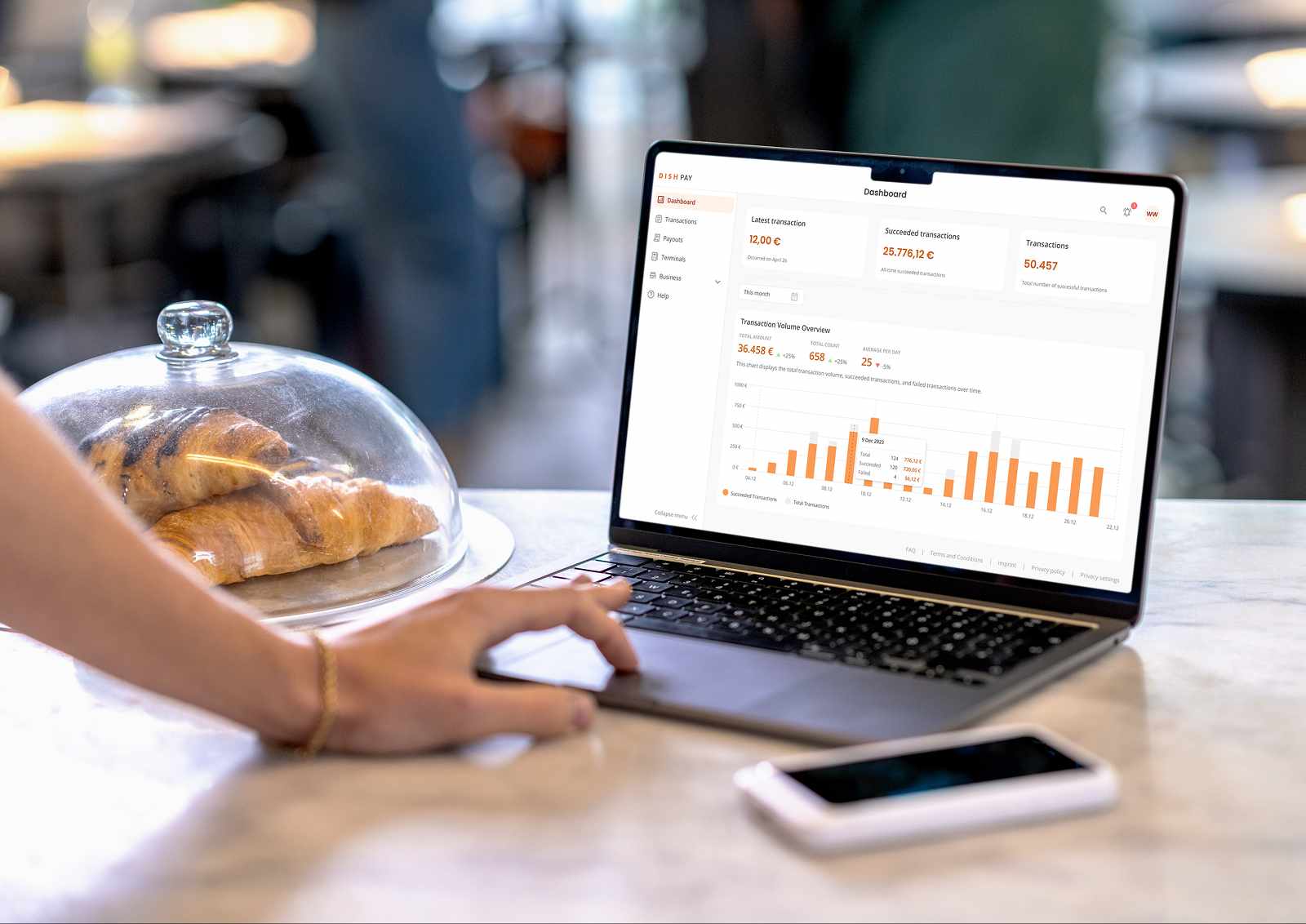
DISH continues to expand both its product suite and geographical reach. Recent additions include Dish Pay, a payment system equipped with handheld terminals designed for smaller cafés that don't require a full-point-of-sale (POS) system. The company is also working on migrating all its systems, including the acquired POS system which currently runs on AWS, to Google Cloud as part of its "One Platform" strategy.
"Through the combination of data analytics, machine learning, and generative AI, we're creating a future-ready platform that puts the customer at the center and makes them more successful in their daily business," says Maecker. "Beyond that, the AI-driven solutions enable Metro to provide customer-centric consulting and support."
As consumer expectations continue to evolve, DISH sees increasing opportunities to help small restaurants compete through smart digitization. The company is exploring deeper integrations with Google services, including the possibility of batch uploads to Google My Business profiles, which would automatically increase restaurant visibility.
"Our vision is to make technology invisible for restaurateurs," concludes Glaeser. "They should be able to unpack our solutions, plug them in, and focus on what they love: creating great dining experiences for their guests. Meanwhile, we'll keep innovating behind the scenes, using Google Cloud to turn data into insights that help both restaurants and Metro succeed."
Our vision is to make technology invisible for restaurateurs. They should be able to unpack our solutions, plug them in, and focus on what they love: creating great dining experiences for their guests. Meanwhile, we'll keep innovating behind the scenes, using Google Cloud to turn data into insights that help both restaurants and Metro succeed.
Dr. Volker Glaeser
CEO, DISH Digital Solutions
DISH Digital Solutions was established in 2015 as a wholly owned subsidiary of METRO AG to develop digital solutions that contribute to the success of hospitality businesses. In 2022, DISH acquired Eijsink, a leading point-of-sale (POS) provider, further strengthening its commitment to quality, innovation, and powerful solutions for restaurant owners.
Industry: Hospitality
Location: Germany
Products: BigQuery, Cloud Composer, Vertex AI