Increased computational bandwidth by 25 to 100-fold compared to previous local processing methods
Helps compress traditional drug discovery and optimization timelines from five-seven years down to just one year
Unified fragmented genomic and protein data into a single, production-grade Kubernetes-orchestrated computational platform
Enabled non-technical scientists to run complex protein simulations with a user-friendly GKE-powered interface
Decoy Therapeutics uses Google Kubernetes Engine and GPU-accelerated pipelines to automate complex protein folding and molecular dynamics simulations. This cloud-native approach compresses years of research into months, accelerating the path to clinical trials for life-saving antivirals.
Decoy Therapeutics uses Google Kubernetes Engine and GPU-accelerated pipelines to automate complex protein folding and molecular dynamics simulations. This cloud-native approach compresses years of research into months, accelerating the path to clinical trials for life-saving antivirals.

Engineering the future of antivirals: Speed, versatility, and the quest for universal care
The development of novel therapies for serious unmet medical needs demands a platform that is simultaneously fast, versatile, and cost-effective. For Decoy Therapeutics, a preclinical-stage biopharmaceutical company, the mission is even more focused: addressing global health threats of existing and novel viruses by applying an engineering mindset to antiviral drug discovery. Founded during the early days of the COVID-19 pandemic, Decoy took inspiration from antibody-drug conjugates to design peptide conjugates to block viruses from infecting human cells. The idea was to essentially turn the Swiss watch complexity of viral fusion machinery into a solvable engineering problem.
Decoy’s proprietary IMP3ACT™ platform is built around a rapid Design-Build-Test-Learn (DBTL). The objective is ambitious: developing lead candidates in weeks rather than years and producing doses at scale for as little as $1 USD per dose. This drive for democratization and global access is central to the company’s mission of shaping programs around both scientific potential and the ability to reach patients at scale. It has helped attract significant non-dilutive funding from public health leaders like The Gates Foundation, BARDA, and others.
However, scaling this vision presents a formidable engineering challenge.
To work within a single platform on Google Cloud that allows you to seamlessly integrate between the compute, the infrastructure, and the data management is highly valuable.
Chinh Duong, Ph.D.
Research Scientist, Decoy Therapeutics
To build designable multi-antivirals (D-MAVs™), a new therapeutic class designed to target shared viral mechanisms across multiple viruses, Decoy needed to unify isolated components. Their infrastructure was fragmented: genomic data lived on Compute Engine, protein data resided in local SQL databases, and various workflows were scattered across disconnected systems. The primary pain point was the need to consolidate these pipelines into a single, production-grade platform capable of handling high-performance computing (HPC) for their two major programs.
When selecting a cloud partner, Google Cloud was the ideal choice due to its deep-rooted leadership in life sciences and its foundational role in the very tools Decoy uses daily. "The most important tool for this work is AlphaFold2, which came from Google," explains Peter Marschel, Co-founder and Chief Business Officer.
For a team leveraging the solution to the once-insolvable "protein folding problem," being able to run these tools on their native infrastructure provided a strategic advantage that made Google Cloud the obvious environment for their research.
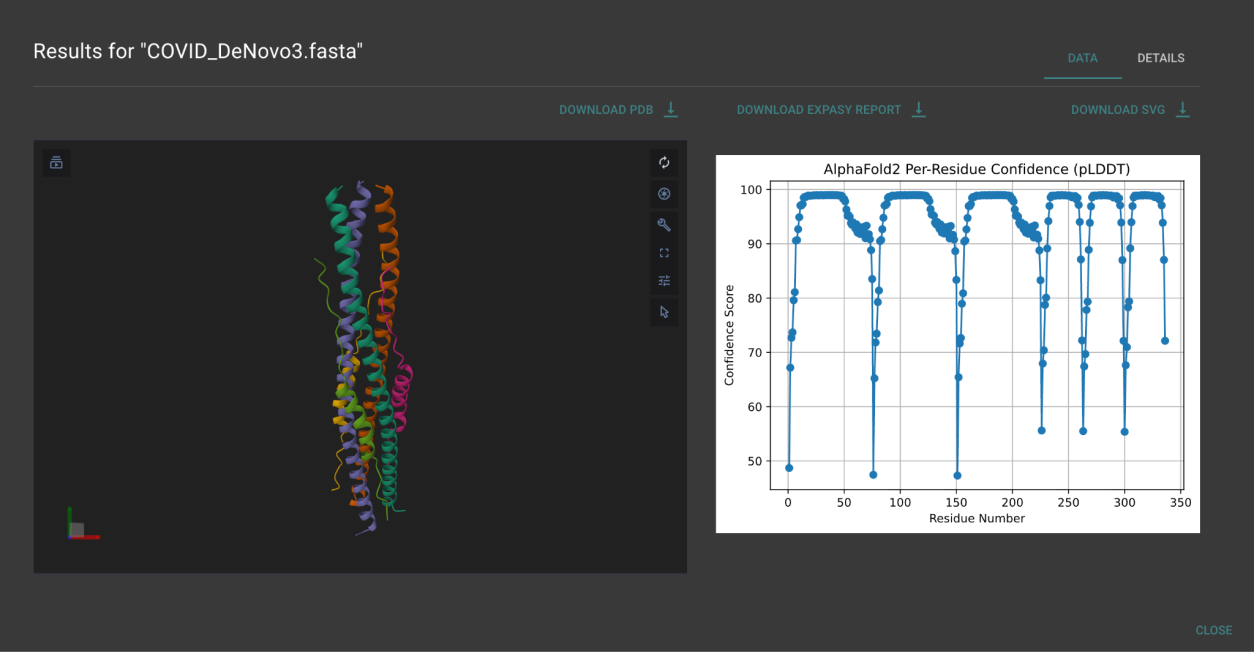
A unified, GPU-accelerated pipeline: Orchestrating discovery with GKE and AlphaFold2
Implementing a unified computational platform required shifting from bespoke Python scripts on local machines to an autoscalable, containerized architecture. Working with Google Cloud, Decoy developed a technical infrastructure heavily rooted in Google Kubernetes Engine (GKE), featuring GPU-enabled node pools specifically designed for heavy-duty biological simulations. This system is managed through robust CI/CD pipelines using Cloud Build, Docker, and Artifact Registry, ensuring that the environment is as repeatable as the science itself.
The platform focuses on two core HPC modules that are critical to the drug design process:
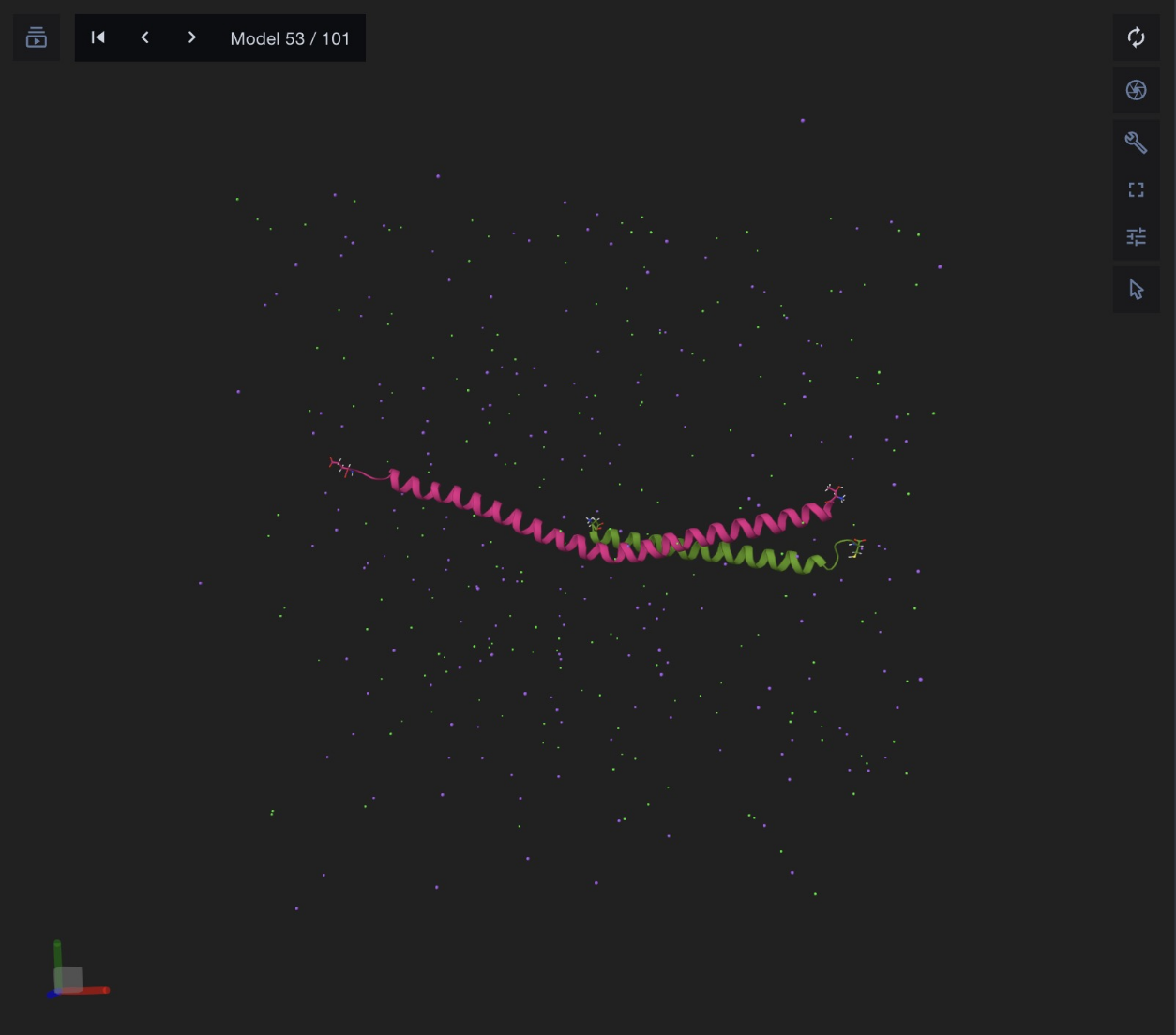
- Molecular Dynamics (MD) Simulation Pipeline: This module utilizes GPU acceleration and optimized engines like GROMACS. To optimize costs, the team uses "Precision Switching"—dynamically choosing between single and double precision—and incorporates machine-learning force fields to approximate interactions, significantly accelerating simulation speed.
- Tiered Protein Folding Pipeline: Decoy implements structure prediction (forward) and design (reverse) workflows. By exposing a tiered set of algorithms, researchers can trade accuracy for speed depending on the needs of the calculation.
Crucially, this technical sophistication is balanced by a user-friendly front-end interface. By deploying their applications on GKE, Decoy has empowered scientists who may not have a software engineering background to run complex compute on their "peptides of interest" with just a few clicks. This removes the bottleneck of manually setting up scripts and ensures the team spends less time maintaining systems and more time on core research.
The collaborative nature of the Google Cloud also plays a vital role in their day-to-day operations. Decoy’s engineers and scientists utilize Gemini Code Assist to troubleshoot code and understand public codebases, further accelerating development cycles.
We're increasing our computational bandwidth by 25 to 100-fold and speeding it up enormously with our approach and the power Google Cloud offers.
Chinh Duong, Ph.D.
Research Scientist, Decoy Therapeutics

Accelerating clinical outcomes: From months to hours and a global vision for antivirals
Decoy is increasing their computational bandwidth by 25 to 100-fold using Google Cloud, helping in part to accelerate discovery and optimization timelines that would typically take five to seven years down to a single year. The speed of the computational design, paired with their proprietary "single-shot" synthesis technology, allows them to move from design to physical molecule in hours or days—a process that previously took months.
This accelerated path is already bearing fruit for their lead program: a pan-coronavirus inhibitor designed to hit all SARS-CoV-2 variants, SARS-CoV-1, MERS, and potentially any novel coronaviruses. Beyond COVID-19, the platform is targeting a "triple threat" respiratory antiviral for influenza, RSV, and COVID-19 with a single D-MAV™. The business impact is clear: Decoy is now a publicly listed company that is traded on the NASDAQ (DCOY), providing the capital needed to push these candidates into human clinical trials.
The success of Decoy serves as a blueprint for other life science startups.
We are trying to become the best in the world at going after this fusion mechanism in viruses–to really change the way we deal and manage viral disease everywhere.
Peter Marschel
Co-founder and Chief Business Officer, Decoy Therapeutics
It demonstrates how a lean team can use Google Cloud AI, HPC, and GKE solutions to build a high-value, scalable business without the need to hire massive teams to manage data centers or security infrastructure.
This efficiency allows Decoy to focus entirely on their mission: creating broad-acting antivirals that are as accessible in low and middle-income countries as they are in the US and Europe.
Looking ahead, Decoy is working with a leading peptide manufacturer to scale-up their proprietary peptide-conjugate synthesis technology to global scale on typical commercially available peptide synthesis equipment. The goal is to be able to take D-MAV candidates designed on the Google Cloud to clinical and commercial scale manufacturing with unprecedented speed, and to easily share that manufacturing globally through a standardized ‘tech transfer’ and licensing process. Put another way, with Google Cloud and others, Decoy Therapeutics is not just building a drug pipeline; they are engineering a faster, more equitable future for global healthcare.
Decoy Therapeutics is a biotechnology company pioneering Designable Multi-Antivirals (D-MAVs), a new category of antivirals engineered to target shared viral mechanisms, enabling a single, adaptable drug to work across multiple viruses. Built on the proprietary IMP3ACT™ platform, which combines AI-enabled design and rapid synthesis, Decoy develops antivirals designed to move faster into the clinic and expand what is possible in viral prevention and treatment. The Company's lead candidates target multiple respiratory viruses, addressing the health and societal burden of viral disease.
Industries: Healthcare and Life Sciences, Startups
Location: United States
Products: GKE Cluster, AlphaFold2, Compute Engine, Gemini, Cloud Build, Docker, Monitoring, Artifact Registry, Cloud Storage, Cloud IAM, Cloud Filestore, Cloud Load Balancing, Cloud DNS