Scaled from 5 to 170+ countries in six months with Google Cloud
13m kg of CO2 saved
70% of users say Bower has improved their recycling behavior
Recycling app Bower used Vertex AI and Gemini to scale to 170+ countries, processing 136M+ waste items and saving 13m kg of CO2.
Recycling app Bower used Vertex AI and Gemini to scale to 170+ countries, processing 136M+ waste items and saving 13m kg of CO2.

Simplifying ML and AI development with Google Cloud
Sorting and recycling consumer packaging is a global environmental challenge. Of all the plastic waste generated, it’s estimated that only 9% globally is recycled, with around 70% ending up in landfill or in nature. Not only does this damage the environment and increase demand for virgin resources, it also generates significant CO2 emissions. These are the challenges Bower set out to solve with the launch of its mobile app. Inspired by deposit schemes that incentivize consumers to recycle bottles and cans, Bower’s app rewards users for correctly recycling any consumer packaging.
Based and launched in Sweden, Bower soon made its app available in four other EU countries, enabling users to scan their waste and gain rewards for recycling it. Keen to pursue its vision of a world where everything has value and trash doesn't exist, Bower then looked for a way to scale globally. However, the app's initial reliance on barcodes hindered this global ambition, as it made it difficult to recognize unfamiliar packaging in new markets, or items without barcodes.
Realizing that artificial intelligence could allow it to identify items anywhere and scale to new regions, Bower searched for easy-to-use AI capabilities that could simplify the AI and ML development process and allow it to scale its app quickly and easily. Bower applied for the Google.org Impact Challenge and soon gained the credits and extensive technical support to build the AI capabilities it needed.
Google Cloud simplifies the development and scaling of any kind of machine learning model. You don’t need ML expertise, you can just use its pre-built model library, Model Garden on Vertex AI, feed it data, and serve it at the click of a button.
Lucas Nilsson
CTO, Bower
“Google Cloud simplifies the development and scaling of any kind of machine learning model,” explains Lucas Nilsson, CTO at Bower. “You don’t need ML expertise, you can just use its pre-built model library, Model Garden on Vertex AI, feed it data, and serve it at the click of a button.”
Scaling a global solution to the world’s waste problem with Gemini
With Google Cloud, Bower has built a comprehensive, self-learning solution to move the app beyond its barcode dependency. Bower used Vertex AI, leveraging high-speed Cloud GPUs with Compute Engine, to develop and train an ML model that allows users to identify any waste item, simply by uploading a photo. This model, which relies on Vision AI for object detection, accurately identifies the item's type, material, estimated mass, and brand, then uses this data to calculate the user’s reward, along with the amount of CO2 emissions saved.
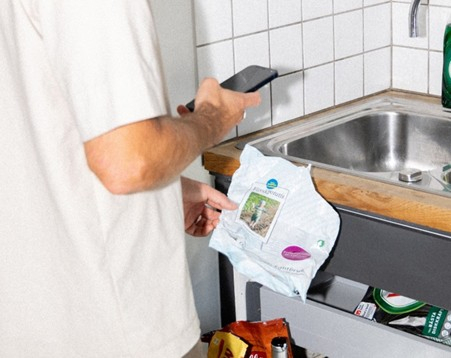
Being able to process items without a barcode means Bower can easily sort waste in any region. However, to scale globally, Bower also needed to be able to quickly gather and process information about local waste infrastructure. Now, with Gemini, Bower can process unstructured user input to evaluate recycling drop-off points, helping it to learn about waste infrastructure in different markets. This multimodal capability allows Bower to build a global knowledge base and provide precise sorting instructions anywhere in the world, drastically reducing the need for manual data entry.
“With Vertex AI and Gemini, we can move beyond the limits of barcodes to identify and provide guidance on any package, even without a barcode,” explains Berfin Mert, co-founder and COO of Bower. “Thanks to our work with Google Cloud, we scaled our app globally from five to more than 170 countries in just six months.”
Central to the system's success is the continuous data enrichment process. With Gemini, Bower can automatically label new data generated by users. Users then validate this new information with a “thumbs up or thumbs down" to continuously train and improve the models' predictions, ensuring the system gets smarter over time.
With Vertex AI and Gemini, we can move beyond the limits of barcodes to identify and provide guidance on any package, even without a barcode. Thanks to our work with Google Cloud, we scaled our app globally from five to more than 170 countries in just six months.
Berfin Mert
Co-founder and COO, Bower
Building a future where waste is a thing of the past
With Google Cloud, Bower has successfully grown from a regional app to a global service, empowering 740k+ recyclers to sort over 170 million packages, resulting in 13 million kg of CO2 saved. As a testament to that environmental impact, when surveyed, 70% of Bower users say the app has improved their recycling behavior, while Bower’s own research shows more than 30% of the waste sorted with the app wouldn’t have been recycled without it.
Looking ahead, Bower aims to perfect its self-learning system by 2027, using Google Cloud AI and ML services to automatically enrich its own data on packages and recycling points worldwide. This will allow the company to scale its environmental impact globally without being limited by regional knowledge or manual input. “With Google Cloud, our vision is to give all packages around the world a value, and thereby fully eliminate the whole concept of trash,” adds Mert. “Because what is trash if everything has a value?”
With Google Cloud, our vision is to give all packages around the world a value, and thereby fully eliminate the whole concept of trash. Because what is trash if everything has a value?
Berfin Mert
Co-founder and COO, Bower
Bower is a Swedish environmental services company incentivizing users to recycle their trash. Active in 170+ countries, it helps users track their environmental impact as part of its mission to rid the world of waste.
Industries: Other, Environmental Services
Location: Sweden
Products: Google Cloud, Compute Engine, Gemini, Cloud GPUs, Model Garden, Vertex AI, Vision AI