
Reduced infrastructure overprovisioning by 30–40%
Cut SAP BW processing from six hours to three minutes
Reduced SAP infrastructure TCO by 20%
Accelerated infrastructure deployment to seconds
Standardized SAP, VMware, and cloud disaster recovery
ATB Financial used Google Compute Engine, BigQuery, GKE, and Google Cloud VMware Engine to modernize banking infrastructure, standardize disaster recovery, and build a more agile, fit-for-purpose IT environment.
ATB Financial used Google Compute Engine, BigQuery, GKE, and Google Cloud VMware Engine to modernize banking infrastructure, standardize disaster recovery, and build a more agile, fit-for-purpose IT environment.
Building a fit-for-purpose banking infrastructure
Powering possibilities for clients, communities, and beyond is what drives ATB Financial. A leading Alberta-based financial institution, ATB has more than $100 billion in total assets and assets under management, with more than 5,000 team members serving over 837,000 clients across Personal and Business Banking, ATB Wealth Management, and ATB Capital Markets.
As customer expectations for digital banking evolved, ATB recognized that delivering faster, more responsive services required an equally agile and scalable technology foundation. To support that shift, ATB began modernizing its infrastructure, SAP environments, analytics platforms, and digital banking services to improve operational resilience and better serve its clients.
“Early in our modernization journey, the goal was simple: move everything to cloud,” says Greg Rogers, Managing Director of Network and Infrastructure at ATB Financial.
Previously, ATB operated a traditional dual-datacenter environment, with one site primarily supporting production workloads and the other handling disaster recovery and non-production environments. While the model provided the resilience required for critical banking systems, it also required maintaining significant excess infrastructure capacity to avoid procurement delays and support future growth. “Provisioning infrastructure could take months,” says Rogers. “To stay ahead of demand, we were carrying 30–40% excess capacity at any given time.”
The complexity increased as SAP HANA workloads demanded dense memory footprints and customer-facing banking applications required greater scalability and operational flexibility. The infrastructure team also needed to meet strict resilience requirements, including very low recovery point objectives (RPOs) for critical banking systems. Growing operational demands meant teams were spending more time maintaining infrastructure and capacity than delivering new capabilities.
As the organization expanded its cloud footprint, ATB evolved from an “all-in-cloud” mindset toward a more pragmatic fit-for-purpose infrastructure strategy.
“As the environment matured, we realized different workloads had different requirements around performance, sovereignty, resilience, and cost,” says Rogers.
Google Cloud gave us the flexibility to right-size infrastructure based on workload requirements instead of forcing everything into the same model. We could scale on demand, modernize SAP HANA on memory-optimized Compute Engine instances, and standardize disaster recovery without overbuilding infrastructure upfront.
Greg Rogers
Managing Director, Network and Infrastructure, ATB Financial
That evolution introduced additional complexity across disaster recovery operations, with workloads distributed across multiple environments and technologies. ATB ultimately needed a more standardized approach that could simplify operations while supporting scalable recovery capabilities across environments.
Google Cloud aligned closely with ATB’s evolving infrastructure strategy. “Google Cloud gave us the flexibility to right-size infrastructure based on workload requirements instead of forcing everything into the same model,” says Rogers. “We could modernize critical financial reporting systems and disaster recovery for SAP HANA workloads supporting our on-premises core banking platform on memory-optimized Compute Engine instances, without compromising our ability to scale on demand or overbuilding infrastructure upfront.”
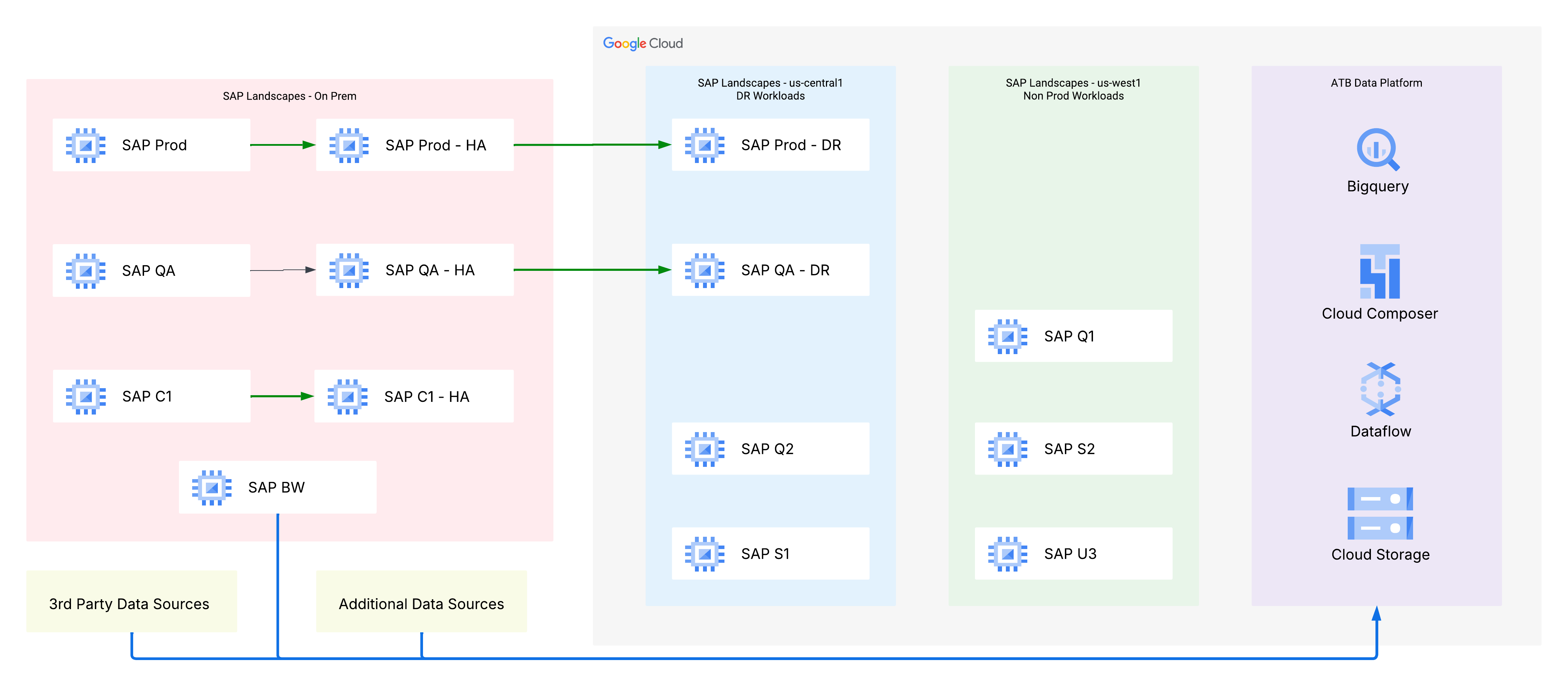
Connecting SAP, analytics, and DR across Google Cloud
ATB’s Google Cloud adoption expanded over time, beginning with analytics and reporting on BigQuery before extending into SAP modernization on Compute Engine, customer-facing banking applications on Google Kubernetes Engine (GKE), and standardized disaster recovery with Google Cloud VMware Engine (GCVE).
Google Cloud VMware Engine lets us use the VMware stack we already know while moving disaster recovery capacity into Google Cloud. That helps us standardize recovery without asking teams to manage a completely different operating model.
Greg Rogers
Managing Director, Network and Infrastructure, ATB Financial
BigQuery serves as the organization’s standardized enterprise data warehouse. Data from SAP and other enterprise systems flows into BigQuery through connectors and ATB’s internal data platform, with curated satellite projects giving business units access to the datasets they need for analytics and reporting. As ATB moved SAP reporting workloads to Google Cloud, SAP financial and reporting data became more tightly integrated with BigQuery, creating a foundation for enterprise analytics and AI. Gemini platform serves as ATB’s standardized platform for AI workloads, using the centralized enterprise data available through BigQuery to support analytics and AI initiatives across the organization.
To support the modernization of SAP workloads, ATB uses memory-optimized M-series virtual machines on Compute Engine, moving from earlier M1 and M2 instances to newer M3 and M4 generations as part of ongoing life cycle modernization designed to improve performance and cost efficiency. ATB pairs these VMs with high-performance Google Cloud block storage based on workload requirements, using Hyperdisk Balanced for M4 workloads. SAP application layers run on N-series and C-series instances. ATB also uses custom machine types to better match SAP application nodes to specific compute and memory requirements.
Compute Engine serves as the robust infrastructure powering ATB’s end-to-end corporate finance and regulatory risk reporting environments across all landscapes. Beyond supporting this core financial ecosystem, it provides critical disaster recovery for both production and pre-production banking stacks, while seamlessly hosting the non-production environments dedicated to ongoing testing and project delivery.
Google Kubernetes Engine (GKE) supports ATB’s internally developed and commercial banking applications. These applications interact with SAP workloads on Google Cloud to exchange financial and operational data supporting critical processes.
Google Cloud VMware Engine (GCVE) supports ATB’s VMware workloads on Google Cloud, including nonproduction banking and support applications outside SAP and virtual desktop infrastructure (VDI) running in an active-active configuration with on-premises environments. GCVE also serves as ATB’s disaster recovery destination for its remaining on-premises production VMware workloads outside SAP, including customer-facing banking applications, enterprise services, and other mixed workloads. Those production VMware environments replicate from the primary datacenter into GCVE using VMware Live Site Recovery Manager and VMware replication, with Cloud Interconnect providing private connectivity between on-premises environments and Google Cloud. “Google Cloud VMware Engine lets us use the VMware stack we already know while moving disaster recovery capacity into Google Cloud,” says Rogers. “That helps us standardize recovery without asking teams to manage a completely different operating model.”
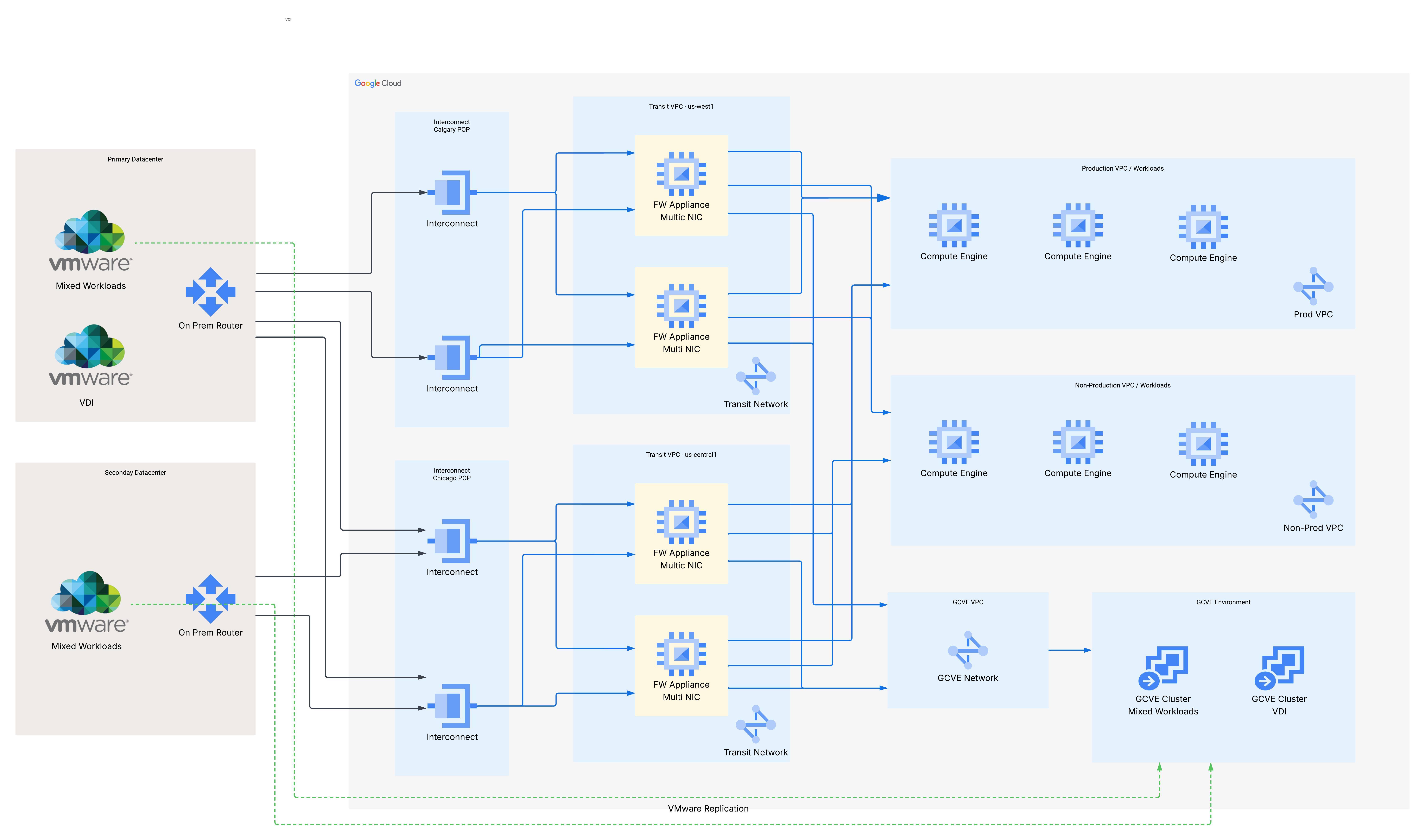
Cashing in on cloud flexibility
With Google Cloud, ATB has improved performance, resilience, and infrastructure efficiency across critical banking systems. Marketing campaigns and month-end processes that once took five to eight hours now run in seconds, giving teams faster access to data when it matters most. ATB has also accelerated the delivery of datasets and insights by 30% and generated more than CA$2.24 million in productivity savings.
“Migrating the critical financial reporting systems at the heart of our banking operations to Google Cloud transformed how quickly we can generate insights—what once took hours now takes minutes,” says Rogers. “It also streamlines our adoption of Google AI services by effectively utilizing our SAP Reporting systems and data warehouse in BigQuery.”
ATB has also moved away from a capacity model built around long procurement cycles and excess hardware. Instead of maintaining 30–40% excess capacity to stay ahead of demand, teams can provision infrastructure on Google Cloud as business needs change. With Compute Engine, tiered storage, custom machine types, and FinOps practices, ATB can better align infrastructure spend to workload requirements, use lower-cost tiers for non-critical systems, and reduce overall SAP infrastructure TCO by 20% across both on-premise and Google Cloud infrastructure.
Disaster recovery has become more scalable and consistent as well. By standardizing VMware recovery on GCVE, ATB reduced DR sprawl across multiple locations, technologies, and automation models. The architecture gives teams a more consistent recovery environment while allowing ATB to scale resources in Google Cloud during a recovery event instead of relying only on a fixed secondary data center footprint.
“Google Cloud has helped us make disaster recovery more practical to operate,” says Rogers. “We can test more efficiently, use the tooling our teams already understand, and scale recovery capacity when the business needs it.”
ATB now runs an annual DR test across its SAP systems and roughly 30 individual application DR tests each year as part of a broader effort to improve consistency across SAP and VMware recovery operations. With GCVE, ATB reduced standardized DR testing time by roughly 25%, depending on the application, and standardized recovery across VMware-based applications, helping teams improve readiness while reducing manual coordination during failover planning.
Together, these improvements give ATB a stronger foundation for modern banking. The organization can support critical workloads, meet strict resilience and sovereignty requirements, expand analytics and AI capabilities, and continue improving cost and performance without returning to the rigid capacity planning cycles of traditional infrastructure.
Migrating the critical financial systems at the heart of our banking operations to Google Cloud transformed how quickly we can generate insights—what once took hours now takes minutes. It also made our AI services using Gemini better.
Greg Rogers
Managing Director, Network and Infrastructure, ATB Financial
ATB Financial is an Alberta-based financial institution serving more than 843,000 customers with personal, business, and investment banking services across the province.
Industry: Financial Services
Location: Canada
Products: Compute Engine, Google Cloud VMware Engine (GCVE), Google Kubernetes Engine (GKE), BigQuery, Gemini platform, Cloud Interconnect, Hyperdisk