
Benchmarking demonstrated ~10% faster response times
Up to ~20% greater search throughput anticipated
Architecture supports deployment across multiple regions
Amadeus is expanding its flight shopping platform on Google Cloud, using Axion-powered compute infrastructure to improve performance and efficiency and process parts of its daily billions travel searches.
Amadeus is expanding its flight shopping platform on Google Cloud, using Axion-powered compute infrastructure to improve performance and efficiency and process parts of its daily billions travel searches.
Scaling flight shopping for billions
of daily search queries
Finding the best flight option is far more complex than a typical web search query. That’s something Amadeus, a travel technology provider, knows well. Amadeus develops the platforms that power booking and travel distribution for airlines, travel agencies, and travel providers worldwide. Its flight shopping solutions process more than three billion flight search queries per day, making it one of the most compute-intensive workloads in its global travel infrastructure. Each request must evaluate airline fares, pricing rules, taxes, and seat availability across multiple carriers while exploring large combinations of routes and connections. These calculations must be completed within strict latency thresholds so travel sellers and consumers receive accurate results almost instantly.
Search volume is growing faster than ever. “The industry is changing quickly,” said Luc Viguié, Director of Strategic Partnerships at Amadeus. “Personalization and more sophisticated airline retailing strategies mean we can rely less on caching and have to compute more results in real time. At the same time, the number of searches keeps growing every year.” Furthermore, the emergence of AI assistants that can query travel systems automatically on behalf of users will probably accelerate flight search traffic growth.
To support these evolving requirements, Amadeus began transforming its technology stack by migrating all its applications to the Cloud and developing cloud-native architectures capable of supporting airline retailing and future AI-driven travel experiences. Then, to globally expand Shopping Platforms specifically, the company partnered with Google Cloud for its worldwide infrastructure footprint and advanced compute capabilities. “Compute performance is critical for our shopping workloads,” said Viguié. “Google Cloud gave us access to the latest hardware innovations, like the Axion Arm processors, which provide new opportunities to improve performance and efficiency.”
Compute performance is critical for our shopping workloads. Google Cloud gave us access to the latest hardware innovations, like the Axion Arm processors, which provide new opportunities to improve performance and efficiency.
Luc Viguié
Director of Strategic Partnerships, Amadeus
Amadeus had already deployed several workloads on Google Cloud, including some running on Compute Engine and Google Kubernetes Engine (GKE) environments. Building on this foundation, Amadeus saw an opportunity to expand the partnership while supporting its broader multi-cloud strategy.
Designing a hybrid compute architecture
for flight shopping
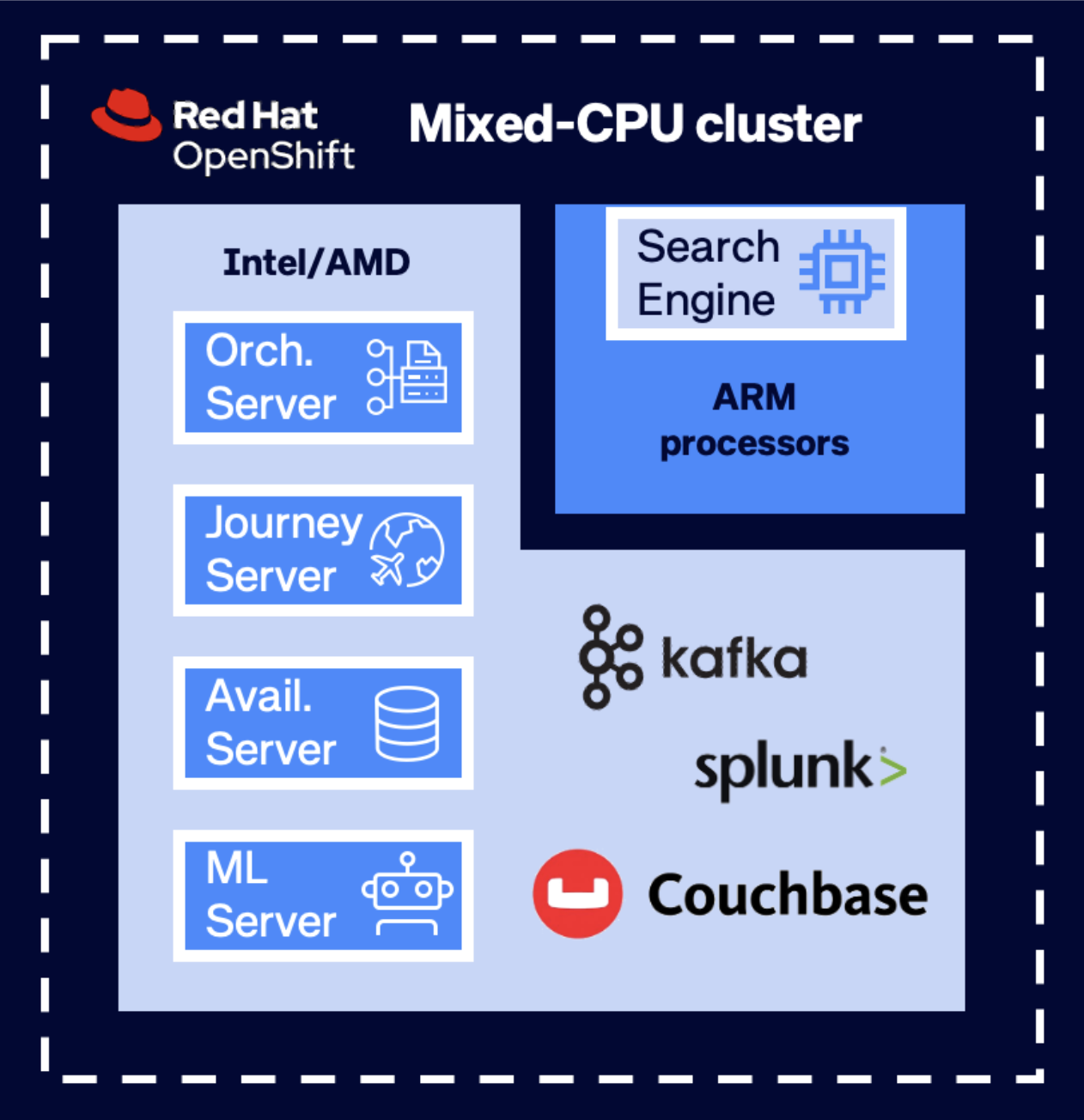
To support the next phase of its flight shopping platform, Amadeus designed a hybrid compute architecture on Google Cloud that aligns infrastructure profiles with the different workloads within the shopping ecosystem. Because the platform processes extremely high query volumes under strict latency constraints, the architecture separates the most CPU-intensive processing from supporting services to optimize performance and resource utilization.
The core engine is planned to run on C4A virtual machines powered by Google Cloud’s Axion ARM processors, which are optimized for compute-heavy workloads. “We saw strong potential with Arm architecture. One of the advantages is that one vCPU corresponds to a full physical core, which allows the application to scale almost linearly with CPU load,” said Antoine Collier, Principal Engineer, Flight Search at Amadeus.
Other components of the platform—including databases, availability services, and supporting middleware—will run on N-series virtual machines, primarily N4 instances using Intel or AMD processors. This approach allows Amadeus to place compute-intensive workloads on C-class machines while running supporting services on balanced infrastructure optimized for memory and general-purpose processing.
Storage performance is tuned for the data services that support the shopping stack. The architecture uses a combination of Persistent Disk and Hyperdisk, depending on the latency and throughput requirements of individual workloads. Performance-sensitive databases can use Hyperdisk for faster disk response times, while other components use balanced storage configurations.
The system runs within a containerized environment based on OpenShift from RedHat, enabling Amadeus to manage large numbers of services across the shopping platform. Deployment follows a phased rollout that began with joint benchmarking and infrastructure validation with Google Cloud engineers.
We saw strong potential with Arm architecture. One of the advantages is that one vCPU corresponds to a full physical core, which allows the application to scale almost linearly with CPU load.
Antoine Collier
Principal Engineer, Flight Search, Amadeus
Subsequent phases will introduce production services and progressively scale the environment as traffic is expanded across additional regions.
Increasing throughput and
response efficiency at scale
Early benchmarking and architecture validation have demonstrated promising performance improvements for the Amadeus shopping engine running on Google Cloud infrastructure. During testing, engineers evaluated the workload on compute-optimized C4A instances powered by Google Cloud’s Axion ARM processors, measuring how the engine performs under production-scale conditions. “Our benchmarking of Google Cloud Axion-based instances showed promising results for the shopping engine,” said Collier. “We’re seeing improvements in both response time and throughput, which ultimately means faster results for travelers and travel sellers.”
Initial results indicate that the architecture can reduce backend response time by approximately 10% compared with previous ARM-based hardware while increasing overall throughput by roughly 20%. At the scale of the Amadeus shopping platform, even incremental improvements in latency and throughput translate into meaningful gains in both system efficiency and infrastructure utilization. Higher throughput per instance allows the platform to process more requests with fewer virtual machines while maintaining fast response times.
Testing also showed that the shopping engine can sustain high utilization levels while maintaining consistent performance. This allows Amadeus to operate infrastructure more efficiently, increasing the number of requests processed per instance without compromising responsiveness.
The hybrid architecture also gives Amadeus greater flexibility as demand changes throughout the day. By independently scaling compute-intensive services and supporting workloads, teams can allocate resources more efficiently while maintaining consistent performance across the shopping platform.
Finally, the deployment targets a distributed regional architecture designed to improve both latency and resilience. This is part of a broader Amadeus strategy, as Pierre-Jean Reissman, VP Cloud Platform shares, “Our collaboration with Google Cloud is a catalyst for the next phase of our Shopping platform evolution. By combining Google Cloud’s global reach, next‑generation hardware, and AI innovation with our multi‑cloud approach, we are scaling smarter, deploying closer to customers, and delivering faster, more resilient, and more personalized shopping experiences at global scale.”
Our benchmarking of Google Cloud Axion-based instances showed promising results for the shopping engine. We’re seeing improvements in both response time and throughput, which ultimately means faster results for travelers and travel sellers.
Antoine Collier
Principal Engineer, Flight Search, Amadeus
Amadeus will thus expand parts of its existing Shopping Cloud platform footprint to Google Cloud, with a deployment across multiple regions, including the Americas and Asia Pacific.
Amadeus makes the experience of travel better for everyone, through innovation, partnerships, and responsibility. Amadeus powers the travel industry at scale, integrating innovative technologies to transform it.
Industry: Travel and Hospitality
Location: France
Products: Compute Engine, Google Kubernetes Engine (GKE), Persistent Disk, Hyperdisk, Google Axion processors