Leverages Compute Engine and Google Kubernetes Engine to support stable Wery.AI Agent workloads
Uses Google Cloud to unify infrastructure and model inference, reducing overall cloud infrastructure and model inference costs by approximately 25%
Uses Gemini platform to centrally access and manage multimodal models including Gemini, Imagen, Veo, and Nano Banana, reducing video and image rendering delivery latency by approximately 40%
Connects with the broader Google ecosystem, including Google Ads, SEO, and Google Play, to support continued international growth
Wekoi uses Google Cloud to power Wery.AI’s multimodal AI, cut costs, enable continuous creation, and support global growth.
Wekoi uses Google Cloud to power Wery.AI’s multimodal AI, cut costs, enable continuous creation, and support global growth.
A more stable generative AI built for continuous creation
Wekoi is an AI technology company focused on multimodal generative AI and agent workflows. Its Wery.AI platform serves content creators and vertical industry users, allowing them to simply define a creative goal while the agent interprets their needs and orchestrates different generative AI capabilities to create characters, posters, scripts, short-form videos, and more.

For high-frequency content creators such as YouTubers, this capability is especially important. Creation is not just about generating a single piece of content, but about continuously producing and publishing content around the same characters, visual language, and storylines. For Wery.AI, the core challenge is therefore not simply to “generate a good-looking image,” but to consistently deliver the images and videos users want with the right balance of stability, speed, and cost. As its user base and international business continue to grow, these requirements have placed greater demands on the underlying cloud infrastructure and model-calling capabilities.
Before migrating to Google Cloud, Wekoi primarily ran its infrastructure on AWS and accessed different generative AI models through third-party platforms. As usage increased, the team began to encounter unstable model calls under high concurrency, higher latency, and rising costs. For agent workflows that require multiple consecutive model calls, a timeout or failure at any stage could interrupt the entire creative process. At the same time, Wekoi was already making extensive use of Google AI models. For a generative AI product operating in a fast-moving market, the ability to test and integrate newly released foundation models quickly has a direct impact on the pace of product innovation.
After migrating to Google Cloud, Wekoi began consolidating its compute, container, database, and data analytics capabilities into a more unified architecture. Compute Engine and GKE provide the runtime environment for Wery.AI’s core services and agent workloads, enabling services to scale with business demand. Google Cloud Database supports user, project, and business data, providing a stable data foundation for the states and content involved in continuous creation. Firebase and BigQuery further bring together user behavior and business data for product analytics, growth insights, and advertising attribution. Another key advantage is that the team can access and evaluate new Google AI capabilities more directly while bringing models, infrastructure, and development environments into a more unified ecosystem.
The migration to Google Cloud took place over several months and followed a phased, “integrate while migrating” approach. It consisted of three stages: feasibility validation; migration of platform services, infrastructure, and big data systems; and finally, migration of core business workloads. Through a phased gray release, Wekoi completed the migration without disrupting user services.
Following the migration, Wekoi reduced its overall cloud infrastructure and model inference costs by approximately 25%. For Wery.AI, which is still expanding its global user base, this not only lowers operating costs but also allows the team to reinvest more resources into product innovation, user growth, and international market expansion.
One of the biggest lessons from our migration to Google Cloud is that the earlier you unify foundational capabilities, the faster product iteration becomes. For developers, that means building event tracking and data analytics early to connect user behavior, product data, and growth data, while also standardizing model access and testing. The advantage of Google Cloud is that data capabilities such as BigQuery and Firebase can work within the same ecosystem as Gemini platform for model access, testing, and management. This makes the entire process more efficient, from understanding users to validating and launching new models.
Jian Hang
CTO, Wekoi
Deepening creative worldbuilding, driving new global growth
After migrating to Google Cloud, Wery.AI began integrating different multimodal AI capabilities into a more unified agent workflow. Gemini platform serves as a key gateway for connecting and managing model capabilities, while models such as Gemini, Imagen, Veo, and Nano Banana each take on specialized roles depending on the task.
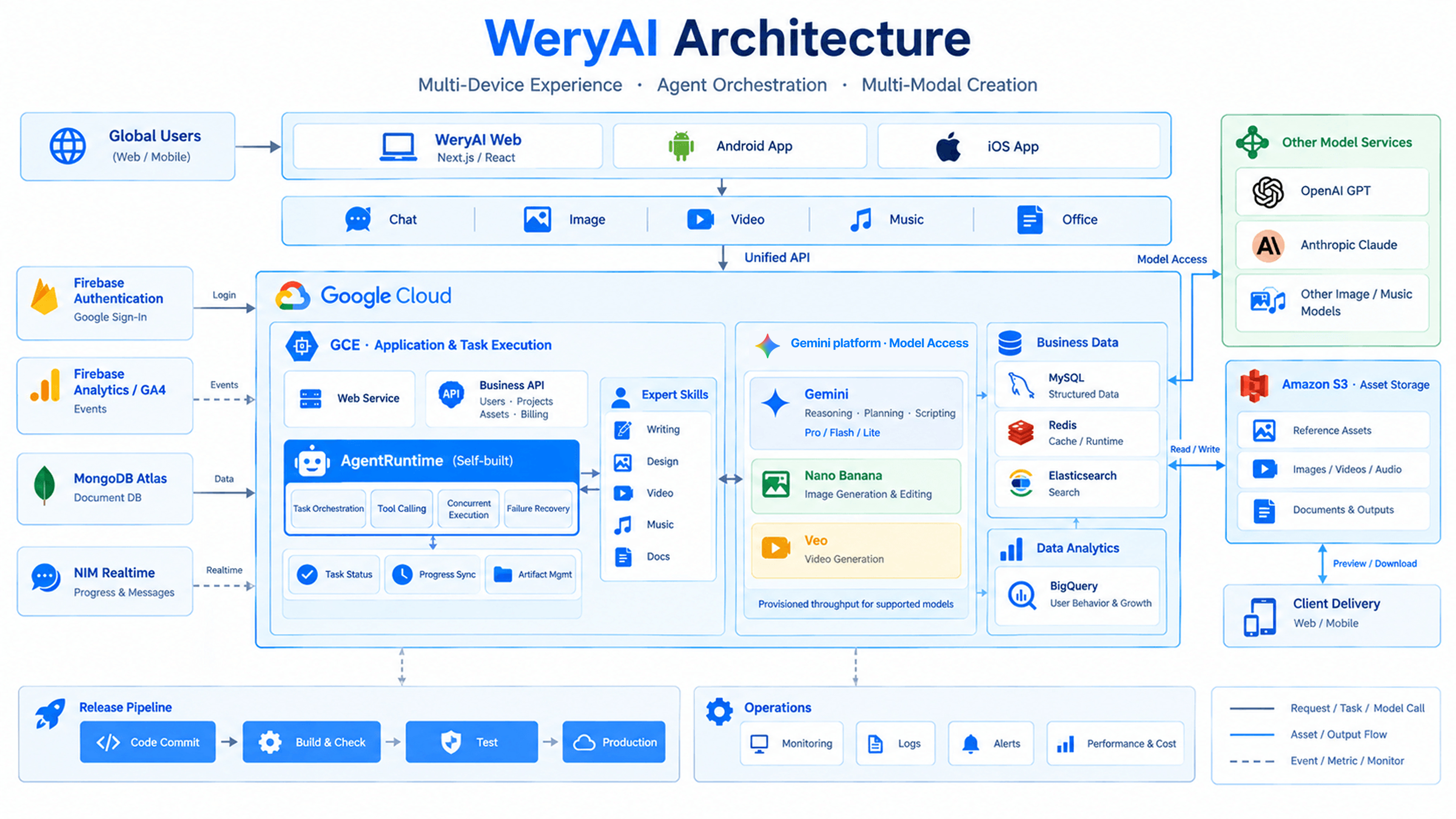
When users give Wery.AI a creative goal, the agent first uses multi-turn interactions to understand their intent, then calls the most appropriate models for the task and continues generating and refining outputs based on user feedback. For Wekoi, the goal is not to use the “most powerful” model in every scenario, but to find the right balance across quality, speed, cost, and stability, while keeping the complexity of model selection behind the scenes.
This unified approach to model access and orchestration has also improved product performance and development efficiency. Wery.AI has reduced video and image rendering delivery latency by approximately 40%, while also improving generation success rates. With the unified Gemini platform environment, the integration cycle for new multimodal AI models has also been shortened from weeks to days.
As Wery.AI serves a growing number of international users, data privacy, enterprise security, and AI safety have become foundational product capabilities. Wekoi follows regional data privacy requirements including GDPR, CCPA, and PDPA, applies the principle of data minimization, and provides mechanisms for users to delete their accounts and data. For content safety, the team combines automated detection with manual review to address areas such as minor protection, copyright, portrait rights, and other sensitive content. The Google Play review process has also helped the team further refine its privacy policies and data handling practices.
Beyond technical capabilities, Wekoi also aims to leverage Google’s global ecosystem to drive business growth. After being accepted into the 2026 Google Export Accelerator Programme, the team plans to draw on Google Ads, SEO and data analytics, and guidance from industry experts and mentors to further validate product-market fit, reduce overseas customer acquisition costs, and explore more sustainable user growth channels.
Looking ahead, Wery.AI is moving beyond simply “integrating more models” toward “understanding creators more deeply.” Wekoi does not want the value of its product to depend on continuously stacking the latest models. Instead, it aims to use Gemini’s deeper contextual and intent understanding to gradually understand the characters, visual styles, stories, scenes, and unique “worldview” within each creator’s project.

For Wery.AI, the next stage is not just about completing a single generation, but helping creators build continuously and consistently over time. From understanding a single prompt to understanding a creator; from calling models to continuously building a story universe that is uniquely their own.
For us, Wery.AI’s value goes beyond completing a single generation. It is about truly understanding creators, even the worlds they are trying to build. Foundation models will continue to evolve, so our competitive edge is not about how many models we integrate, but about enabling users to create continuously and efficiently without having to think about the underlying models. Gemini 3.5 has already impressed us, and we are excited to see what innovations Gemini 4 will bring to the creative experience.
Will Yan
AI Director, Wekoi
Wekoi is an AI technology company focused on multimodal generative AI and agent workflows, providing generative AI solutions for content creators, marketers, and enterprise customers. Its Wery.AI platform brings together multimodal capabilities across text, image, video, and audio, using AI agents to understand user intent and orchestrate different models and creative workflows, helping users turn a simple idea into continuously produced content.
Industry: AI
Location: China
Products: Google Cloud, Compute Engine, Google Kubernetes Engine (GKE), BigQuery, Google Cloud Database, Google Ads, SEO, Google Play, Firebase, Gemini, Gemini platform, Imagen, Veo, Nano Banana