
Reduces supplier onboarding from weeks to hours
Automates support responses, reducing average response time from 30 hours to 30 seconds
Unifies multimodal customer inputs to improve agent memory
Sourced $6.8M+ in demand and supply pipeline in one month
Warehouse Exchange generated more than $25M in revenue from unused logistics space through Gemini-based agent teams.
Warehouse Exchange generated more than $25M in revenue from unused logistics space through Gemini-based agent teams.
Turning unused warehouse space into gold
In traditional commercial real estate, businesses routinely rent 30% to 50% more space than they currently use to accommodate future growth and avoid expensive, disruptive moves. For companies that need new warehouse space, finding a place, contracting, and getting it ready for use takes an average of 18 months. Because commercial brokers ignore short-term, smaller spaces due to low commissions, about 30% of all US warehouse space—amounting to 4.5 billion square feet—sits empty.
While users wait to grow into that space it sits empty. Yet thousands of small business owners and entrepreneurs need smaller warehouse spaces for short-term contracts but have no way to access this unused space. Remember what happened to that extra bedroom you never went into but may now generate incremental revenue? Warehouse Exchange set out to bridge this gap by matching warehouse owners and lease holders with tenants through an automated platform using agents.
Without AI agents, this is a marketplace that could not exist. We’re inventing on-demand warehousing because we now have technology that makes it financially possible.
Jonathan Rosenthal
Co-founder and Executive Chairman, Warehouse Exchange
Before the company was able to begin training agents, it had to manually vet and match leaseholders and tenants. The company knew that to make on-demand access viable, it needed to reduce the manual back and forth of negotiation. “Without AI agents, this is a marketplace that could not exist,” says Jonathan Rosenthal, Co-founder and Executive Chairman of Warehouse Exchange. “We’re inventing on-demand warehousing because we now have technology that makes it financially possible.”
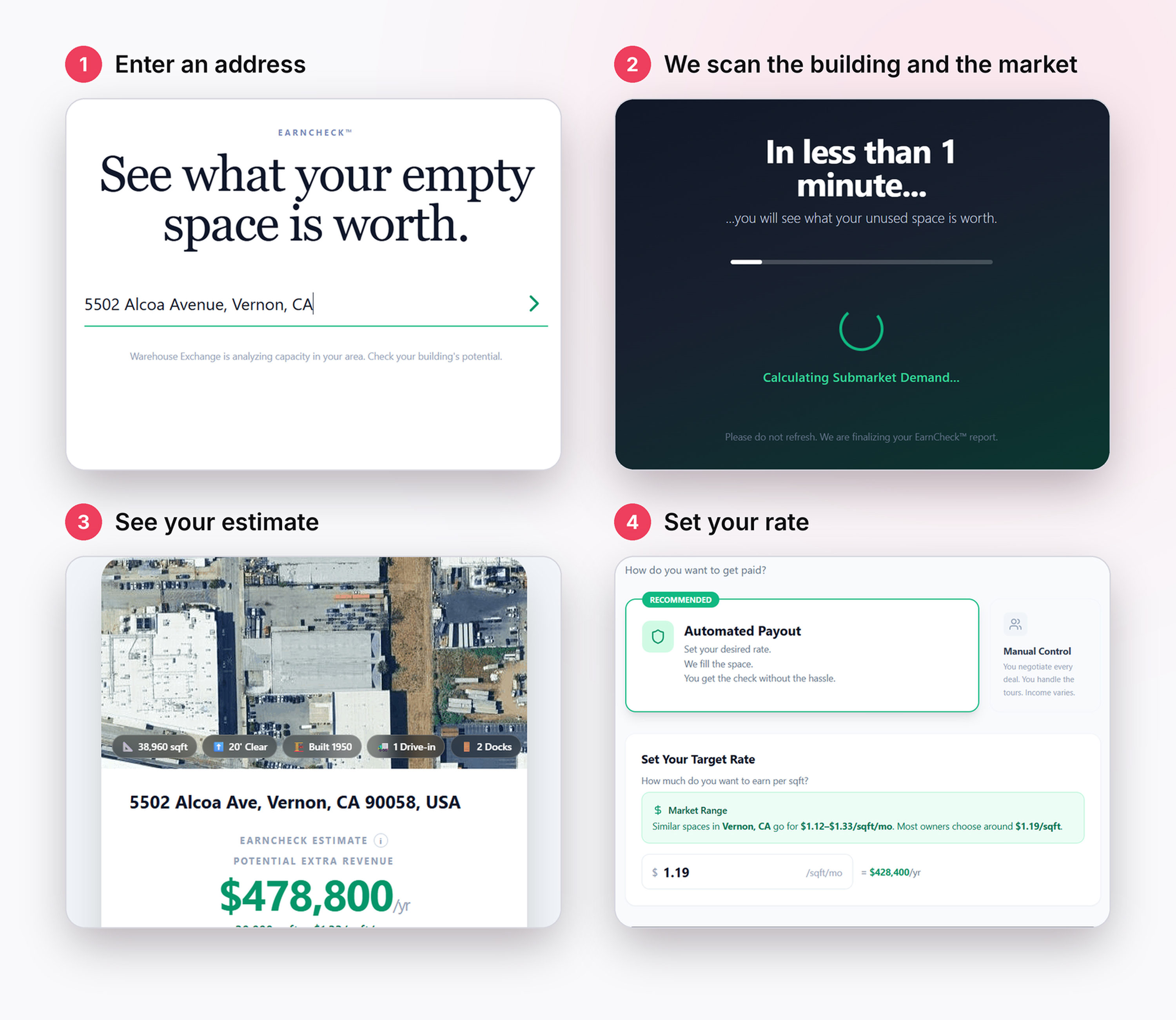
Previously, supplier onboarding required users to answer 100+ questions and took at least a day and half. Customer inquiries took four to eight hours to process, and questions about building specifications could drag negotiations out over several days.
Designing a team of multimodal agents to shape a new industry
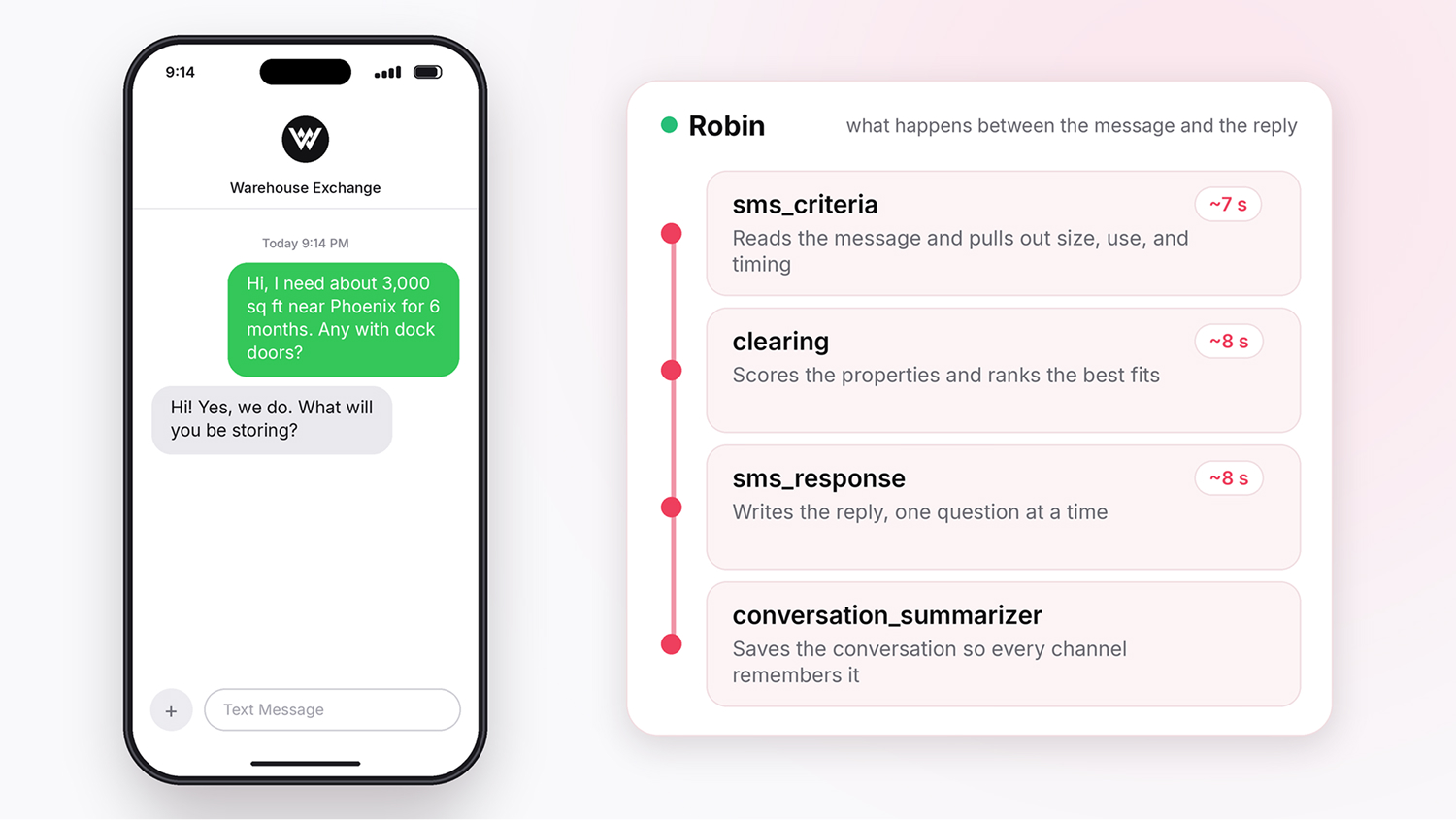
In Warehouse Exchange’s journey to build, train, and optimize an agentic platform, the team first had to identify an AI and cloud partner to collaborate with. The company chose Google Cloud to deploy its complex web of 100 specialized AI agents with the Gemini platform. The architecture uses a dynamic, multi-model approach using Gemini Pro as the core reasoning engine, managing complex logistics and matching logic. Meanwhile, lighter models like Gemini Flash handle SMS and phone interactions to reach customers quickly.
Recently, Warehouse Exchange has also started to offer customers virtual tours of warehouses through the platform using a combination of Gemini 2.5 Flash image and Veo. By giving potential renters access to enhanced photos and virtual access to their potential space, the team can increase the likelihood that the renter will ask for an in-person tour as well.
When you introduce agents to a process, you learn a lot about what you haven’t defined, and then you need to fill those gaps with training. Google has highly effective training data, and combining their expertise with our industry knowledge has helped us create something brand new for our industry.
Jonathan Rosenthal
Co-founder and Executive Chairman, Warehouse Exchange
Warehouse Exchange was also able to collaborate with the Google team on creating agents with robust memory capabilities. Since customers frequently interact with the platform across voice, SMS, email, and its website, the team designed a cross-channel memory layer. This architecture ensures agents tap into a single, unified context, preventing them from forgetting a buyer's requirements if they switch channels. “When you introduce agents to a process, you learn a lot about what you haven’t defined, and then you need to fill those gaps with training,” Rosenthal shares. “Google has highly effective training data, and combining their expertise with our industry knowledge having closed more than 800 transactions has helped us create something brand new for our industry.”
In addition to building confidence through innovation, Warehouse Exchange is also able to rely on the enterprise-grade security controls available through Gemini to reassure even conservative logistics companies that their proprietary data and intellectual property are safe.
Moving logistics leaders into the AI era
Warehouse Exchange’s bet on the value of unused warehouse space is already proving to be a successful one. Customers are now able to list their spaces on the platform in minutes. The platform’s agents scrape the web for warehouse specifications including construction dates, safety details, floorplans, marketing materials, and more to compile a profile, pricing estimate, and virtual assets almost instantaneously. Meanwhile, organizations looking to rent space are able to discover it, sign a contract, and move in within a matter of days rather than months.
Our collaboration with Google has helped us move incredibly fast, and the Google team is genuinely interested in what we’re building, how we’re using their tools, and what results we’re seeing.
Dinesh C
CEO, Warehouse Exchange
As the company optimizes its models, performance continues to improve. Supplier onboarding has increased 40% month-over-month, customer response times have dropped from 60 seconds to just 40, and the platform is able to match interested parties to properties in less than five minutes. “Our collaboration with Google has helped us move incredibly fast, and the Google team is genuinely interested in what we’re building, how we’re using their tools, and what results we’re seeing,” says Dinesh C, CEO of Warehouse Exchange.
This speed directly translates to a rapidly growing customer base. In just one month, a team of Gemini-based agents sourced and qualified $3.28M in warehouse buyer demand and managed 258+ inbound opportunities at just $0.12 per lead. And on the supply side of the business, another agent team sourced $3.55M in new properties.
With this evolving team of agents connecting buyers and owners, the team has their sights set on scaling the platform and its reach, even beyond just US warehouses. “It’s reassuring to have Google behind us as a technology partner and as a brand,” Rosenthal shares. “The brand alone validates our work to non-technical potential investors. When they see what we’ve built, and who we’ve built with, they more readily trust that our work is safe, enterprise ready, and a big deal.”
Warehouse Exchange is an AI-driven clearinghouse for temporary logistics space that uses agents to connect owners and renters to fill millions of square feet of unused warehouse space.
Industry: Technology
Location: United States
Products: Gemini, Google Cloud