
Scaled from pilot to millions of active IoT devices on a single platform
Active tracking service from $0.99 per asset per year
Up to 25% reduction in idle fleet assets is achievable without output loss
Cold-chain alerts enable automatic shipment rejection before warehouse receipt
Proof of concept deployable in days, no wiring or fixed infrastructure required
TRLLN turned IFCO's supply chain expertise into a global Tracking-as-a-Service platform on Google Cloud.
TRLLN turned IFCO's supply chain expertise into a global Tracking-as-a-Service platform on Google Cloud.
When visibility has a price tag
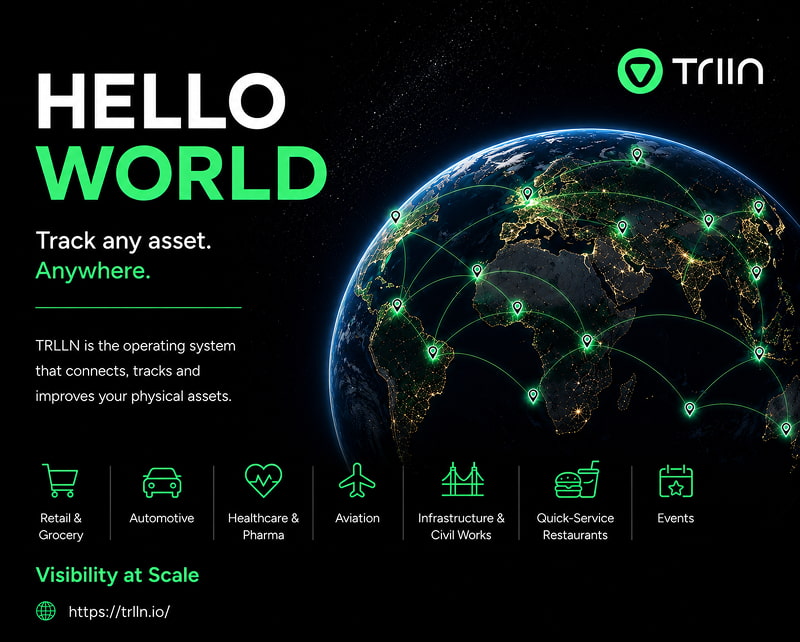
IFCO manages one of the world's largest pools of reusable packaging with more than 400 million containers circulating across 50+ countries. That scale is the business, and it’s also the challenge.
For years, keeping track of those assets meant choosing between systems that were prohibitively expensive or too rigid to deploy at volume. Traditional RFID-based solutions required fixed gate infrastructure at every handover point—costly to install and maintain, and invisible everywhere in between. Satellite-based alternatives existed, but carried price points that made them unworkable for assets measured in the hundreds of millions. The industry had broadly accepted that continuous, granular visibility across a pool of this size was simply not economically viable.
TRLLN, founded as a 100% subsidiary of IFCO, was built to disprove that assumption. But the founding insight went further than solving IFCO's own problem. The challenge IFCO faces is not unique to fresh food logistics. Every industry that operates large volumes of reusable assets—automotive manufacturers tracking parts and containers across production lines, airports managing ground equipment and luggage, retailers monitoring roll cages and specialty carts—runs into the same wall. Visibility at scale is either too expensive, too complex, or both. IFCO's operational experience across 50+ countries was not just an internal advantage. It was a product waiting to be built.
As the world market leader in fresh logistics, we realized that the problem we solve for ourselves is actually industry-agnostic. Every sector with assets in the millions has this challenge. We just found a way to solve it affordably, at a scale no one had reached before.
Dr. Sebastian Grams
CEO of TRLLN and Chief Digital Officer of IFCO
When evaluating cloud platforms, TRLLN's engineering team of more than 50 specialists based in Barcelona centered on one question: which provider could grow with them, not just to millions of devices but toward a vision of one trillion connected assets worldwide? Google Cloud's strength in large-scale analytics, anchored by BigQuery, and the elastic, container-native infrastructure of Google Kubernetes Engine provided the technical foundation. The platform's self-service model was equally important: TRLLN's team wanted the freedom to build and iterate on their own terms. Google Cloud gave them that environment.
A postage stamp that knows where it's been
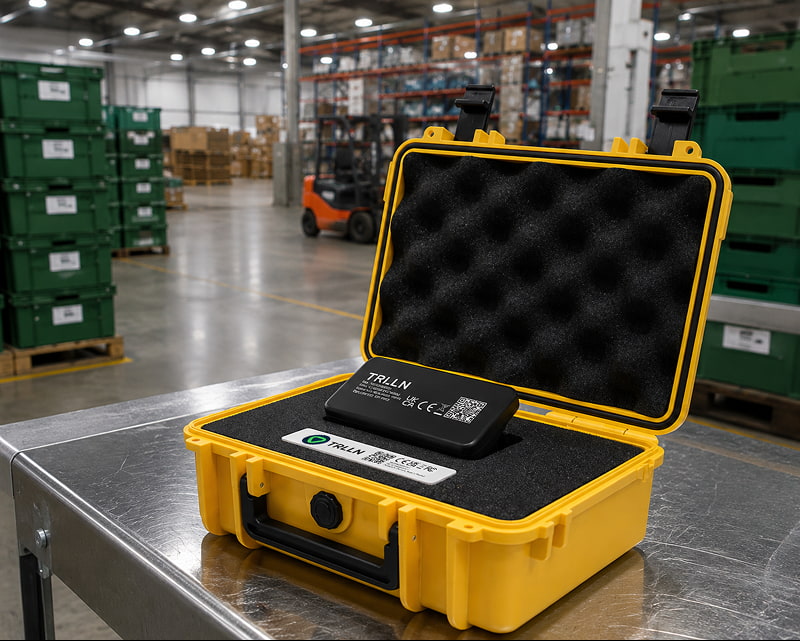
At the center of TRLLN's platform is a deliberately simple piece of hardware. The Intelligent Node—a Bluetooth Low Energy label roughly the size of a postage stamp—contains printed electronics, a custom-designed chip. It costs less than a physical postage stamp to produce. It lasts seven years, a figure chosen deliberately to match the average operational lifespan of a standard reusable crate, so that tag and container retire together under normal conditions. No mid-lifecycle replacement. No additional maintenance overhead.
We sometimes describe it as an industrialized AirTag: the same intuitive simplicity everyone knows, but engineered for millions of assets in the harshest industrial environments, at a cost that actually makes sense at that scale.
Dr. Sebastian Grams
CEO of TRLLN and Chief Digital Officer of IFCO
The seven-year target is an engineering commitment, not a specification afterthought. It reflects the core design philosophy behind the entire platform: carry no more technology than you actually need. That discipline is what makes the price point possible. And the price point is what makes the scale possible. TRLLN owns the intellectual property behind the hardware, owns the production machinery, and works with a manufacturing partner to produce tags at scale, a model borrowed deliberately from the consumer electronics industry. The result is volume production at a price point that would be structurally impossible if hardware and software were sourced separately.
In the field, Intelligent Nodes broadcast to Super Nodes by Bluetooth, each Super Node capable of capturing up to 30,000 signals simultaneously. Super Nodes transmit to the cloud using 4G or WiFi. Google Cloud processes the resulting data stream: Cloud DNS and Cloud Armor handle security; Google Kubernetes Engine (GKE) orchestrates the backend; Pub/Sub and Managed Service for Apache Kafka ensure no event is lost under high load; Datastream enables near-real-time data capture; AlloyDB and Cloud SQL manage the database layer; and Google Maps Platform translates raw coordinates into a live, navigable view of every tracked asset. Frequencies, geo-zone activations, and alert thresholds are all configurable over the air—the platform adapts to the customer's operational rhythm, not the other way around.
The same architecture scales across radically different asset types. A strawberry crate in a food retailer's supply chain carries temperature data. A roll cage in an automotive plant carries service history and location within a geo-fenced production zone. A luggage trolley at an airport carries its pool entry date and scheduled maintenance window. The asset changes. The platform does not.
Supply chains that learn
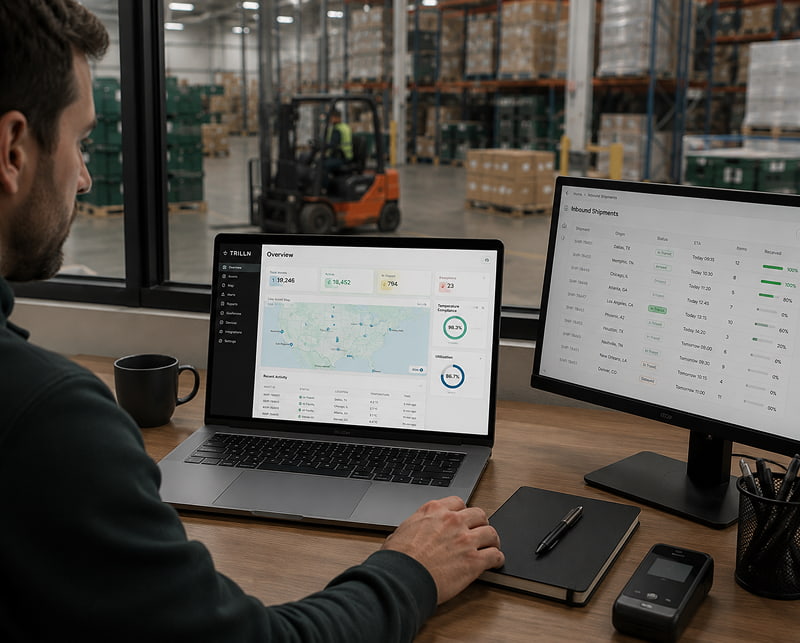
TRLLN's platform is designed to solve the same four problems regardless of industry: where is the asset, is it in the right condition, has it been delivered to the right place, and what is its full history? The use cases that emerge from those questions differ depending on the sector, but the underlying technology remains unchanged.
In fresh food logistics, the immediate impact is measurable. Analysis of IFCO's own pool revealed that roughly 25% of containers are idle at any given time—sitting at distribution points rather than circulating. For a fleet measured in the hundreds of millions, even a modest improvement in utilization translates directly into a smaller pool requirement at equivalent throughput. For retail customers, the value shifts to the delivery side: when a shipment arrives, and the TRLLN data confirms correct volume, location, and an unbroken temperature chain, automated goods receipt replaces manual scanning. If a threshold has been crossed, the alert fires before the truck unloads. In a sector where an estimated 30% of food products are lost to waste before reaching the end consumer, catching a cold-chain failure at the point of arrival—rather than discovering spoilage in the distribution center—represents direct cost avoidance at scale.
Five years from now, when any enterprise faces a large-scale asset tracking challenge, the answer should be clear: you call TRLLN. Asset-agnostic. Industry-agnostic. Built on infrastructure that can genuinely grow with us.
Dr. Sebastian Grams
CEO of TRLLN and Chief Digital Officer of IFCO
In automotive manufacturing, the same platform tracks tooling, containers, and production parts within geo-fenced factory zones, reducing the manual inventory counts and asset search time that accumulate across large production sites. In aviation and airport ground operations, equipment pools and luggage infrastructure can be monitored with the same tag and dashboard, configured to the operational rhythms of an airport environment. The hardware is identical. The configuration is not.
Gemini platform integration is also in development, with a conversational analytics layer that will allow operators to query the platform in natural language: which assets are delayed, which have gone dark, where losses are accumulating. The data has always been there. The next step is making it speak.
TRLLN is available directly on the Google Cloud Marketplace, enabling organizations to streamline deployment and seamlessly integrate it into their existing cloud infrastructure. Access the solution.
TRLLN, a technology subsidiary of IFCO, delivers Tracking-as-a-Service for all kind of assets in every kind of industry.
Industry: Logistics
Location: Germany
Products: BigQuery, Google Kubernetes Engine (GKE), AlloyDB, Cloud SQL, Datastream, Pub/Sub, Managed Service for Apache Kafka, Google Maps Platform, Cloud DNS, Cloud Armor, Gemini platform