Reduces game design from months to minutes
Maintains an average estimated cost of just $0.12 per Gemini Flash model orchestrated generation request
Meets approximately 80% of 3D asset needs using existing 3D assets
Provides a platform for designers to launch their own startups
Rosebud AI uses Google Cloud and Gemini to reduce video game creation from months to minutes for millions of users.
Rosebud AI uses Google Cloud and Gemini to reduce video game creation from months to minutes for millions of users.
Lowering the barrier to entry for high-quality video game development
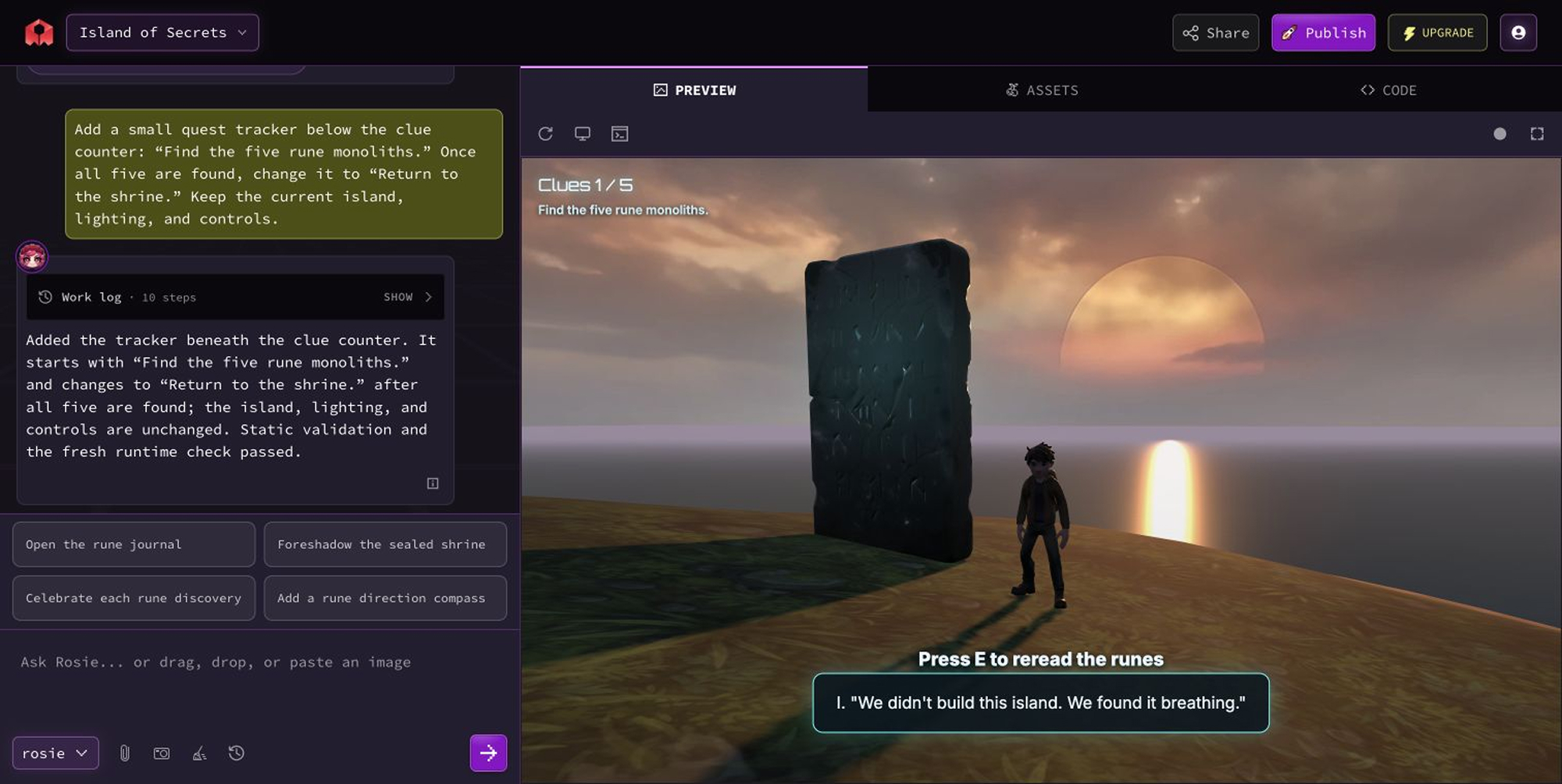
Developing video games is a complex, multi-team process that requires sophisticated tools, coding skills, illustration and animation techniques, and more. It can take months or years before a concept is even playable, but Rosebud AI is reimagining the game development process. The platform lets anyone create 2D or 3D games without requiring coding experience. Creators can describe an idea, play it in their browser, refine it through chat, and publish it for others in minutes. “Our hope is to shorten the distance between having an idea and sharing it with the world to test and play,” says Vladimir Glazachev, CEO of Rosebud.
Providing Rosebud’s users with this simplified experience requires a tightly connected tech stack that can interpret user intent, generate code, produce and properly utilize high-quality creative assets, and host the final projects. Unlike hosting static assets or videos, hosting video games requires responsive and interactive real-time controls.
To make browser-based game generation viable at scale, Rosebud wanted a cloud-based, unified tech stack. The platform’s infrastructure needed to process real-time audio, visual, and button inputs while managing massive traffic fluctuation in the event of a game going viral or influencers sharing the platform with their audiences.
Code generation is at the heart of our product, so the AI had to be excellent at it to start. But it also had to have an aesthetic understanding of games, and we found that with Gemini.
Vladimir Glazachev
CEO, Rosebud AI
The team also needed AI models that combined cost-efficiency with a creative style suited for video games. “Code generation is at the heart of our product, so the AI had to be excellent at it to start,” Glazachev shares. “But it also had to have an aesthetic understanding of games, and we found that with Gemini." Rosebud AI decided to consolidate its infrastructure on Google Cloud and use a series of Gemini models through Gemini platform.
Creating a unified AI and cloud stack to empower game design
When a user would enter a prompt into Rosebud, a Gemini-powered conversational agent could walk them through a questionnaire to flesh out their concept. This initial request is passed to a "one-shot generator" that builds a playable version of the request as quickly as possible. Rosebud uses Gemini 3 Flash as the primary generation model for both speed and keeping overhead costs as little as $0.12 per Flash model orchestrated generation request.
It also uses Gemini embeddings to power 3D asset retrieval and a reranking engine. Together, these are helping Rosebud generate and host assets. Approximately 80% of users' asset needs are then met by existing 3D assets instead of regenerating net-new assets with every prompt, further saving on token costs.
As an engineer, Cloud Run is my favorite kind of solution: it works, and I don’t have to worry about it. My team doesn’t have to think about our site crashing or tools slowing down because we have a big spike in traffic.
Vladimir Glazachev
CEO, Rosebud AI
While customers can directly interact with the platform’s generative AI, the platform’s cloud infrastructure is what keeps Rosebud moving. Cloud Run helps the company dynamically scale compute resources to absorb 100x+ traffic surges effortlessly, while Cloud Tasks pulls long-running build jobs off the main web path to keep the browser UI responsive. “As an engineer, Cloud Run is my favorite kind of solution: it works, and I don’t have to worry about it,” says Glazachev. “My team doesn’t have to think about our site crashing or tools slowing down because we have a big spike in traffic.”
Additionally, Cloud Storage and Cloud SQL help manage project states, so users can return to their workflows when they choose. Rosebud also uses Vision AI to help moderate images in line with its content standards, so the company can set its own standards for acceptable, appropriate content.
Supporting millions of games and designers with reliable cloud tooling
With a secure infrastructure and cost-effective AI ecosystem powering these new game creators, Rosebud has supported more than 2.5 million user-created games with a team of just three engineers. Creators can generate and play a V1 game in less than two minutes. Based on a 72-hour snapshot captured in June 2026, Rosebud powers 84% of its agentic LLM generation traces at the time of that analysis and 98.7% of its one-shot generations with Gemini models.
The platform’s speed, stability, and scalability have directly contributed to new startups emerging out of Rosebud’s platform. One power user is now designing educational games on the platform to distribute to pediatric doctors’ offices across the U.S. “Reliability and platform stability are obviously important to us,” says Andi Bucescu, Head of Marketing at Rosebud. “But for users who are building on our platform, they’re invaluable. It means a lot to be able to provide them with peace of mind.”
Rosebud plans to build on its current success by integrating music generation through Lyria to give users even more opportunities to flesh out their titles with generated sounds. As the platform grows, the team also hopes to include video-generated gameplay to further bypass traditional coding constraints.
Reliability and platform stability are obviously important to us. But for users who are building on our platform, they’re invaluable. It means a lot to be able to provide them with peace of mind.
Andi Bucescu
Head of Marketing, Rosebud
Beyond improving its creator-focused tools, Rosebud is also focusing its attention on its Play page where users can share and play games together with their friends. By expanding access to game development and making it easy to share and distribute those projects, Rosebud AI is helping millions make their gaming dreams reality.
Rosebud AI is a browser-based AI game maker that helps anyone create, edit, and publish games through natural-language prompts—no coding experience required.
Industry: Gaming
Location: United States
Products: Cloud Run, Cloud SQL, Cloud Storage, Cloud Tasks, Google Cloud, Gemini platform, Vision AI