50% reduction in Prisma Access costs
20% reduction in compute costs with C4A instances
40% higher network throughput on Google Kubernetes Engine (GKE)
85% faster response to enterprise demand spikes
By modernizing Prisma Access on Google Cloud, Palo Alto Networks reduced compute costs by 20% while increasing throughput by 40%.
By modernizing Prisma Access on Google Cloud, Palo Alto Networks reduced compute costs by 20% while increasing throughput by 40%.
Why Palo Alto Networks chose Google Cloud to rethink enterprise security
As workforces became more distributed across offices, homes, and branch locations worldwide, enterprise security requirements evolved with them. The security perimeter moved to the cloud. Enterprises now expect protection wherever users connect, without compromising the performance of the applications they depend on. For Palo Alto Networks, meeting that expectation at scale meant rethinking how Prisma Access, its cloud-delivered security service, was built.
Prisma Access inspects enterprise traffic inline before it reaches its destination. Each customer runs on dedicated compute and network resources, completely isolated from other tenants.
“Everything is dedicated—compute, network, resources,” says Pankaj Bhagra, Sr. Distinguished Engineer at Palo Alto Networks. “Think of it as an enterprise buying a product. We run it as a service for them.” A global enterprise doesn't share infrastructure with the customer alongside it. That isolation remained non-negotiable throughout the modernization.
Delivering on that commitment, however, came at a cost. Palo Alto Networks runs hundreds of thousands of VMs on Google Cloud for Prisma Access alone. Enterprise traffic swings roughly 80% from weekend lows to weekday peaks. Under the previous VM-based architecture, meeting demand meant either maintaining excess capacity around the clock or waiting five to seven minutes for new VMs to boot. Neither approach was sustainable.
Palo Alto Networks had operated Prisma Access on Google Cloud since 2018, building direct working relationships with Google Cloud networking and product teams. Premium Networking—with its global points of presence and deterministic routing—provides the geographic reach and latency consistency enterprise security demands. When required capabilities didn't yet exist, Palo Alto Networks worked directly with Google's engineering teams to build them. That depth of collaboration made Google Cloud the natural platform for what came next.
The modernization effort was to move away from monoliths to a more cloud-native, containerized platform that could scale up and down faster, scale down to near zero when needed, and still maintain the highest level of isolation.
Pankaj Bhagra
Sr. Distinguished Engineer, Palo Alto Networks
Moving Prisma Access to Kubernetes on Google Cloud without compromising isolation
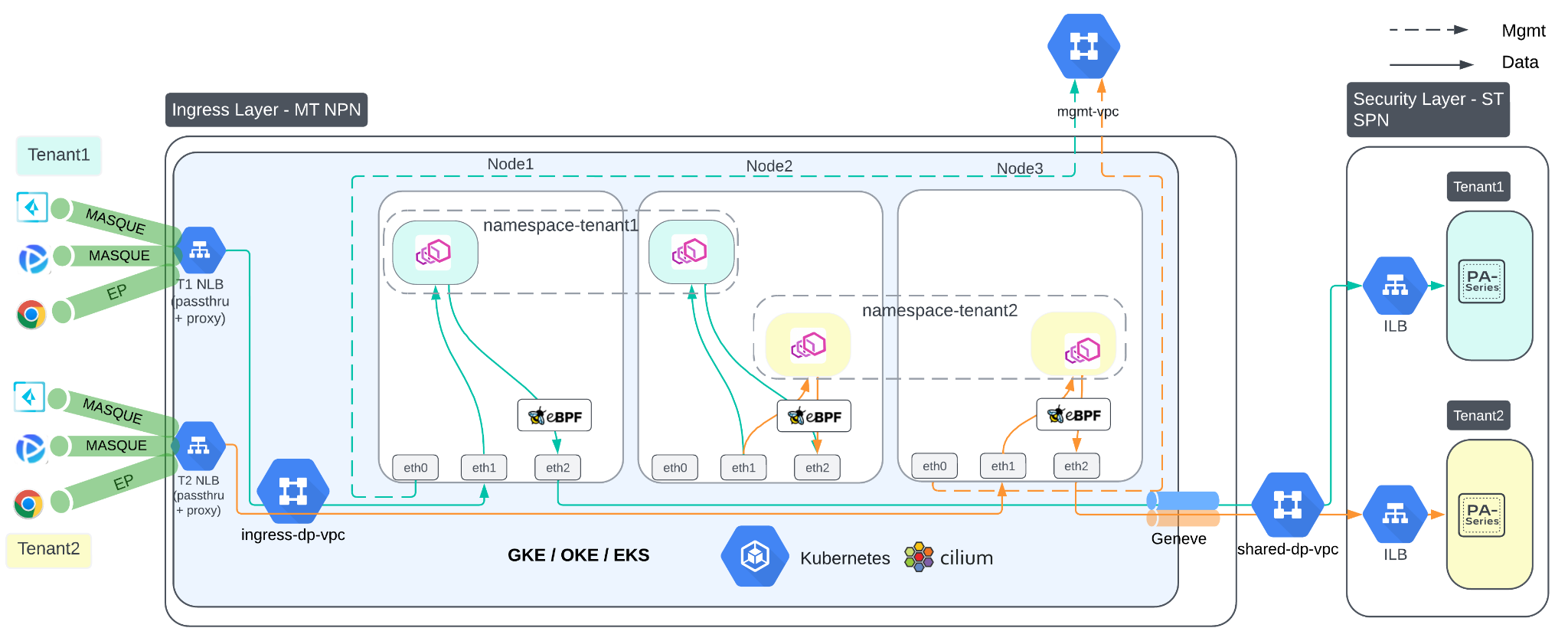
To modernize Prisma Access without compromising its security guarantees, Palo Alto Networks separated the platform into two independently scalable layers. The ingress layer handles traffic routing and forwarding, running on Google Kubernetes Engine (GKE), with Axion C4A driving down the cost under the hood through its price-performance advantage. The security layer handles threat inspection, running on dedicated single-tenant VMs fronted by an Internal Load Balancer. Each layer can now scale, update, and operate independently.
For enterprise users, the difference is immediate. When employees begin their workday and traffic surges, the ingress layer scales in 20 to 30 seconds to meet demand. As activity subsides throughout the day, it scales back down automatically, eliminating excess capacity while maintaining the consistent performance enterprise customers expect.
The ability to influence the Google Cloud product and engineering team to deliver specific features keeps us, as an engineering team, more engaged with Google Cloud. That's why Google Cloud is our first choice. It's not just an executive decision.
Pankaj Bhagra
Sr. Distinguished Engineer, Palo Alto Networks
Achieving that required a capability that didn't yet exist in Kubernetes. Standard pod networking provides only a single network connection, but Prisma Access requires strict separation between data, management, control, and service plane traffic for every tenant. Working alongside the GKE networking team, Palo Alto Networks co-developed an industry-first implementation of multi-NIC pods that preserved network isolation at the pod level. Together, the teams also built container-native load balancing, enabling traffic to flow directly to individual pod endpoints while maintaining VM-level networking performance.
"VMs were the baseline," says Bhagra. "How close containers could get to VM throughput—that was the race. Together with Google Cloud, we bridged that gap. We achieve line rate with GKE."
The results followed directly from the new architecture. Prisma Access now responds to demand spikes 85% faster, delivers 40% higher network throughput on the same compute footprint, and reduces compute costs by 20% using C4A instances on Compute Engine. Overall, Prisma Access costs have dropped 50%.
Enterprise security, engineered for what comes next
Many of the capabilities developed through this collaboration, including multi-NIC pod support, container-native load balancing, network-policy-driven Cloud NAT egress selection, and high-bandwidth NCC Gateway connectivity, have since become part of Google Cloud’s networking platform. When new capabilities are needed, the engineering partnership continues to help bring them to market.
The modernized architecture will reach full general availability in October 2026, extending these improvements across the Prisma Access customer base. With the ingress and security layers operating on independent update schedules, either layer can evolve without requiring changes to the other.
Our feature list is ever-growing. Since our product is growing and we're entering entirely new markets, we continue driving new networking and compute features. Google Cloud remains our first partner of choice. That isn't changing.
Pankaj Bhagra
Sr. Distinguished Engineer, Palo Alto Networks
This foundation is opening new opportunities, including Prisma Access Browser Connector, which uses the container infrastructure to simplify deployment and support the cost structure needed to reach the SMB market.
The collaboration is also expanding beyond Prisma Access, with teams across Palo Alto Networks drawing on Gemini platform and BigQuery to support intelligence and analysis workloads across the business.
Palo Alto Networks is a global cybersecurity leader. Prisma Access is its cloud-delivered security service protecting thousands of enterprises worldwide.
Industry: Technology
Location: United States
Products: Compute Engine, Google Kubernetes Engine (GKE), Cloud NAT, Cloud Load Balancing, Network Connectivity Center, Premium Networking, Gemini platform, BigQuery