
Production time for campaigns reduced from several months to a few days
Campaign creation costs reduced by 70% to 75%
Founded in 2026, Belgian company Inku relies entirely on Google Cloud to operate "Brand Engine", an AI layer that understands enterprise brands intimately and enables them to produce content at scale while maintaining total control over their image.
Founded in 2026, Belgian company Inku relies entirely on Google Cloud to operate "Brand Engine", an AI layer that understands enterprise brands intimately and enables them to produce content at scale while maintaining total control over their image.
Industrializing content production without losing brand control
As a vital driver of growth, marketing content production has accelerated dramatically in recent years. Fueled by the rise of artificial intelligence, companies are now able to produce content at scale, across all channels, continuously. However, this acceleration has a downside: by multiplying generated content, brands risk losing control of their image. Variations in tone, visual inconsistencies, diluted messaging. At scale, AI can quickly introduce unpredictability where consistency is essential.
"AI has made content production extremely easy and inexpensive so much so that the challenge today is not producing more, but maintaining control. Without a framework, companies risk diluting their messaging and weakening their brand with inconsistent content. Our approach consists precisely of putting the brand back at the center of the system to guarantee industrialized production that never drifts and remains continuously faithful to the brand's identity," explains Gus Vanherf, co-founder and CEO of Inku.
Launched in Belgium in 2026, Inku develops a SaaS platform designed to deeply transform how companies produce their marketing content. While most generative AI solutions focus purely on content creation, Inku takes a different approach: structuring the brand upstream to make creation reliable and viable at scale.
At the core of this approach is the Brand Engine, an in-house developed mechanism that centralizes and organizes all brand information such as guidelines, visual identity, products, tone of voice and creative references. This brand truth is then enriched with external signals like market research and competitor data to provide a holistic view on how your brand is positioned.
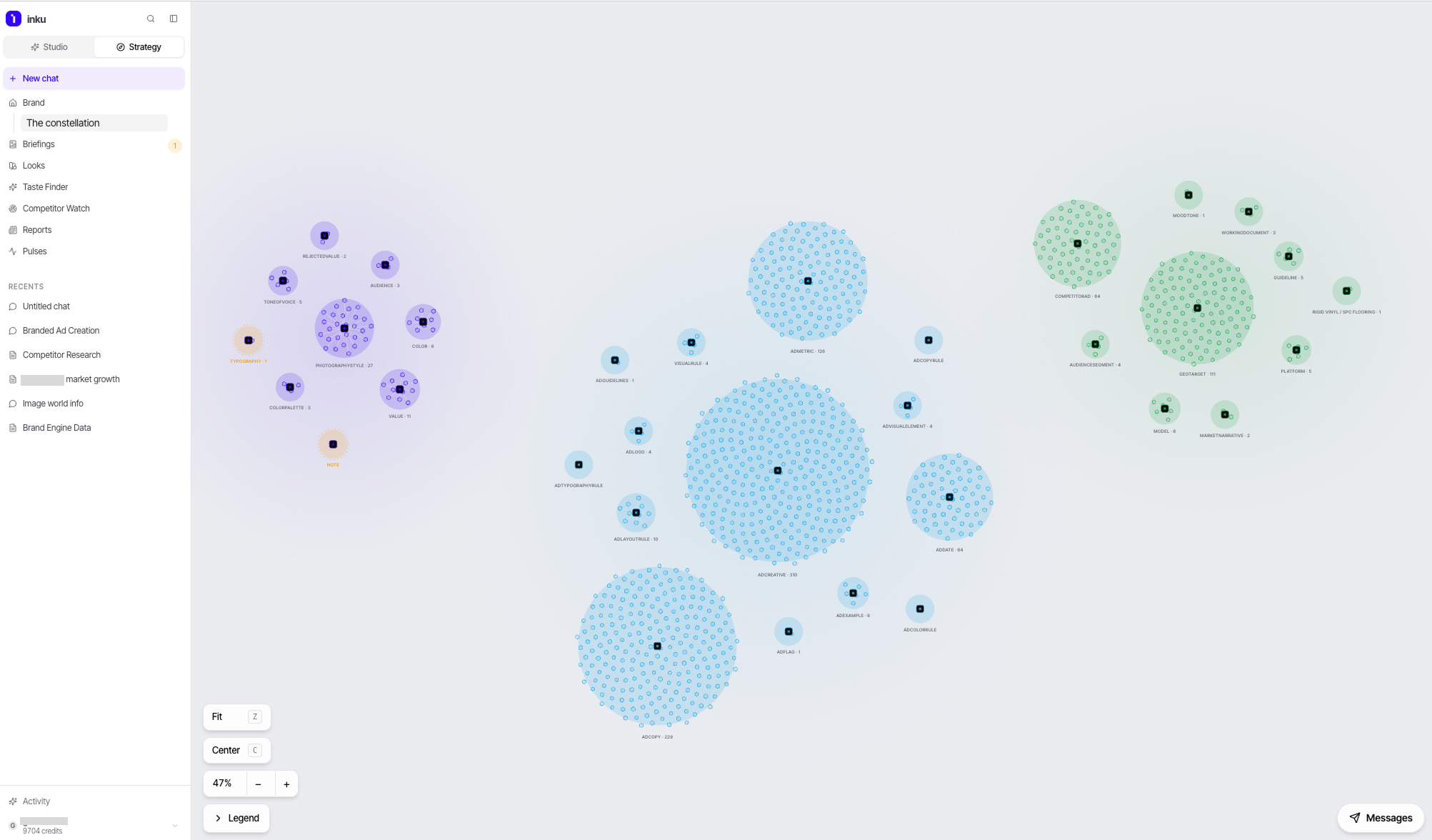
"The idea is to stop starting from a blank prompt, but rather from a system that already understands the brand," notes Gus Vanherf. "By injecting context from the information stored on our platform into the generation pipelines, we enable our clients to produce content that is not just fast to create, but above all consistent with their brand, accurate, and ready to use."
This approach changes the game for large organizations. It allows them to move beyond a logic of experimentation, often limited to ad-hoc use cases, to enter a phase of true, controlled content industrialization. Designers, marketing teams, brand managers, or agencies can thus collaborate from the same repository, guaranteeing a consistent level of quality regardless of volume or channel.
Designed to manage the entire end-to-end process from the initial brief to asset production the platform offers a unified environment where teams no longer just generate content: they orchestrate complete campaigns faster and with an unprecedented level of control.
AI has made content production extremely easy and inexpensive so much so that the challenge today is not producing more, but maintaining control. Without a framework, companies risk diluting their messaging and weakening their brand with inconsistent content. Our approach consists precisely of putting the brand back at the center of the system to guarantee industrialized production that never drifts and remains continuously faithful to the brand's identity.
Gus Vanherf
Co-founder and CEO, Inku
An AI-native architecture driving agility and performance
To realize this vision, Inku built a sophisticated architecture entirely running on Google Cloud. "We needed an infrastructure capable of handling complex workloads, orchestrating different models, and scaling without compromising on performance or security. Google Cloud’s managed services, automated scaling, and ease of model integration were decisive. They allowed us to develop our solution faster while operating with a lean team. In other words, with Google Cloud, we can focus our efforts on development and client value rather than technical management," explains Bjarne Desmet, co-founder and CTO of Inku.
In practice, Inku relies on Google Kubernetes Engine (GKE) and Cloud Run to orchestrate its services and intelligently distribute workloads, continuously adapting resources to actual needs. To optimize costs, the company leverages KEDA (Kubernetes Event-driven Autoscaling), which manages resources based on actual pending requests rather than server activity alone. "With generative AI, workloads arrive in waves. By using an approach based on requests to be processed rather than resource consumption (CPU, RAM), KEDA consumes nothing when the platform is inactive. This approach to scaling, directly aligned with business needs, is a key lever for fine-tuning cost control in a context where AI workloads can be highly resource-intensive," emphasizes Bjarne Desmet. Following this same logic of optimization and robustness, Inku relies on managed services like Cloud SQL and Cloud Storage to ensure reliable data and asset management, even during peak loads.

On the AI front, Inku uses Gemini Enterprise Agent Platform to orchestrate all its models and seamlessly integrate them into its workflows. "By smoothing out the integration and orchestration of various models within our workflows, Gemini Enterprise Agent Platform allows us to quickly transition from experimentation to production without having to rebuild our architecture with every iteration. This enables us to continuously test, adjust, and deploy while maintaining high performance," states Bjarne Desmet. Inku relies heavily on Gemini models for generation and reasoning tasks, alongside third-party models tailored to specific needs.
Finally, Inku utilizes Firebase Authentication to isolate each client's environment. "Our platform is strictly multi-tenant: model training and fine-tuning are completely siloed, ensuring that one brand's data is never used to serve another. Firebase Authentication considerably simplifies identity and access management, which is essential for operating a multi-tenant platform at scale," notes Bjarne Desmet.
We needed an infrastructure capable of handling complex workloads, orchestrating different models, and scaling without compromising on performance or security. Google Cloud’s managed services, automated scaling, and ease of model integration were decisive. They allowed us to develop our platform faster while operating with a lean team.
Bjarne Desmet
Co-founder and CTO, Inku
Heading toward fully orchestrated, automated, and controlled marketing
By combining scalability, control, and model orchestration, Inku is already fundamentally shifting marketing content creation.
Where producing a campaign could previously span several months, it can now be completed in a few days. Where creation costs once rapidly accumulated, the platform drives reductions of 70% to 75%, allowing companies to reallocate those budgets toward more strategic investments.
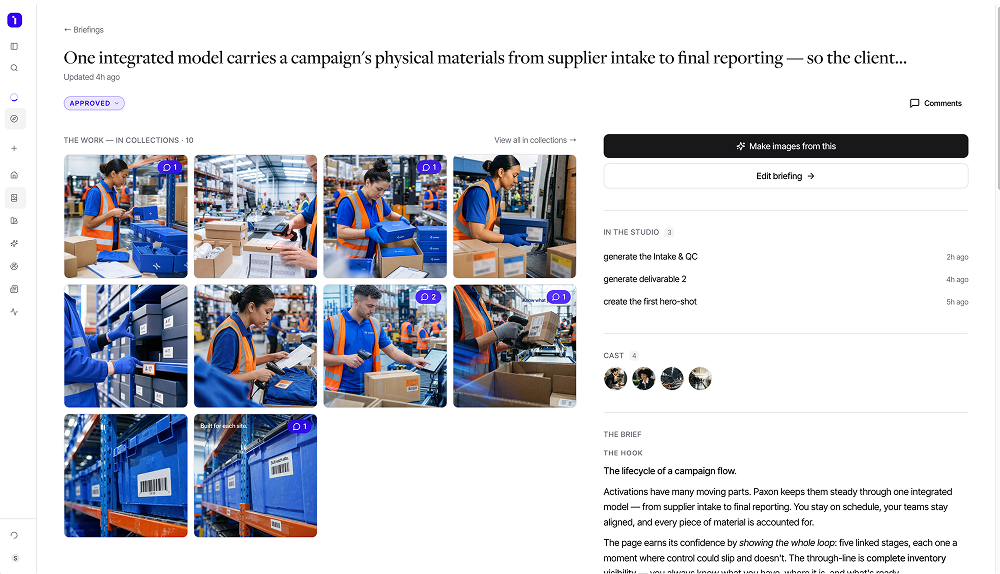
Ultimately, by managing the entire process end-to-end from a centralized brand repository, "Brand Engine" not only enables clients to produce consistent, brand-compliant content, but also streamlines and industrializes a historically fragmented creative process, improving the overall efficiency of marketing strategies and teams alike.
Building on this success, Inku already has a busy roadmap for the coming months, structured around three main pillars: reinforcing generation capabilities, embedding performance measurement into core processes, and moving toward full marketing orchestration. Eventually, the objective is to transform the platform into a true marketing orchestration system capable of autonomously generating, analyzing, and improving content.
"Today, many players use AI to produce more content. Our ambition is different: we want to help brands produce better content by embedding their identity at the heart of every asset. The challenge is not just to generate, but to ensure that every communication piece strengthens the brand and genuinely contributes to its performance. Google Cloud plays a key role in this approach: as an accelerator, its managed services allow us to move fast and focus on our core business while guaranteeing the absolute robustness of our platform," concludes Gus Vanherf.
The challenge is not just to generate, but to ensure that every communication piece strengthens the brand and genuinely contributes to its performance. Google Cloud plays a key role in this approach: as an accelerator, its managed services allow us to move fast and focus on our core business while guaranteeing the absolute robustness of our platform.
Gus Vanherf
Co-founder and CEO, Inku
A Belgian company founded in 2026, Inku aims to transform brand content creation by making it more consistent, faster, and easier to industrialize. Designed to meet the exploding visual needs of marketing teams, its platform relies on an AI trained on each brand's unique DNA, ensuring content is always faithful to its identity. This enables companies to move from brief to campaign in just a few days, delivering significant gains in costs, speed, and quality.
Industry: Marketing
Location: Belgium
Products: Google Kubernetes Engine (GKE), Cloud Run, Gemini Enterprise Agent Platform, Cloud SQL, Cloud Storage, Firebase Authentication