
Health list deployment cut from three months to 15 days
Data pipeline execution reduced from 20 hours to 4 to 5
Monthly data traffic reduced by four times
Scaled from 65 to 330 municipalities on the same infrastructure
Infrastructure costs expected to drop by up to 60%
ImpulsoGov rebuilt on Google Cloud to cut deployment 6x and scale preventive care to four million Brazilians.
ImpulsoGov rebuilt on Google Cloud to cut deployment 6x and scale preventive care to four million Brazilians.

Rebuilding a public health data platform
to save more lives, faster
ImpulsoGov is a Brazilian nonprofit healthtech that turns public health data into action. Brazil's universal health system covers 210 million people and holds the world's largest public health database. Yet despite this wealth of information, a preventable death occurs every nine minutes. ImpulsoGov's mission is to close that gap, helping municipalities use the data they already have to identify and reach the citizens who need care before it is too late.
Today the organization operates across more than 330 municipalities in 25 Brazilian states, reaching four million citizens directly at a cost of just 70 cents per person. Their organizational goal is bold: to go from saving one life every 2.3 days to saving one life every hour. "To close that gap, we need a data platform that is reliable and that lets us generate impact and save lives in hours, not months," says Victor Souza, chief technology officer.
The infrastructure the organization had built wasn’t going to get them there. ImpulsoGov had always used Google Cloud, but alongside external services including a separate cloud provider, and was underusing the tools already available to them. As the number of municipalities grew, the original architecture could no longer keep pace: every day, it required a full data pull from all municipalities, rather than processing only incremental changes. A single database was handling workloads it wasn’t designed for, processing times were growing, costs were rising faster than the municipality base, and the team had no visibility into how much each city or each health condition was actually costing them. "With 65 municipalities the model was reaching its limit," Souza explains. "With 330 or more, it becomes mission impossible."
The decision wasn’t to change providers, but to finally use Google Cloud the way it was designed to be used, with support from the Google team and participation in the Google for Nonprofits program helping make it possible.

Processing sensitive health data faster
to reach more patients sooner
As ImpulsoGov rebuilt its data infrastructure on Google Cloud, municipal health records began flowing through the new architecture. Those records now arrive daily through a transmitter application installed in each city, running into Cloud Storage as raw data.
From there, an orchestrator running on Google Kubernetes Engine (GKE) manages the entire pipeline, processing and refining the data through a Medallion architecture, with bronze data in Cloud Storage and silver and gold layers in BigQuery.
Cloud Run and Cloud SQL support the applications that deliver the final data to healthcare professionals.
The shift to transmitting only daily changes reduced monthly data traffic by four times and cut pipeline execution time from 20 hours to 12, with a target of four to five hours once the full migration is complete.
Security was rebuilt alongside the architecture. All resources run in São Paulo, keeping citizen data in Brazilian territory. Access to sensitive production data requires justification and expires automatically, with a full audit trail for every access request.
Separate production and non-production environments ensure developers can build and test without ever touching real patient records. "Since the beginning we have been very careful with this nominal health data," says Alexsandro Santos, data coordinator and tech lead. "Every action we took was to guarantee that security."
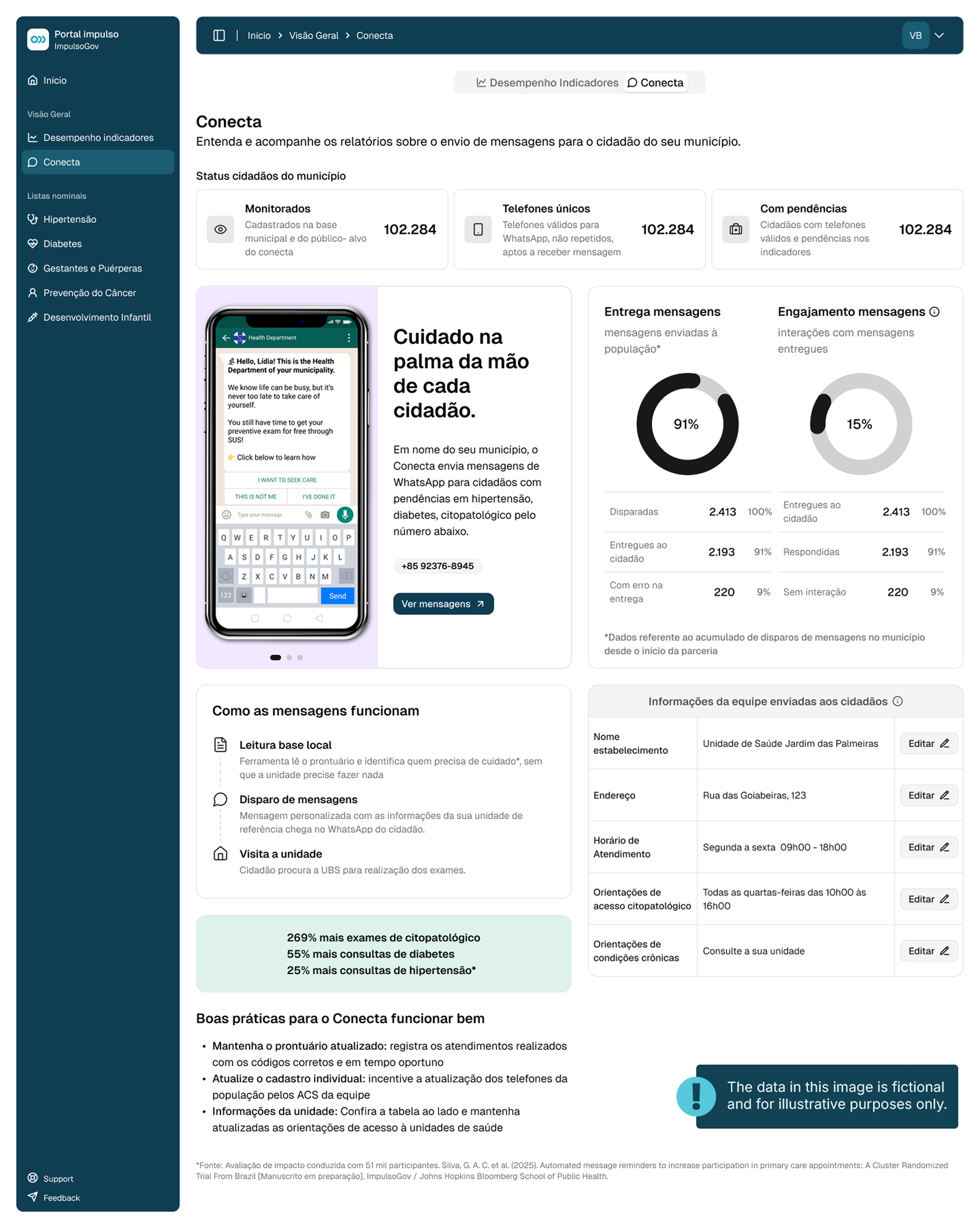
The result for healthcare professionals was immediate. Deploying a new health monitoring list dropped from three months to 15 days. Lídia, a woman from the interior of Ceará, had not done a cervical cancer screening in over 10 years. ImpulsoGov's messaging platform identified her as overdue and sent a WhatsApp reminder. She went to her local clinic, was found to have precancerous lesions, and was referred for surgery in time to reverse the diagnosis.
Having Google's team available to review our architecture, give us feedback, and tell us if something makes sense or not is very important to us. That proximity, alongside the platform itself, is what gives us the confidence to handle the health data of millions of citizens responsibly.
Victor Souza
Chief Technology Officer, ImpulsoGov
A randomized clinical trial with more than 35,000 people confirmed that sending that message alone increases preventive procedure completion rates by four times.
Scaling to save a life every hour through data, technology, and prevention

The numbers tell part of the story. Data pipeline failures that once occurred weekly and took up to five days to resolve are now rare and resolved in one to two days. The organization expects to reduce total infrastructure costs by up to 60% while running comfortably at 330 municipalities and ready to scale further.
The speed of the platform is itself a form of care. "When we are fast, it creates a cycle of engagement," says Helena Alves, tech product manager and analytics engineering lead. "Health professionals use the platform more frequently and incorporate it more into their routines. And that generates more impact on the health of the population."
That engagement is what turns a technology platform into a public health tool, shifting the entire model from reactive treatment to proactive prevention, the principle behind “Busca Ativa” (active case-finding), a public health strategy in Brazil's national health system that ImpulsoGov's technology helps put into practice.
The next frontier is predictive care. ImpulsoGov is building machine learning models that will assign a risk score to each citizen based on their health data, allowing healthcare professionals to prioritize the patients most likely to deteriorate without intervention. That capability, built on the same Google Cloud infrastructure now supporting 330 municipalities, will allow the organization to move from monitoring to genuine prevention at scale.
For Souza, the partnership with Google is what makes the mission possible. "It helps us keep the health data of millions of people secure and use the best available technology in service of those who need it most," he says. "We want to reach the balance where our data platform generates impact and saves lives in hours, not months. Google Cloud is what makes that possible."
This partnership with Google supports us in generating real change in the lives of the Brazilian population. It helps us keep the health data of millions of people secure and use the best available technology in service of those who need it most.
Victor Souza
Chief Technology Officer, ImpulsoGov
ImpulsoGov is a Brazilian nonprofit healthtech that helps municipalities use public health data to reach citizens proactively, supporting four million people across more than 330 municipalities.
Industry: Non-Profit
Location: Brazil
Products: BigQuery, Cloud Run, Cloud SQL, Cloud Storage, Google Kubernetes Engine (GKE), Google Workspace