30+ LLMs trained with a total of 5+ trillion parameters
270M+ patient interactions, zero safety incidents, and 8.9 out of 10 average satisfaction rating for patient interaction
Hundreds of engineering and maintenance hours saved monthly
Millions of model safety evaluations performed with Gemma and < 500ms TTFT and <1.5s turn-to-turn latency for voice conversations
Better care, improved outcomes, and hours returned to nursing
Hippocratic AI is partnering with Google Cloud to create healthcare abundance through infinite hours of patient care.
Hippocratic AI is partnering with Google Cloud to create healthcare abundance through infinite hours of patient care.
Diagnosing the healthcare worker shortfall
Hippocratic AI, a global leader and pioneer in safety-focused AI agents for healthcare, launched with a mission to improve patient care while helping address one of the industry’s most critical challenges: a growing global shortage of 15 million healthcare workers. Human clinical staff are already stretched thin caring for the individuals right in front of them, let alone trying to keep up with other non-diagnostic interactions—from follow-ups after a visit and routine check-ins to ongoing communications.
While generative AI is already reshaping the industry, conventional chatbots offer little relief to hospitals and healthcare providers beyond answering basic questions.
Our AI is able to scale that clinical outreach so that we can contact every single patient. We're able to take that off the plates of human clinicians, so they can focus on bedside care and clinical decision-making.
Vishal Parikh
Co-founder and Chief Product Officer, Hippocratic AI
They can’t access health records, lack specialized knowledge, and don’t have the clinical reasoning or empathy to handle complex medical scenarios. Hippocratic AI’s solution is voice AI, capable of having real conversations with real patients and delivering advanced care.
“Our AI is able to scale that clinical outreach so that we can contact every single patient,” explains Vishal Parikh, Hippocratic AI’s co-founder and chief product officer. “We're able to deliver patient care using well over 50 clinical skills. We do this conversationally, not just in text but in voice, so the patient can have a natural, free-flowing conversation.”
To bring healthcare abundance to everyone, Hippocratic AI developed Polaris—a groundbreaking constellation architecture of more than 30 specialized large language models (LLMs), built on hundreds of millions of real-world patient interactions and tested by more than 7,500 licensed human clinicians. Behind the scenes, Google Cloud’s AI infrastructure supports the delivery of natural, human-like voice conversations while protecting patient safety at the highest level.
Giving AI a voice for natural dialogue at scale
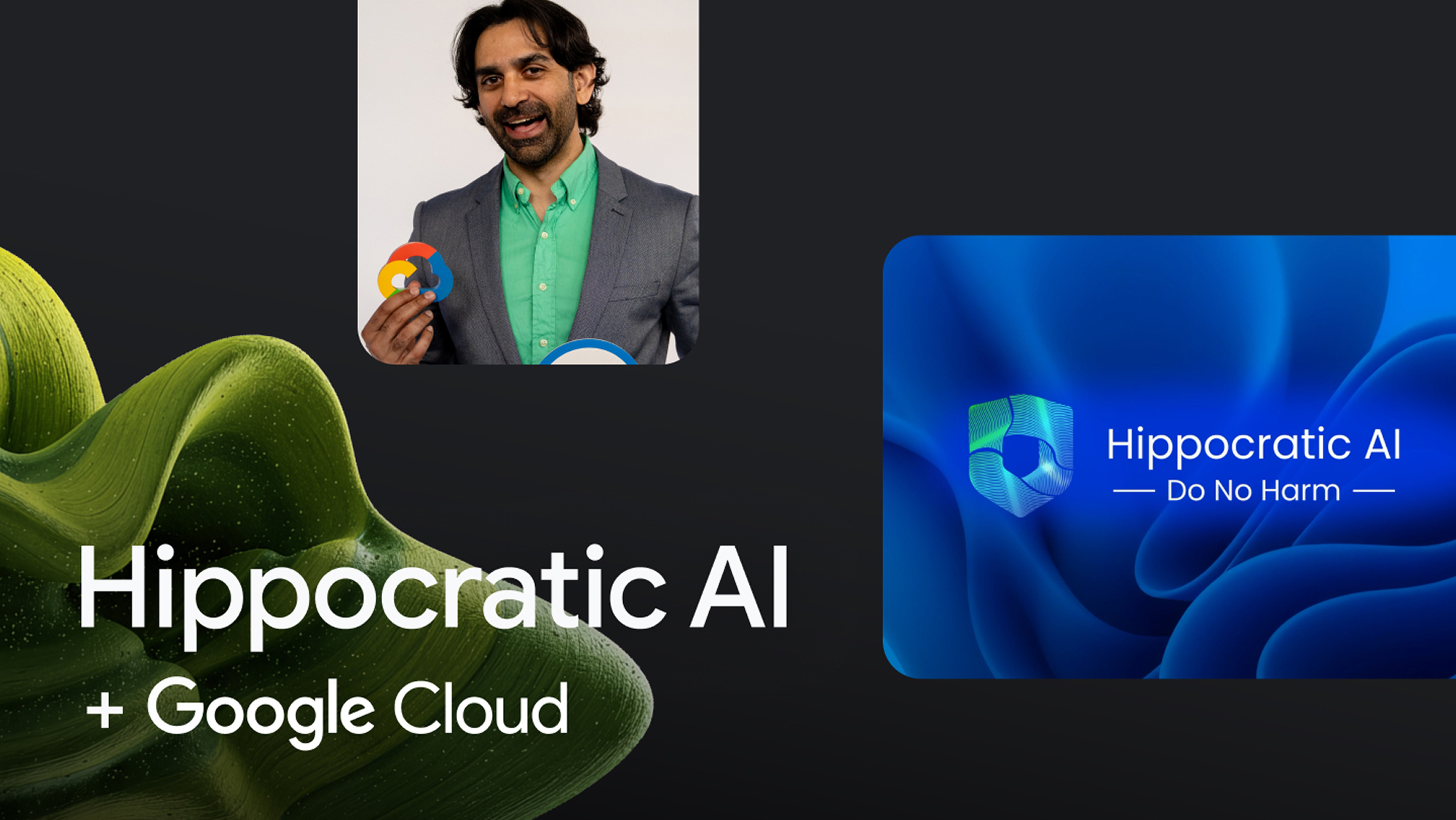
GKE has given us the ability to actually deliver a large-scale system with a time-to-first-token under 500 milliseconds and an average turn-to-turn latency of around 1.5 seconds, which gives you both the safety and the real-time conversational experience.
Vishal Parikh
Co-founder and Chief Product Officer, Hippocratic AI
Powering an agentic architecture like Polaris called for flexible, open AI infrastructure that could adapt to custom frameworks, hardware, and model routing.
“To provide safety, we have to run five trillion parameters over 30 models on every conversational turn, and delivering that within a real-time, voice-based latency constraint is incredibly challenging,” Parikh shares.
Compounding this complexity was the fluctuation in demand, which surged during daytime hours and dropped off overnight. Hippocratic AI needed to be able to scale dynamically to process real-time AI workloads without constant, manual oversight or paying for idle capacity. However, traditional approaches proved operationally burdensome as well as prohibitively costly.
To address these challenges, Hippocratic AI anchored Polaris on AI Hypercomputer, Google’s AI-optimized infrastructure built for the agentic era. Specifically, Google Kubernetes Engine (GKE) and flexible consumption options like Dynamic Workload Scheduler allowed the team to automate scaling, both on a schedule and in response to real-time demand, saving hundreds of engineering hours every month. Crucially, according to Parikh, GKE’s native extensions and integrations also help speed up request routing and model loading, preventing lags that can impact patient care.
“GKE helps us deliver a large-scale system with a time-to-first-token under 500 milliseconds and an average turn-to-turn latency of around 1.5 seconds, which gives you both the safety and the real-time conversational experience,” he reports. This strong foundation ensures AI agents are always available when patients need them, but agility and reliability are only half the equation. By building on Google Cloud, Hippocratic AI also inherits a secure-by-design platform, including built-in trust and governance to meet the rigorous compliance standards required to operate safely at scale.
“Google Cloud has allowed us to run with much lower maintenance and engineering overhead but also maintain the security and real-time constraints that we need,” Parikh says.
Building trust and confidence without compromise
In an agentic system, every component is highly interconnected. Even the most minor edits to prompts could inadvertently trigger unintended consequences. To achieve velocity without compromising patient safety, Hippocratic AI uses Gemma, Google’s most advanced open models to help validate its proprietary AI models, as an objective “internal critic” to test, evaluate, and validate its proprietary AI models.
“Gemma has been instrumental in orchestrating our testing. When you have a world-class reasoning model in healthcare, you need another world-class reasoning model to test that model,” Parikh notes. “We run millions of evaluations with a goal of over a billion. That's our safety bar made operational.”
While human clinicians retain final oversight, Gemma handles the intermediate evaluation stages, rapidly analyzing every clinical conversation against 36 critique dimensions, from transfer failures to medication adherence and scheduling hallucinations. Gemma’s advanced reasoning capabilities excel at picking up on the nuances of clinical language, such as a patient hedging or an escalation hidden in small talk.
This tight feedback loop helps fine-tune models for safety, clinical reasoning, and conversational accuracy, enabling Hippocratic AI to launch more than a thousand AI agents for healthcare settings. This strategic approach is already proving successful, creating the natural conversational cadence that puts patients at ease. On average, agents receive 8.9 out of 10 satisfaction ratings.
Gemma has been instrumental in orchestrating our testing. When you have a world-class reasoning model in healthcare, you need another world-class reasoning model to test that model. We run millions of evaluations with a goal of over a billion. That’s our safety bar made operational.
Vishal Parikh
Co-founder and Chief Product Officer, Hippocratic AI
“We view ourselves as a massive accelerator for human clinicians. We can check in with patients monthly, weekly, even daily—and if the patient does have a real clinical need, we do bring a human in the loop,” Parikh concludes. “We're able to take that off the plates of human clinicians, so they can focus on bedside care and decision-making.”
Hippocratic AI, a global leader and pioneer in safety-focused generative AI agents for healthcare, is on a mission to address the global shortage of clinicians and deliver healthcare abundance. The company built a patented safety constellation architecture, Polaris, enabling non-diagnostic AI agents to support patients through natural conversations across a range of use cases.
Industry: Healthcare
Location: United States
Products: AI Hypercomputer, Google Kubernetes Engine (GKE), Gemma