
Scaled from zero to 3.4 million builders across 200 countries on a single Firestore database
More than 250 million end users using apps built with FlutterFlow
Zero outages over five years while serving more than 750 billion reads and 75 billion writes on Firestore
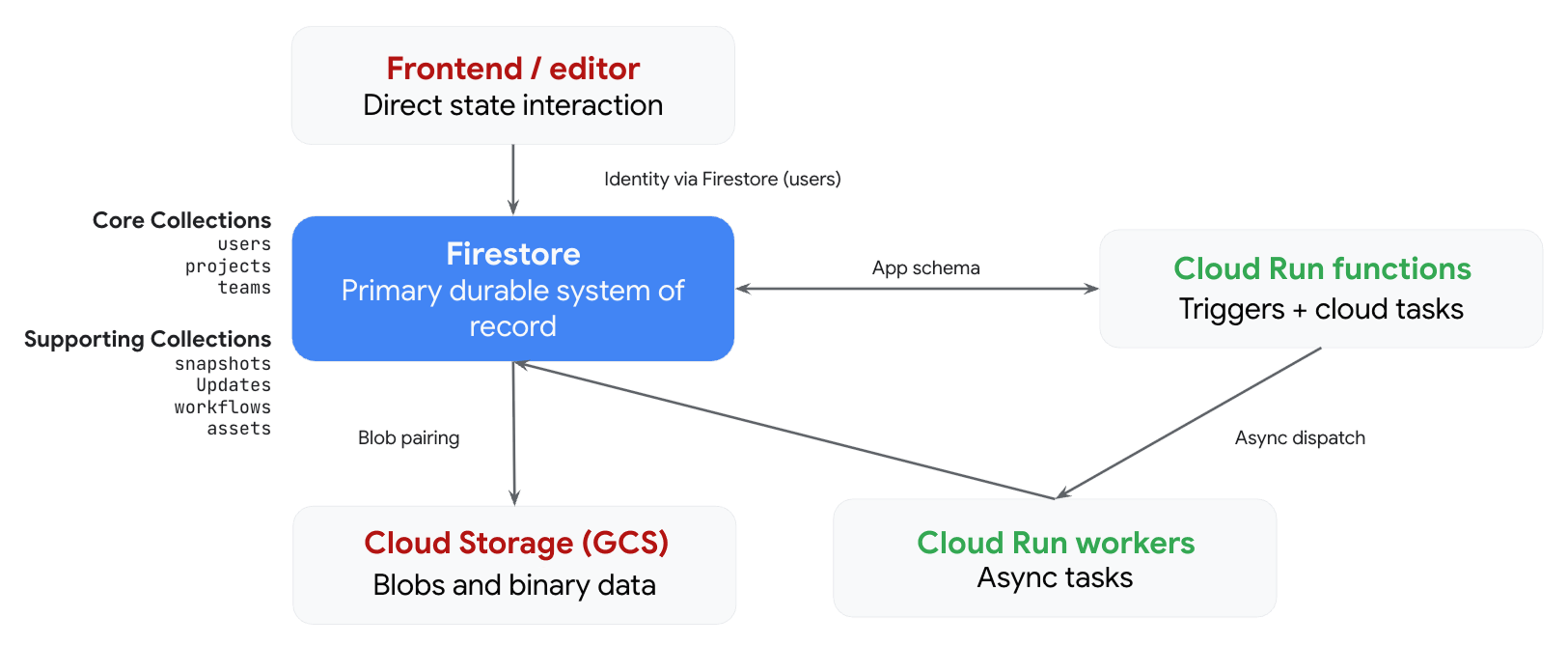
Persistent Firestore state powers AI-native workflows across FlutterFlow MCP, FlutterFlow Test Mode, and FlutterFlow Designer
FlutterFlow’s products utilize Firestore’s native real-time sync features to enable collaboration at production scale for teams building together
FlutterFlow set out to remove the technical barrier between builders and their products. Firestore became the foundation that let the company scale from zero to 3.4 million builders while serving more than 750 billion reads without outages for five years.
FlutterFlow set out to remove the technical barrier between builders and their products. Firestore became the foundation that let the company scale from zero to 3.4 million builders while serving more than 750 billion reads without outages for five years.
The knowledge barrier that decided
who was able to build new applications
When Abel Mengistu’s cousin set out to build an audiobook platform for Amharic literature, he successfully tackled operational hurdles by securing licensing and recording the content. Yet, despite investing over a year of his life and six figures of his own savings, the actual mobile app remained an unfinished roadblock that stalled his launch.
"The part that always stuck with me," said Abel, "is that the product shouldn't have been the hardest part. Getting the licensing done, getting the content in place…that was the real work. The app should have been the easy part. But it wasn't."
Almost everyone knows a story like this: someone with deep knowledge of a community, an industry, or a problem who runs into technology and stops. They know exactly what should exist, but they simply can't build it.
Not because the idea isn't valuable, but because the technical barrier is too high.
That is the barrier that FlutterFlow was built to remove.
When Abel Mengistu and Alex Greaves founded FlutterFlow in 2021, they needed infrastructure that could match that mission: invisible, reliable, and scalable from day one.
Firestore let the team get started immediately. It scaled without a dedicated infrastructure team. Its flexible document model evolved alongside the product. Real-time listeners made collaborative experiences possible from the beginning, laying the foundation for everything FlutterFlow would build next.
Firestore has been the foundational database for FlutterFlow. We are true believers in Firestore.
Abel Mengistu
CEO and Co-founder, FlutterFlow
The hardest problem FlutterFlow solved
was inside the builder itself
The most technically demanding use of Firestore isn't inside a customer's app.
It's inside FlutterFlow itself.
Real-time collaboration runs on Firestore's real-time listeners. Multiple developers can edit the same FlutterFlow project simultaneously, with every change synchronized instantly and no one's work overwritten.
That same infrastructure now powers FlutterFlow's newest AI-native products.
- FlutterFlow MCP lets developers bring any AI agent (Claude Code, Gemini CLI, Cursor, Codex) directly into the FlutterFlow canvas. Firestore carries the context those agents need between sessions. The agent that knew the codebase yesterday knows it today: not because it was briefed again, but because Firestore held the real-time state.
- FlutterFlow Designer, the AI-native visual design tool, uses Firestore for real-time multiplayer collaboration. Multiple designers, developers, and AI agents work on the same canvas simultaneously, with changes across users synced instantly.
As software shifts from specifications to prompts, data models have to evolve just as quickly. Firestore's flexible document model handles changing data naturally, without schema migrations, downtime, or operational overhead slowing product development.
Keeping state changes in sync across multiple users, without overriding anyone's work, was the most technically tricky challenge we solved with Firestore. It's what made real-time collaboration possible.
Abel Mengistu
CEO and Co-founder, FlutterFlow
How Firestore powers FlutterFlow’s
real-time Test Mode
FlutterFlow continues to build on its generative AI solutions to better serve developers and data needs.
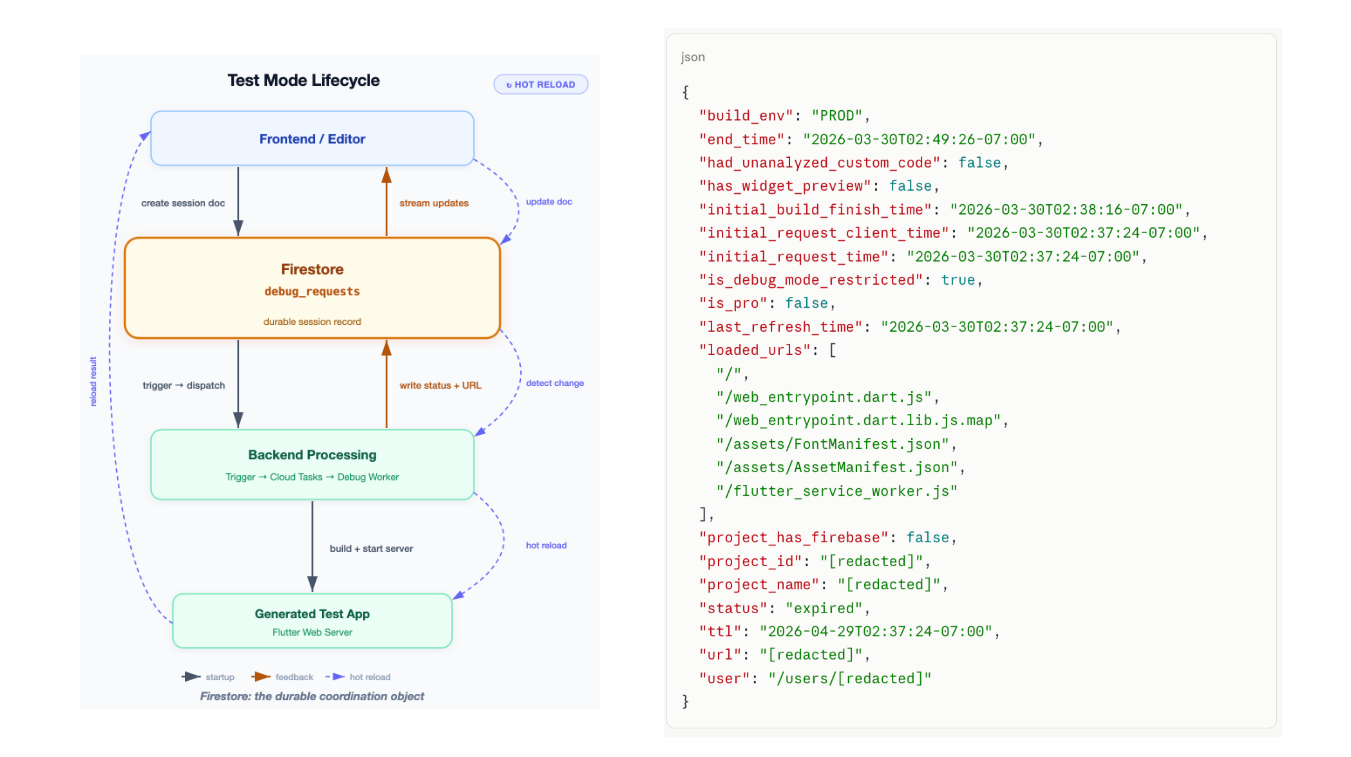
FlutterFlow Test Mode uses Firestore as the durable coordination layer for every test session. When a builder starts a test run, Firestore creates a session document in debug_requests that the frontend, backend, and generated app all read from and write to simultaneously.
The backend writes build status and the app URL back to that document. The frontend streams updates from it in real-time. Hot reloads are triggered through it. The session persists across devices and survives reconnections.
The diagram follows a single Test Mode session from start to finish.
When a builder clicks Run, the Frontend/Editor creates a session document in Firestore's debug_requests collection. The Backend Processing layer picks it up, builds the app, starts the Flutter Web Server, and writes the app URL and build status.
The Generated Test App reads the app URL and writes hot reload triggers as the session progresses. Meanwhile, the Frontend/Editor streams every status change to the builder in real time.
The JSON panel on the right shows the production document: build environment, timestamps, loaded URLs, session status, TTL, and the user reference.
Every field shown is written by one system and consumed by another.
What does 750 billion reads actually mean?
FlutterFlow's database has now processed more than 750 billion reads.
It's a number that is difficult to imagine.
Behind every read is someone building, opening a project, previewing a screen, adjusting a component, reviewing a teammate's work, and deploying to production.
Each read represents a builder turning an idea into software.
More than 750 billion of those moments.
Today, more than 250 million people use applications built with FlutterFlow and backed by Firestore.
In a way, every one of those 750 billion reads represents someone who didn't run into the same barrier that inspired FlutterFlow in the first place.
Someone who shipped.
Someone who built something their community needed.
Someone whose infrastructure stayed invisible because it was reliable, scalable, and simply worked.
750 billion reads represents hundreds of millions of hours of builders spending time creating their projects on FlutterFlow. Every read is someone in the middle of building something they care about.
Abel Mengistu
CEO and Co-founder, FlutterFlow
FlutterFlow is the visual interface between human judgment and AI execution, enabling 3.4 million builders across 200 countries to design, build, and ship production-grade, cross-platform applications.
Industry: Technology
Location: United States
Products: Firestore, Firebase Authentication, Cloud Run functions, Firebase AI Logic (Gemini), FlutterFlow, FlutterFlow Designer, FlutterFlow MCP