Wayne State University and Syntasa: Transforming public health assessments with AI
Austin Adams
Director, Partners, Google Public Sector
Michael Finn
SVP of Public Sector, Syntasa
When it comes to public health, having a clear picture of a community’s needs is vital. These insights help officials secure crucial funding, launch new initiatives, and ultimately improve people’s lives.
That is the idea that inspired Dr. Phillip Levy, M.D., M.P.H., Professor of Emergency Medicine and Associate Vice President for Population Health and Translational Science at Wayne State University and his colleagues to develop Project PHOENIX: the Population Health OutcomEs aNd iNnformation eXchange. PHOENIX ingests information from electronic health records including demographic data, blood pressures and clinical diagnosis, and combines this with social and environmental factors from more than 70 anonymized data sources into an integrated virtual warehouse. Researchers, advocates,community leaders, and policy makers are able to use this data to better understand how different factors correlate to health outcomes and design targeted interventions.
With such functionality, the PHOENIX team recognized the potential to transform the Community Health Needs Assessment (CHNA) process. Required by the federal government, public health departments, nonprofit hospitals, and Federally Qualified Health Centers in the United States must complete a CHNA every three years—a largely manual, time-consuming task that can take up to a year to complete.
That’s where a collaboration between Wayne State University, Google Public Sector, and Syntasa came in. They teamed up to create CHNA 2.0, an innovative solution that drastically cuts down the time it takes to create these vital reports. By combining PHOENIX data with Vertex AI Platform, CHNA 2.0 can deliver a complete CHNA in a matter of weeks, giving health leaders valuable insights more quickly than ever.
Extracting community sentiment from public data
One of the most challenging parts of drafting a CHNA report involves conducting in-depth surveys to understand conditions in the community. This is often the most time-consuming part of the process, as it takes months to create, review, run, and analyze insightful surveys. By the time a CHNA report is complete, data from the surveys might be nearly a year out of date, which can prevent organizations from making a meaningful impact on their communities.
CHNA 2.0 uses public health data from the PHOENIX warehouse along with insights from Syntasa Sentiment Analytics, which combines information from surveys with real-time data from Google Search and social media posts. Syntasa Sentiment Analytics provides insights regarding the questions people are asking and what issues they’re posting about to uncover health-related problems affecting a given community, such as growing concerns about asthma or frustrations with long waits at clinics.
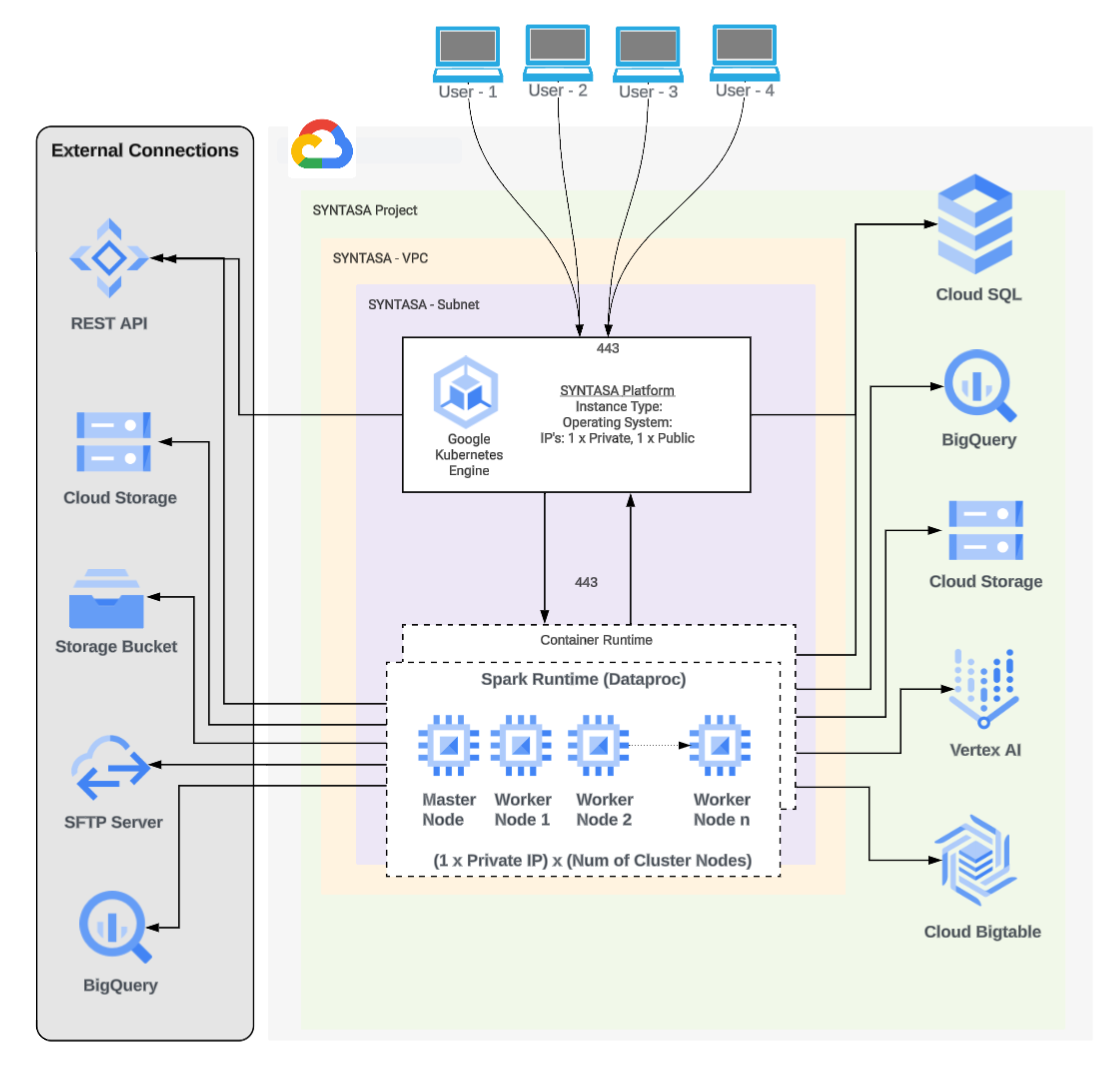
The architecture for this solution was built on the Syntasa Data + AI Platform. Workloads run on Google Kubernetes Engine (GKE) for its scalability, allowing the platform to process incoming sentiment data quickly. The platform also uses Cloud SQL and Google Cloud Storage as part of its data foundation, with BigQuery doing the heavy lifting for sentiment analysis. BigQuery provides the performance, efficiency, and versatility needed to handle large datasets of search and social media information efficiently.
Creating reports with the power of humans + AI
After gathering the necessary information, CHNA 2.0 uses Vertex AI and Gemini to help analysts create the report in less time. CHNA reports are highly complex and lengthy – and require manually integrating multiple data elements. Syntasa solved this challenge by breaking down the report into smaller, more manageable tasks and bringing human oversight into the loop.
Now the person in charge of handling the CHNA defines the report’s structure. Gemini extracts insights from tailored datasets and fills in the relevant details. By combining both human and AI intelligence, CHNA 2.0 delivers reports in a fraction of the time.
Organizations can also use this method to deliver a living document that is constantly updated with fresh data. This means public health officials don’t have to wait years to understand their communities—they can access the latest insights at any time to make faster and more impactful decisions.The net result is a transformation of the CHNA process from static to dynamic, enabling real time, data driven decision making for the betterment of all.
Supporting public health with technology
The City of Dearborn, Michigan, became the first to use CHNA 2.0 to great success. The long-term vision is to bring this same capability to other cities and counties in Michigan and across the nation.
This project with Wayne State University and Syntasa showcases how the right technology and a strategic partner can create a powerful, scalable solution to a long-standing public sector challenge. By partnering with Google Public Sector to leverage the most advanced AI and data tools, Wayne State not only automated a critical process, but also empowered public health officials to better serve their communities.
From improving community health to modernizing infrastructure, discover how technology is transforming the public sector. Sign up for our newsletter to stay informed on the latest trends and solutions.