Tokenomics: Why smart teams spend more on AI, on purpose
Eric Lam
Head of Value, Delta, Google Cloud Consulting
Disciplined organizations are moving past reactive sticker shock over AI bills and embracing tokenomics. They're building visibility to understand their AI not as a static license cost but as a variable, measurable business lever.
A few months ago, my team and I sat in on a budget review that felt more like an autopsy.
A customer's AI spend had jumped more than 50% in a single month, and the leaders wanted to know why. Who was the top offender? Which team, which project, which agent? Because no guardrails or frameworks were in place when the organization started using AI, there was no clear or definitive answer on their spending. Finance could only look backward and guess.
Conversations like these are becoming common across the industry, as organizations wrestle with their AI spend. Concepts like AI leaderboards and “tokenmaxxing” have become popular, but they often distract from the real potential behind the AI at work.
In our case, as in many others, the size of the bill wasn't the real story. The issue wasn't that this company had spent too much — the issue was that they had spent too enthusiastically, without the visibility or care that typically comes with technology spending.
Not that such measurements are easy or straightforward. Accurate AI forecasting takes a new approach, just as these new tools do. And with nearly every company in every industry racing to embrace AI and balance the costs of doing so, leadership and finance can feel trapped by the need to invest to remain competitive. But it’s hard to steer when going full throttle.
That’s why the companies pulling ahead with AI haven’t stopped spending. What they have changed is that they’re more closely and carefully tracking, and appreciating, what each dollar buys. That visibility is precisely what lets them spend more, on purpose and with purpose.
In a word, they have embraced tokenomics.
The unit of cost has changed
For years, technology spend was something you could plan around. Licenses and headcount are static and predictable. You buy a seat, you know the price, and no license bill sends anyone hunting for a top offender.
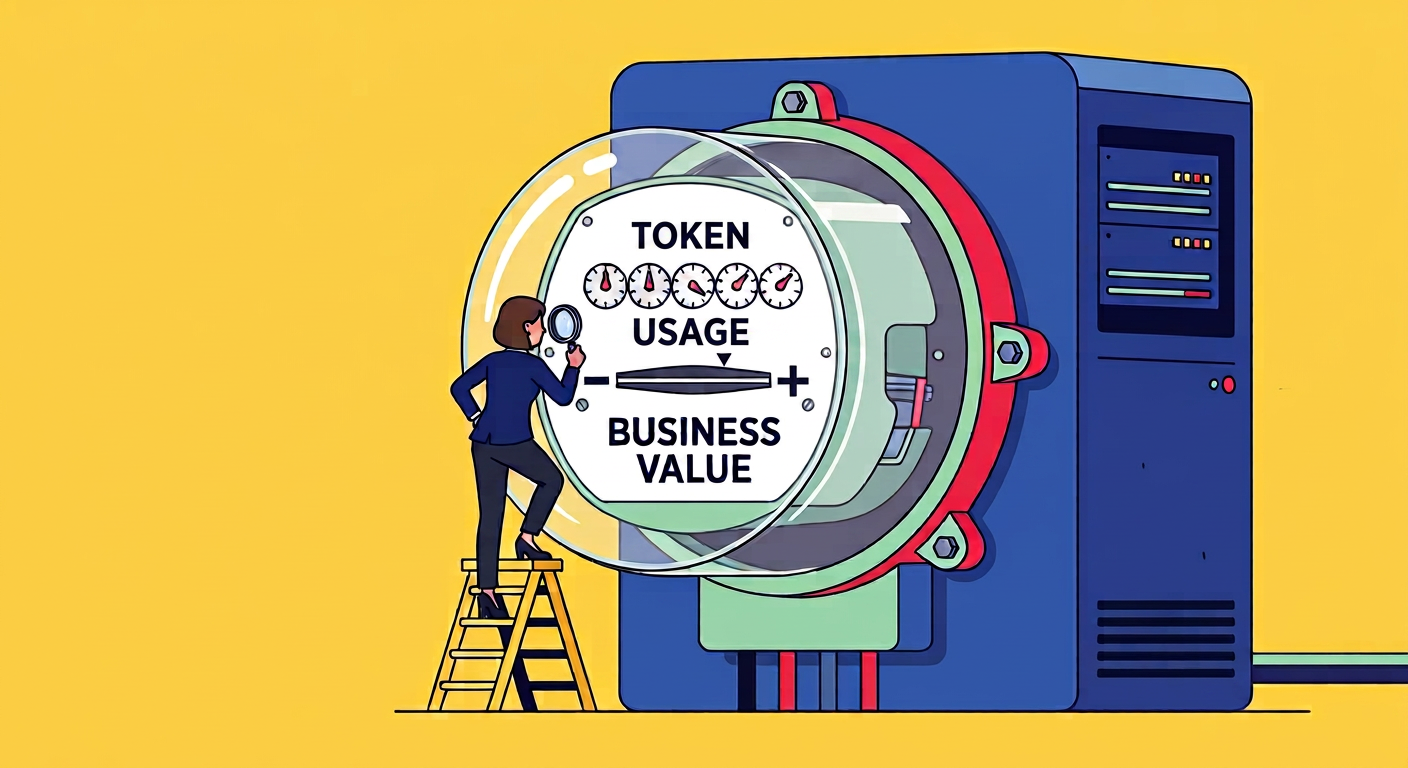
Token pricing for AI is different. The fundamental unit of AI computing, a token is a fragment of text or data, roughly equal to four written characters. Every prompt and response runs up a live charge, a little like the kilowatt-hours on an electric meter. In a sense, the old model was like only needing to know how many light bulbs your team needed, whereas now you have to understand who’s flipping the light switches, how often, and if they’re even illuminating things of value to the business when they’re firing those filaments (or tokens, to be precise).
Furthermore, because the models keep no memory between turns, they re-read the whole conversation each time, so costs can compound as the work gets more involved. A simple chatbot exchange might run a couple thousand tokens. An agent working through an engineering task can run a couple million tokens. The technology is identical, but the counts can differ a thousandfold.
Costs that behave like this are almost impossible to manage with tools designed for steady, predictable spend.
Why the old playbook needs a rewrite
Cloud FinOps evolved in a world of compute hours: workloads you could schedule, spend you could forecast, and bills that held roughly steady month to month. Agentic AI scrambles those assumptions. Cost now depends on how much context a model carries and how many loops an agent takes to finish a job; the same task rarely costs the same twice. The deterministic tools finance has relied on were never built for this.
Even experienced FinOps teams are sometimes surprised by how little the raw bill reveals. The token invoice is only the visible tip. The full technology layer you can see (tokens plus the licenses, platform, and compute around them) often accounts for only about a third of the real total.

Below this sit the parts the bill doesn’t itemize: the work to build and integrate the system, the governance and controls to run it safely, the people who still review what the agents produce, and the upkeep to keep it all current. Across many AI initiatives, those layers add up to more than the tokens themselves, and the only way to account for them is to model the full picture up front, since they never appear on an invoice.
Even the spend that does appear there doesn't explain itself. Without end-to-end traceability that ties each charge back to what every agent, model, and tool actually did, you can't tell which of them ran up the bill.
From counting tokens to cost per outcome
Picture an enterprise moving a large retrieval-augmented generation (RAG) pipeline into production, the kind that grounds its answers in a company's own data. The bill spikes, and leadership panics at the raw infrastructure line item.
Then the team lays business metrics over that cost, and the mood in the room shifts.
Say the overlay shows a 20% rise in token spend lining up with a 40% drop in customer support handle time. Same bill, different meaning, because now people can understand it.
Cost discipline comes down to knowing how and where to spend to maximize the return on each dollar. Companies get there in three stages:
- Make AI spend visible. Know where every dollar goes.
- Define unit economics. Know the real cost per interaction.
- Connect spend to business value. Know what the spend actually bought.
Token bills tell you what you spent. Cost per outcome tells you why. Once a company can answer "What did this buy?" it can make sharper investment decisions.
Growing a fleet of enterprise agents sustainably also means budgeting for it deliberately: one budget for the daily cost of running agents, and a separate one for improving them. Teams that split the two avoid the "maintenance trap" of spending everything on upkeep.
While creating agents is inexpensive, the manual maintenance required when edge cases or prompt drift occur scales with a punishing 100x difficulty curve. An optimization budget solves this by funding autonomous self-evolution, allowing systems to adapt to drift without the need for manual engineering intervention.
Why the disciplined teams spend more
The teams furthest along often spend more once they can measure cost per outcome. CFOs don't hate spending money. They hate unquantifiable and unmanaged financial risk. Remove the risk and prove the return, and the reins loosen. When the ROI becomes clear, CFOs may even encourage spending more.
One technology company asked us to measure the return on their token consumption against the metrics they cared about most: revenue, feature adoption, user growth and engagement, and content viewership. That turned their AI bill from a worry into a roadmap, and showed them which segments and features deserved more of the budget.
Token bills tell you only what you spent. Cost-per-outcome tells you why. Once a company masters that distinction, the bill stops being a worry and becomes a roadmap.
You can see the same discipline in a large multinational healthcare organization we're working with, as it prepares to scale its AI use cases roughly 5X across a multi-agent system. At that size, estimating cost per query gets genuinely hard, so before scaling, the team built the visibility layer first. They did this by putting attribution in place that traced cost and latency down to the tokens each model consumed, across every subagent and tool call.
Now they’re ready. They estimate cost per query about five-times faster than before, and their sales and delivery teams share a baseline to plan against. They will know what the next phase costs before they commit to it. This is a company choosing proactive prescriptions over a costly autopsy later.
Give your developers room to run
The teams building cost attribution and governance early do it so they can give developers unthrottled access safely, with the right cost controls in place. Governance, done well, is what makes confident spending possible.
The advantage no longer comes from adopting AI first; it comes from adopting it fast, alongside the right cost-management structure and good discipline.
If you’re looking to define and build a full-cost model for your agentic AI use cases and turn visibility into value, Delta is here to help. We’re Google Cloud Consulting’s forward-deployed engineering practice focused on maximizing business value, and we’ve helped numerous organizations get a handle on their AI spend.