How AI ROI Leaders prioritize investments for real business outcomes
Oliver Parker
VP, Global Generative AI GTM, Google Cloud
New survey of 2,400 executives shows how world-class organizations are deriving value and driving cost-effective growth with AI.
Every day, when we’re working with our customers, a common question comes up: Where can we derive the best value from AI?
With AI spending making headlines and driving social conversation, it’s no surprise there’s renewed interest in AI’s ROI. In fact, Google Trends data shows there’s been four-times more interest in "token efficiency" than "tokenmaxxing" or "token leaderboards" since January 2026.
We’re seeing this first-hand with Google Cloud customers large and small, all around the world. They grasp the importance of not simply investing in AI but prioritizing AI investments for real business outcomes. And they are becoming particularly adept with measurement to ensure their ROI is captured and reinvested in the right places. That value is evident in the types of AI projects these organizations are undertaking.
And there’s new research validating what we’re hearing directly from customers. Google Cloud, working with the National Research Group, just completed our third annual survey of executives sharing their organization’s experience with AI.
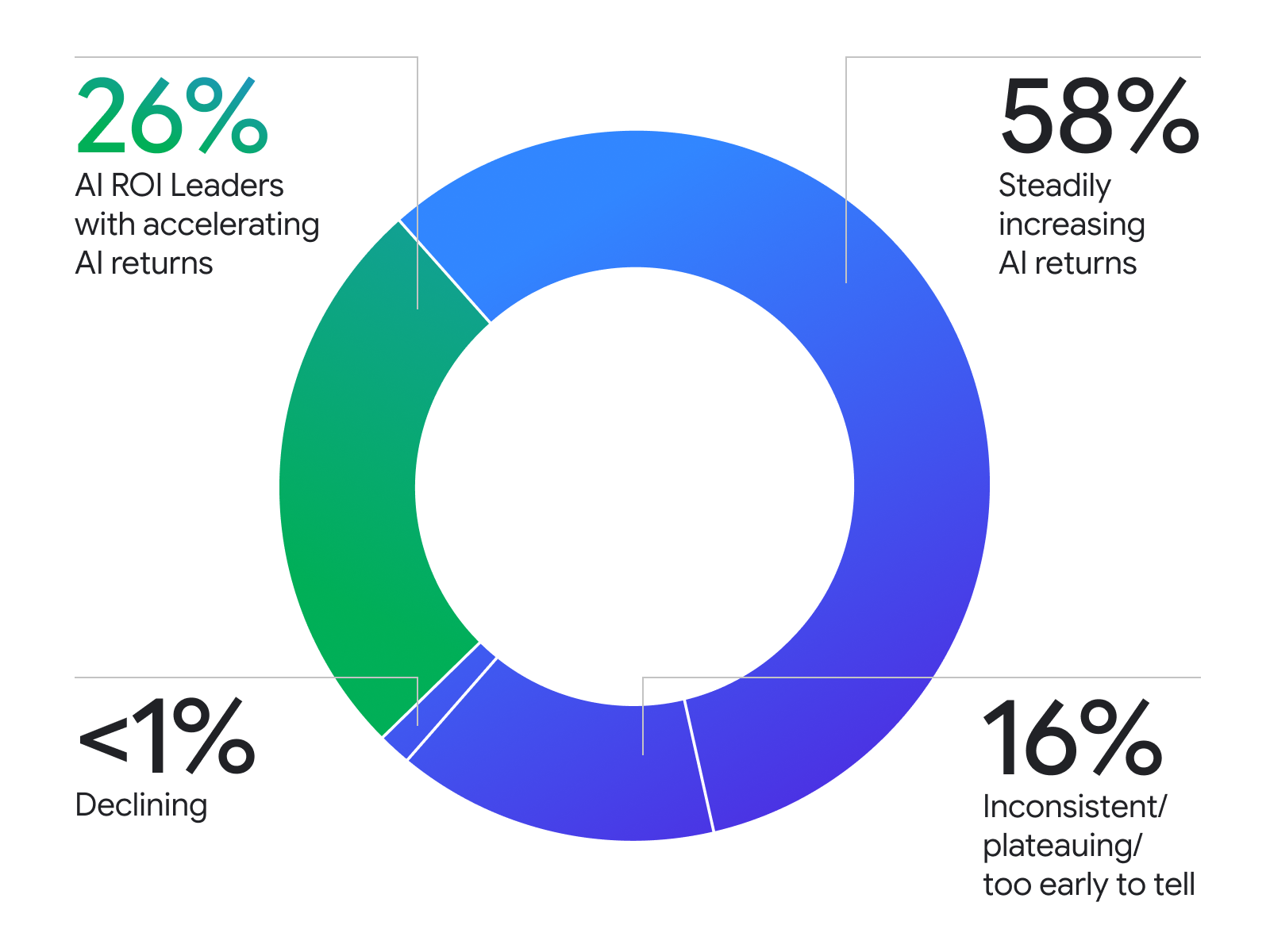
Among the more than 2,400 CXOs, VPs, and heads of business units that we surveyed, 84% of executives said they are seeing increasing financial returns from AI initiatives. Among this cohort, 26% report returns that are accelerating year over year.
We’re calling this latter group “AI ROI Leaders.” These leaders aren’t just good at driving returns on AI but prioritizing where AI is applied to drive the greatest impact. In fact, our research shows that these AI ROI Leaders consistently use the same set of practices to achieve this success. The approaches outlined below, and explored deeper in the full report, provide a clear, practical path for bringing these insights into your own organization.
3 things AI ROI Leaders are doing to drive cost-effective growth
When we looked at our AI ROI Leaders, those 26% of organizations who are seeing accelerating financial returns from AI, our research identified three consistent practices:
- Clear ownership: 48% institute “extremely clear” ownership and decision-making authority for AI and agentic initiatives.
- Embed AI into workflows: Almost half said they have “embedded AI into core business processes and revenue streams” or “AI is enabling new business models or revenue opportunities.”
- Mandate AI fluency: 38% have “comprehensive, ongoing AI capability development embedded into roles with required training.” For example, ongoing skilling programs and constant investment in the current workforce.
What does this all mean? The successful AI leader establishes very clear POVs on how AI can be used to transform the way work is done, followed by the necessary resources and training so employees can put it to use. For example, a finance leader may share the best AI agents for streamlining purchase-order approvals or an HR leader presents effective ways to synthesize massive volumes of dense manuals and benefit plans to provide immediate answers to employees. These leaders then provide ongoing training and enablement and a focus on improving both technology and processes alongside accountability.
When done right, the results are clear: 86% of the 2,400 executives we surveyed said that AI is driving cost-efficient growth, helping scale revenue or output without proportional increases in operating costs.
Agents are the key to ROI
For organizations seeing returns from AI, one thing rises above all the rest in those ROI gains: agents.
Our survey found that agentic AI is positively impacting all three core business metrics: revenue growth, cost savings, and operational or profit margin improvement. In our survey, nearly every respondent (94%) reports that AI agents are contributing to cost savings and revenue, with a modestly higher weighting towards savings.
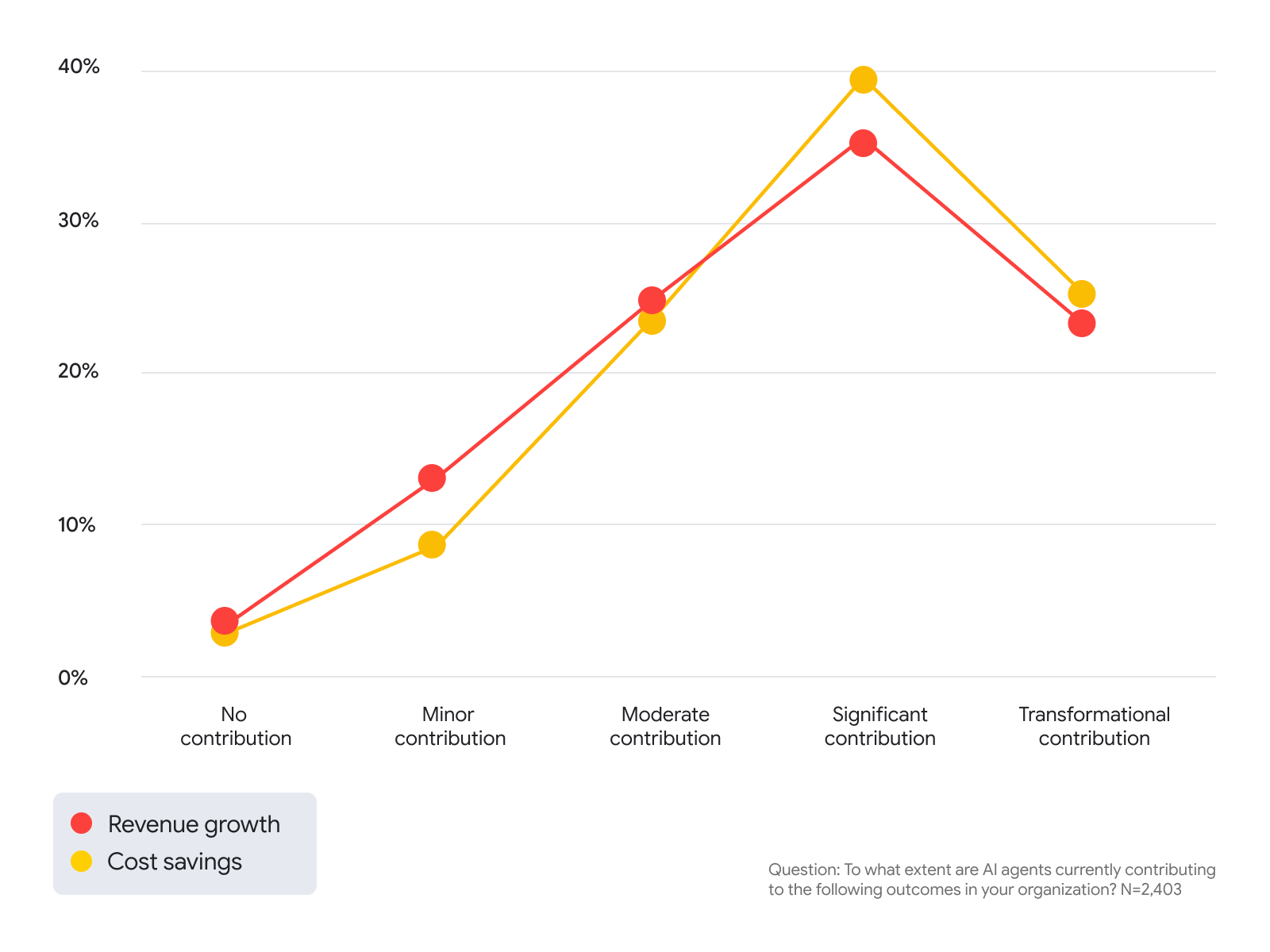
94% of respondents report AI agents contribute to both cost savings and revenue, with 6% reporting no contribution.
Where is ROI showing up?
AI ROI has moved beyond foundational productivity gains. Our research shows that “driving faster strategic decision making” and “increased workforce capacity” are now the top-cited measurable impact driven by AI investments. The value of every member of the workforce is increasing.
These organizations are also more focused than ever on customer impact. As evidenced by the research, ROI is showing up in areas like “improved customer lifetime value” and “acceleration of innovation cycles.”
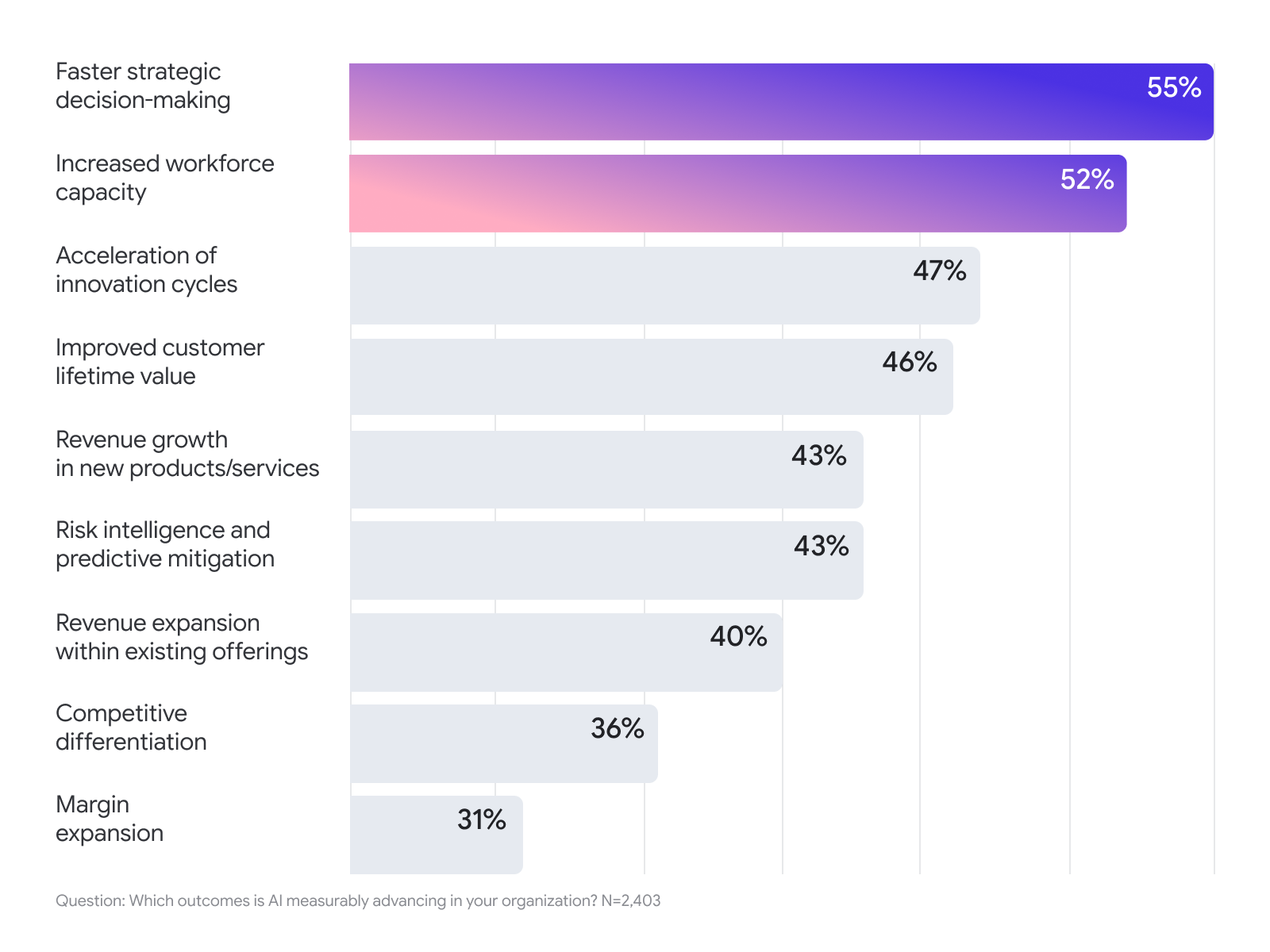
Faster decision making + increased workforce capacity + extra focus on customer value = higher returns for organizations investing in AI.
How are world-class organizations driving the ROI of AI
Across industries, we’re working with leading enterprise organizations to support their objective of rapidly scaling AI to drive bottom-line impact. By moving past isolated pilots and embedding AI directly into core operations, they are experience real change in revenue and operations.
Retail
Best Buy uses Gemini Enterprise Agent Platform to condense thousands of product reviews into concise insights that help customers make informed buying decisions.
Learn more
Financial services
PayPal is using Gemini Enterprise to build the intelligent, data-driven decision layer that powers smarter, more personalized customer experiences at scale.
Learn more
Manufacturing
Tata Steel is rapidly scaling autonomous capabilities across its vast global organization, successfully deploying a fleet of more than 300 specialized AI agents built on Gemini Enterprise in just nine months to drive efficiency and precision across its global operations.
Learn more
Healthcare
Highmark Health scaled employee impact with Sidekick, an AI assistant built on the Gemini Enterprise Agent Platform, that has delivered $27.9 million in value in 2025 alone by automating research protocols and providing “AI search proxies” for internal teams.
Learn more
Life sciences
Elanco is using Gemini Enterprise Agent Platform and Gemini models to implement a framework supporting critical business processes, such as pharmacovigilance and customer orders, resulting in an estimated ROI of $1.9 million since launching last year.
Learn more
Telecommunications
Amdocs used Gemini Enterprise for Customer Experience to create its Telco Customer Experience Agent, which can reason, orchestrate, and execute end-to-end telco processes that improve resolution speed, cost efficiency, and customer satisfaction.
Learn more
Media & entertainment
Thomson Reuters added Gemini Pro models to its suite of approved models specifically because Gemini makes some tasks as much as 10-times faster to process, and it can process entire documents in context.
Learn more
Wealth management
Citi Wealth is launching Citi Sky, an always-on AI-Powered member for the Citi Wealth team that brings Citi’s global intelligence to clients’ fingertips through the Citi app.
Learn more
Consumer goods
Coca-Cola and Footballco use advanced image generation, cinematic video synthesis and high-fidelity voice modeling — combined with human creativity — to deliver real-time, social-first entertainment at scale for their global content series to reach football fans during the world’s biggest tournament.
Learn more
Future bets: Higher budgets, stronger strategy, and better ROI
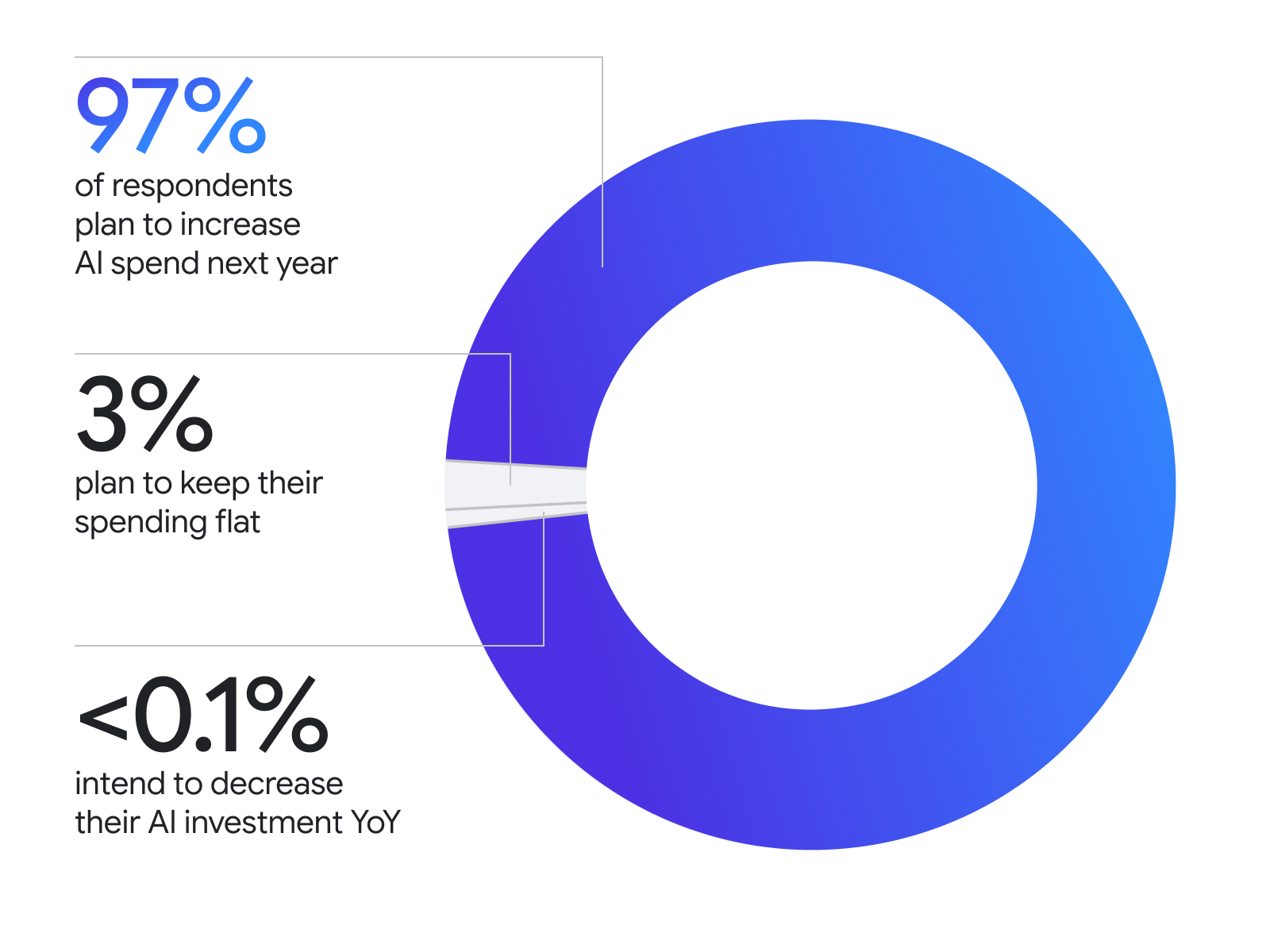
Arguably the biggest signal organizations are seeing ROI is their continued investment in AI. We asked industry executives to rate the estimated impact of AI on key use cases in the next 12 months. It turns out nearly every organization (97%) plans to invest more in AI.
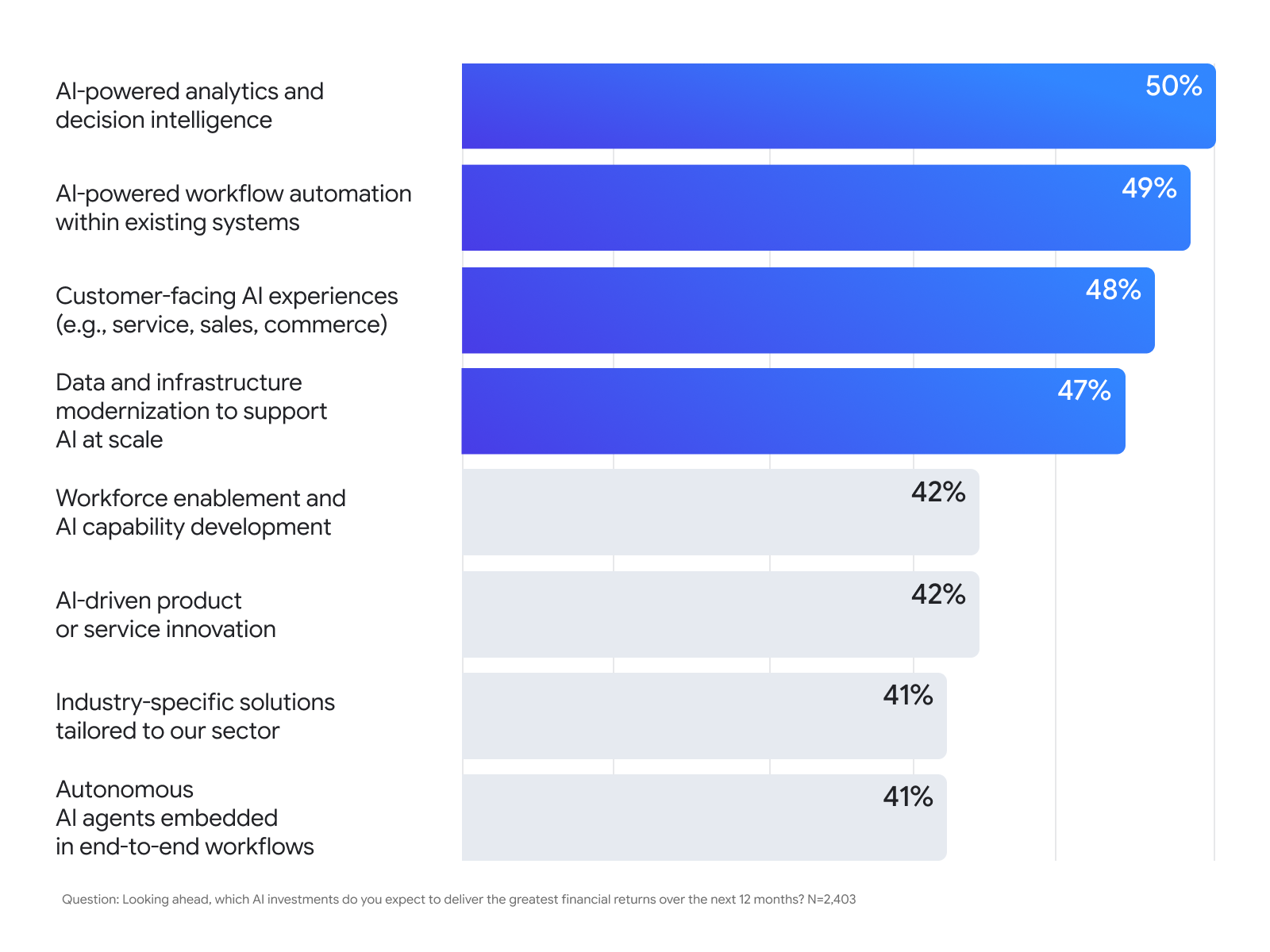
Our respondents identified eight areas of greatest potential for AI investments. For many, it’s all about AI-powered analytics, workflow automation, customer experiences, and AI infrastructure.
AI is everyone’s job
The real opportunity of AI isn’t only about doing our current work faster. The opportunity is transforming how we operate, so we can elevate the impact our employees deliver and drive business growth in the process.
The evolution from early AI experiments to true enterprise-wide value requires us to bridge the gap between smaller "pockets of greatness" and scaled production. That journey triggers a powerful domino effect: As AI unlocks individual workplace capacity, roles evolve, team dynamics flatten, and traditional corporate hierarchies adapt.
The ultimate payoff for AI ROI Leaders isn't only a boost in productivity; it is the organizational speed that comes with fast, decentralized decision-making. When you can scale this model across the business, you don’t just optimize workflows — you build a fundamentally more agile organization designed for the future.
Methodology and process
Working with the National Research Group, we surveyed 2,403 executives across global markets and all industries.
We used Gemini Enterprise and Google Antigravity to analyze roughly 300,000 data points. We evaluated the data across four key dimensions: industry, geography, company size, and AI adoption stage.
We supplemented this with publicly available data from Google Trends and YouTube Trends, and qualitative data from Google Cloud customers.