What Stephen Curry learned about his game from a custom Gemini agent

Benjamin Aguirre
Contributing Writer
A custom Gemini agent built on Google Cloud analyzed Curry’s 16-year career to find new insights and give him a fresh perspective for the 2025-26 season.
After 16 seasons, Stephen Curry, the four-time NBA Champion and two-time MVP, has left a trail of numbers that stretch across the Golden Gate Bridge — about 1,350 times, in fact.
That’s the distance he’s run, covering 2,291 miles across the hardwood over his 40,912 minutes played. He’s scored 29,668 career points in that span. And of course, almost half of those points came from 4,729 three-pointers.
Fans and players alike obsess over stats — it’s one of the ways we measure the greatness of players like Curry. But when it comes to such a singular talent, it takes an equally unique approach to capture all the ways he has dominated the game for a decade and a half.
At Google Cloud, we wanted to use one of our own all-stars, Gemini, to go beyond the boxscore so this Golden State Warrior could reflect on his numbers, see how well he knows his own game, and help him bring a new perspective into the 2025-26 season.
Rather than simply paging through the NBA media guide, we took every regular season, play-in, and playoff game from Curry’s career (through the end of the 2024-2025 season) and input the data into a custom-built agent using Google Cloud’s Agent Development Kit and Gemini APIs. (If you want to try it for yourself and see what highlights are in your own data, check out the same advanced agentic platform we used, now available in Gemini Enterprise.)
Thanks to our agent’s multimodal capabilities, which can understand text, video, and audio simultaneously, we could pull out highly-specific insights, putting together a series of questions for a conversation we dubbed “Curry on Curry.”
In addition to the stats above, we came up with novel ones, like:
- His three-point shooting percentage after more than seven dribbles, with a minimum 105 attempts (40.2%)
- The spot behind the arc where he’s made the most threes (above the break, left side)
- How many points Curry generated for his teammates off of screens since 2013 (1,105)
After training our model and armed with our data-driven questions, we met with Curry himself, who’s also Google’s new Performance Advisor. Could Curry recognize the numbers in his game? Or would he be caught off-guard and learn something new?
Curry on Curry was more than a number-crunching exercise, though. It’s also yet another demonstration of how AI is playing a bigger role in sports.
Winning over fans and building up athletes with AI
While many early experiments with AI have tended toward the lighthearted — writing emails in the form of sonnets or finding who can create the wackiest prompts for Nano Banana — fans, teams, and media have been drawn to ways AI enhances our enjoyment of the game.
Major League Baseball has created daily highlight videos for fans and launched a home run prediction engine at this year’s Midsummer Classic. Fox Sports used Vertex AI to build its Fox Foresight tool, which helped deliver stats and storylines to its broadcast team at fastball speeds during the World Series.
At the same time, we’re seeing performance-focused use cases emerge to boost the quality of play.
Curry’s own Warriors are using modeling in BigQuery ML to help make informed decisions on player acquisitions and trades. Other tools allow for deep research into athlete mechanics, like the finesse of a batter’s swing or helping Formula E drivers shave tenths-of-a-second off of lap times. Or ask our latest collaborator, two-time U.S. Open Champion Bryson DeChambeau, who’s using AI to refine his swing through a deep analysis of his biomechanics and body position.
Regardless of what you’re building — across sports or in any field — the approach is largely the same: Gather the right data and team it with the right AI.
Building a roster of AI sub-agents
For our Curry on Curry project, a team of technologists at Google Cloud started by ingesting, cleaning, and structuring data from public APIs of NBA stats and other basketball analytics websites. This became our unified dataset in BigQuery, Google Cloud’s AI-powered data warehouse, and gave complete coverage on Curry’s 16-year career.
We then curated and defined data schemas, like stats at the team level and player level, which would support our complex queries. At the same time, we developed a creative technology foundation that allowed us to uncover new ways of looking at Curry’s numbers. Agent Development Kit brought the pieces together to form the working version of our agent.


The Gemini API was key to handling our most layered and detailed queries, while Gemini Code Assist helped us write custom-built scripts for the agent; it’s Gemini on Gemini, if you will. This tag team allowed the agentic system to tackle deep, multi-step analysis of our data, as well as analyzing hours of Curry videos from YouTube.
While long-context video understanding was one of the Gemini agent’s strengths, there were still technical challenges to solve. Some videos could be analyzed all at once, while others, like a seven-hour video of Curry’s threes, needed to be chunked into smaller sections for the agent to review. For certain questions, we also had to screenshot videos at precise moments, like the spot where Curry has made successful threes, and then feed those stills to the agent as a batch of several dozen photos.
Through the layering of these different agent-based tasks, we were able to develop a multi-agent system that allowed for a quicker intake of information, more reliable outputs, and limited downtime.
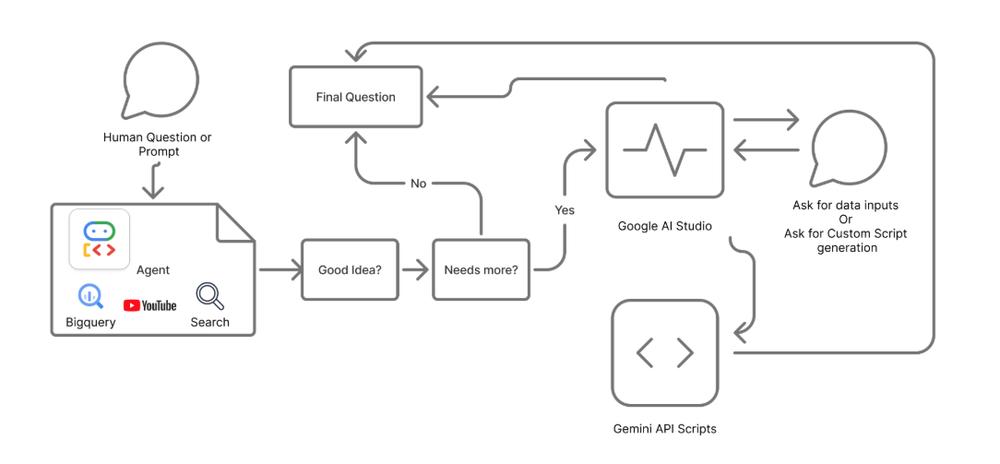
The goal was to use the main Curry-on-Curry agent to amplify our brainstorming. We’d prompt the agent with an initial idea for insights from Curry’s numbers, and then engage in an iterative, back-and-forth process. This process, outlined in the chart above, would help get us to a line of questioning that would keep Curry intrigued.
Tossing around questions with an AI teammate
Once the agent was fine-tuned, we could query for hyper-specific information like the stats noted above, as well as things like how Curry performed in cities where he ranked popcorn highest, his win percentage on specific days of the week, and other unique perspectives. Agent outputs were text-based responses, including a data breakdown and rationale as to how the agent reached its answer.
The agent gave our team the precise analysis we had hoped for. Instead of countless hours of manual research, we got query results in less than a minute. Some of our queries were so obscure, we wouldn’t have reached a valid answer without the ability of the agent to analyze the rich data.
For example, how much Curry would theoretically have to pay his mom in a friendly wager, where he owes her $100 every time he has three turnovers in a game, and an extra $100 for every additional turnover ($161,900!).
As we gathered final stats and insights, we turned them into questions for our conversation with Curry. Nestled in the Los Altos foothills at a community college gym, we waited for him with a special guest.
Going Curry on Curry, hosted by Coach Bob McKillop
We tapped Curry’s college coach from Davidson, Bob McKillop, to lead the Curry on Curry conversation. Coach McKillop is one of the few people who knows Curry’s game just as well, if not better, than the player himself. He brought color, personal anecdotes, and a bit of gentle teasing to the analysis.
After a brief catchup, the duo got down to business. Coach McKillop posed each question to Curry, from how much time elapses on his no-look threes, which season he ran the most in, and his record in games that he had a successful dunk (Coach McKillop was surprised Curry even had dunks).


We wrapped the day with a series of short, numbers-driven true-or-false questions. Had Curry scored more than 2,000 points in the state of Texas? True. If his 29,668 career points were divided across each day since his debut in 2009, would the average be higher than 4 points per day? True.
The insights kept Curry on his toes. He did a little mental math and was smiling the whole time, saying he could spend all day digging into the data.
Curry reflects on Gemini insights to improve on the court
As someone who’s always been methodical in his game-day preparation, Curry noted that these Gemini insights changed the way he’ll approach the new NBA season. “Gemini is going to be in my head this year, cause I'm going to be looking at all these details,” he said at the end of his conversation with Coach McKillop.
It’s clear that AI can help even the greatest athletes see their game in a new light. The technology will continue to change sports, creating more opportunities for amateurs and professionals to grow into the best version of themselves on the field, track, court, and in life.