Lights, camera, blueprints: A guide for startups building advanced generative media platforms
Hussain Chinoy
Technical Solutions Manager
Shai Alon
Global Founder Advocate
Discover how savvy startups are integrating world-class generative media models into secure, brand-aligned creative workflows that perform.
While it might feel like hyperbole, it’s rather undeniable that the creative landscape is moving at a speed we’ve never seen before. Today’s designers, filmmakers, composers, and marketers have an incredible array of tools powered by generative media models at their disposal, which have unlocked the means to explore and execute on bold new ideas within minutes, not months.
As the space matures, the competitive moat for startups building — and using — such tools has fundamentally shifted.
It’s no longer just about who can create the coolest standalone AI image or video generator. Instead, savvy startups are building efficient, context-aware agentic workflows using powerful models like Gemini Omni Flash. The result? Creative applications that deliver consistent, synchronized multimodal media that’s also secure and on brand.
To give founders a technical blueprint for this next wave of creation, we’ve launched the Startup technical guide: Generative media. It explains how to integrate Google DeepMind’s world-class media models into intelligent, enterprise-grade workflows using advanced orchestration tools, robust quality assurance parameters, and governance guardrails.
Here’s a snapshot of what you’ll find in the new guide. Also, don’t forget, as you start building, you can reach out to our AI experts at Google Cloud for help.
Build with cutting-edge models at the core
You don’t need to start from scratch when building the next big thing in the generative media space. Instead, you can innovate fast using an enterprise-grade portfolio of foundational models that span:
- Image generation: Our Gemini Image models (popularly known as Nano Banana) let users create and edit images conversationally. They feature character and object consistency across scenes and the ability to render accurate, multilingual text directly into visuals.
- Video generation: Gemini Omni is multimodal and excels at sequential, conversational video editing and generation of up to 10 seconds with speech, music and sound effects. Veo offers cinematically realistic video generation for 4, 6, or 8-second clips of up to 4K resolution with natively synchronized audio.
- Music generation: Lyria is a family of models designed for professional-grade music generation, offering structural control and the flexibility to guide vocal styles and lyrics.
- Speech generation: Gemini’s suite of audio models can process and generate expressive speech through Gemini text-to-speech (TTS) and Gemini Live for live conversation with function calling, offering startups the flexibility to select the best solution for different workflows.
Choose the right tooling for the job
In the early days of a new product, startups need the ability to iterate fast, leaning on tools that enable rapid, low-friction prototyping. As concepts become more concrete and evolve into complex, multi-step pipelines, more robust developer frameworks are required.
For the prototyping phase, developers and designers can quickly build interactive UI front-ends with tools like Stitch; design bespoke media features using Flow; and deploy lightweight applications via Google AI Studio to gain direct, immediate access to Google’s complete model portfolio.
For advanced orchestration, Antigravity and Gemini Enterprise Agent Platform offer the granular control, autonomous agent orchestration, and enterprise-grade infrastructure you need when building scalable, production-ready systems.
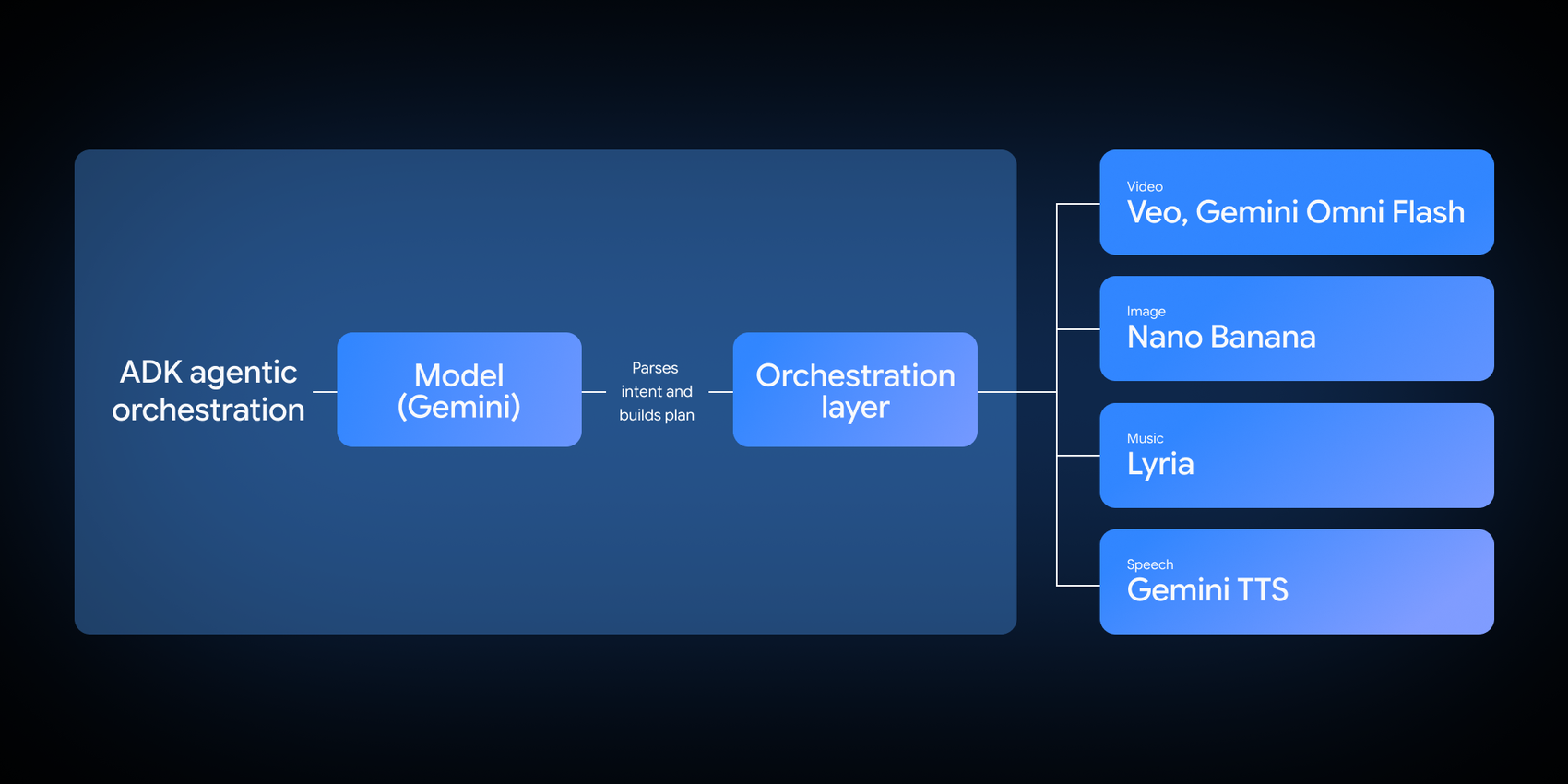
ADK enables fine-grained control of sophisticated agents, giving startups an advanced framework for architecting autonomous agents.
For example, the Agent Development Kit (found within Gemini Enterprise Agent Platform) is a practical choice for building autonomous multi-agent systems. Developers can use it to build agents that possess three essential components: a multimodal model that reasons on the reference content and outputs, tools that take programmatic action, and an orchestration layer for planning and observability.
Assure quality with automated evaluation loops
When your startup scales from producing a handful of assets to tens of thousands of variants a day, manual quality assurance becomes a bottleneck. An automated, closed-loop evaluation system helps remove this bottleneck, with two core components at play:
- Gemini-as-a-judge agent: This acts as an automated auditor, verifying if generated assets adhere to the requested tone, style, and physical constraints.
- Gecko-based interpretable autorater: This deconstructs prompts into semantic elements, dynamically generates strict verification questions, and visually probes the media for factual alignment.
If an error is flagged, the asset doesn’t fail out to the user. Instead, the failure log is handed to an optimizer agent that automatically rewrites the prompt and triggers a silent, backend self-correction loop — backed by an execution budget to keep latency and costs tightly controlled, maintaining human oversight where required.
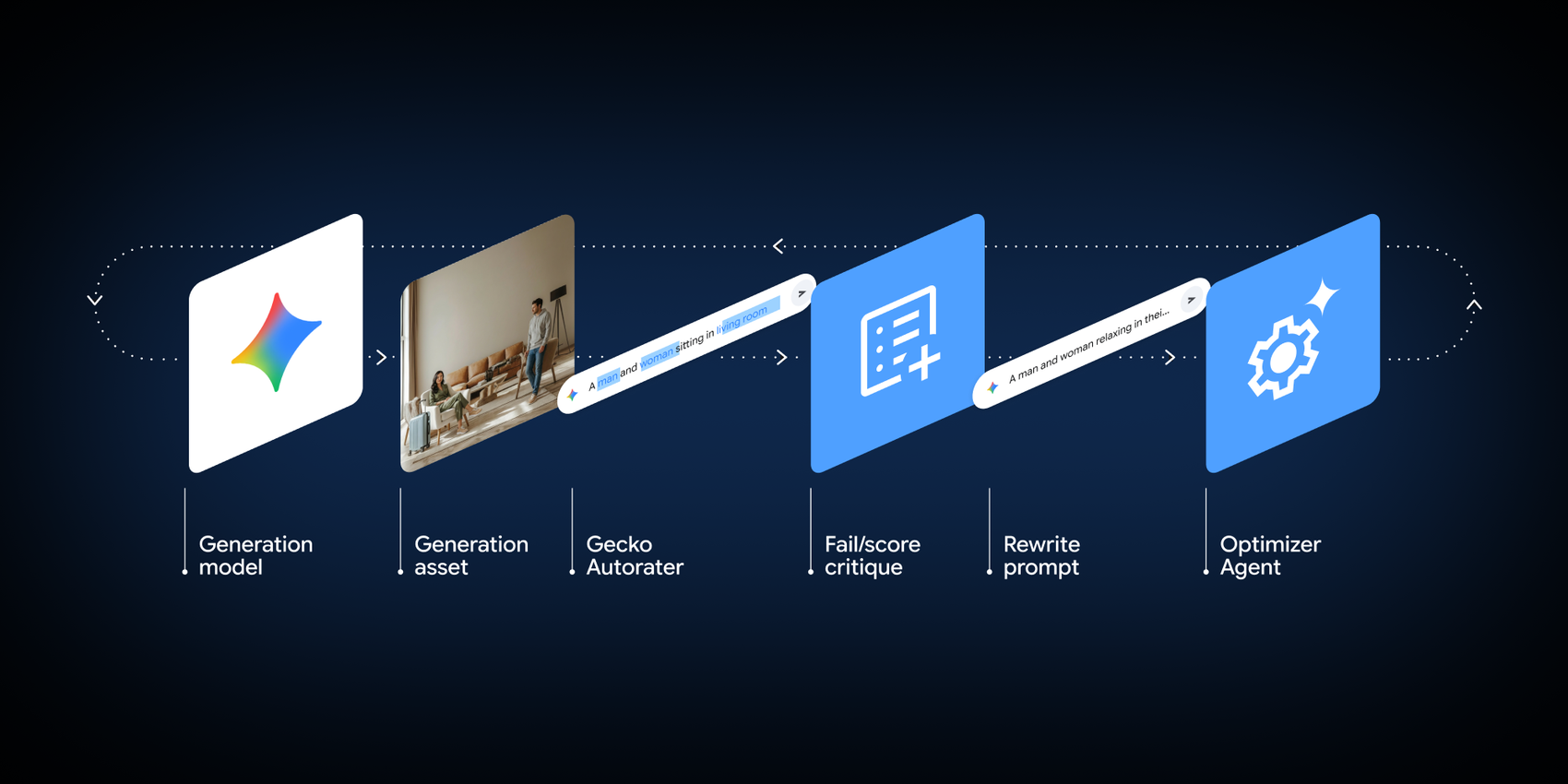
Two automated evaluation pipelines can work in tandem to assure quality output.
Consider the economics of generative media
Running complex multimodal workloads requires a proactive approach to compute management. To protect startup margins and build a solid economic base for generative media applications, it’s important to maximize architectural efficiency with strategies like context caching and tiered prototyping and rendering.
Startups should also think differently about how to measure performance.
Rather than relying solely on traditional frameworks, you should measure agentic workflows through cost per interaction, or CPI. Here, the “interaction” is the automated cycle where the pipeline runs to generate a customized, localized, or translated asset variant. Measuring CPI tracks the actual compute cost of these automated generation runs, allowing teams to treat content as a variable, data-driven resource that scales directly with their experimentation needs.
Last but not least, embed trust and governance
Before commercializing your generative media application, you must establish a robust framework that covers both synthetic asset governance and enterprise-grade infrastructure security.
For example, startups can address synthetic asset governance and legal compliance with confidence, as all Google gen-media models are watermarked with Google DeepMind's SynthID cryptographic provenance. Startups also benefit from Google Cloud's shared fate indemnification strategy alongside robust digital IP and version-control features.
To ensure a safe and responsible experience, Google’s media generation capabilities are equipped with a multi-layered safety approach. This is designed to prevent the creation of inappropriate content, including sexually explicit, dangerous, violent, hateful, or toxic material.
Ready to build?
The next wave of success with generative media models belongs to the founders who look beyond the basic prompt box and focus on building context-aware agentic workflows that produce trusted, consistent images, video, and audio at enterprise scale. It’s the founders and teams that can solve customer needs, not just deliver cool tools and flashy interfaces (though those never hurt).
The Startup technical guide: generative media — which also includes a technique library with pre-built agentic blueprints to rapidly deploy production-grade generative media pipelines — will help your team seize on this opportunity.
No matter where you are with AI adoption, we are here to help. Contact our Startup team today or sign up for our Startup newsletter.