How Google Does It: Using agents to help find, track, and fix vulnerabilities

Archana Ramamoorthy
Senior Director, Cybersecurity & Data Protection
Brian Roddy
Vice President, Product Security and User Protection, Privacy, Safety & Security, Google
Get original CISO insights in your inbox
The latest on security from Google Cloud's Office of the CISO, twice a month.
SubscribeFrontier agents have fundamentally altered the economics of how software flaws are discovered — and exploited. In less than two years, what previously required weeks of specialized, manual reverse-engineering now can happen in minutes.
When we detailed how Google finds, tracks, and fixes vulnerabilities in early 2025, defense centered around a familiar cadence: assessing risk, prioritizing severe bugs across our systems, running tabletop simulations, and canarying fixes through standard build pipelines.
Since then, the reality of software security has changed completely. Agents can now find and attack software flaws faster than ever before, and enterprise defenders are finding more of those flaws than they ever thought existed. To maintain an agile, responsive defense, we engineered a new approach that uses automated, agentic systems on top of the foundations we described last year.
When remediation latency becomes the vulnerability
As agents increased vulnerability volume and collapsed time to repair, old security team assumptions about triage, ticketing queues, and patch windows no longer held true.
The first reality every security team faces today is exponential volume. Agents make discovering and reporting software flaws much easier. Inbound vulnerability reports across first-party code and open-source dependencies have multiplied and now swamp traditional human triage queues.
The deeper challenge, however, is time. Learning about a vulnerability is no longer the decisive step in defense. When adversaries possess autonomous tools that convert weaknesses into exploits in hours, remediation latency — the window between when a flaw is identified and when the patch is deployed in production — is itself becoming a vulnerability.
"In software defense, knowing about a vulnerability without being able to rapidly develop and deploy a fix leaves an organization exposed. Attack automation has compressed exploitation timelines to the point where response latency is the primary risk factor," said Chris Betz, CISO, Google Cloud.
Allowing vulnerability discovery to expand exponentially while remediation proceeds at a linear, human pace means allowing the security gap to widen indefinitely. Instead, we’ve created agentic defenders to protect against agentic attacks.
Coordinating a company-wide defense across a complex fleet
At Google, we run tens of thousands of distinct services, manage vast first-party code repositories, and depend on thousands of open source packages. Different business units maintain their own operational cadences and deployment requirements.
The goal was straightforward: Equip every product area with centralized discovery tools, automated patching services, and deployment pipelines to keep pace with machine-speed threats.
When agentic vulnerability discovery accelerated across the software industry, we recognized that individual teams operating in isolation would create fragmented tooling, duplicated effort, and dangerous blind spots. A company-wide, coordinated effort allows us to centralize tool deployment and integrate security capabilities deep into our development pipelines.
The goal was straightforward: Equip every product area with centralized discovery tools, automated patching services, and deployment pipelines to keep pace with machine-speed threats.
Crucially, we didn’t approach this challenge alone. Because modern software depends on an interconnected open source foundation, enterprise security is collective security. We partnered with industry peers through initiatives like Project Glasswing to study how advanced reasoning models uncover vulnerabilities.
At the same time, we expanded our work with open source foundations and maintainers to help protect the shared digital commons.
The core architecture: Agentic scanning and automated patches
Traditional vulnerability scanners run periodic batch checks, flag dangerous patterns and known-vulnerable dependencies, and file tickets for human engineers to investigate. When thousands of new vulnerability reports arrive at machine speed, this manual handoff collapses.
To solve this, we built Project Fortify, an internal program that shifts the model from passive detection to active remediation. It’s an agentic scanning platform that continuously searches for vulnerabilities and directly drives automated patch generation.
Instead of treating detection and fixing as disconnected tasks, our find-fix-deploy pipeline connects autonomous discovery directly into automated code repair.
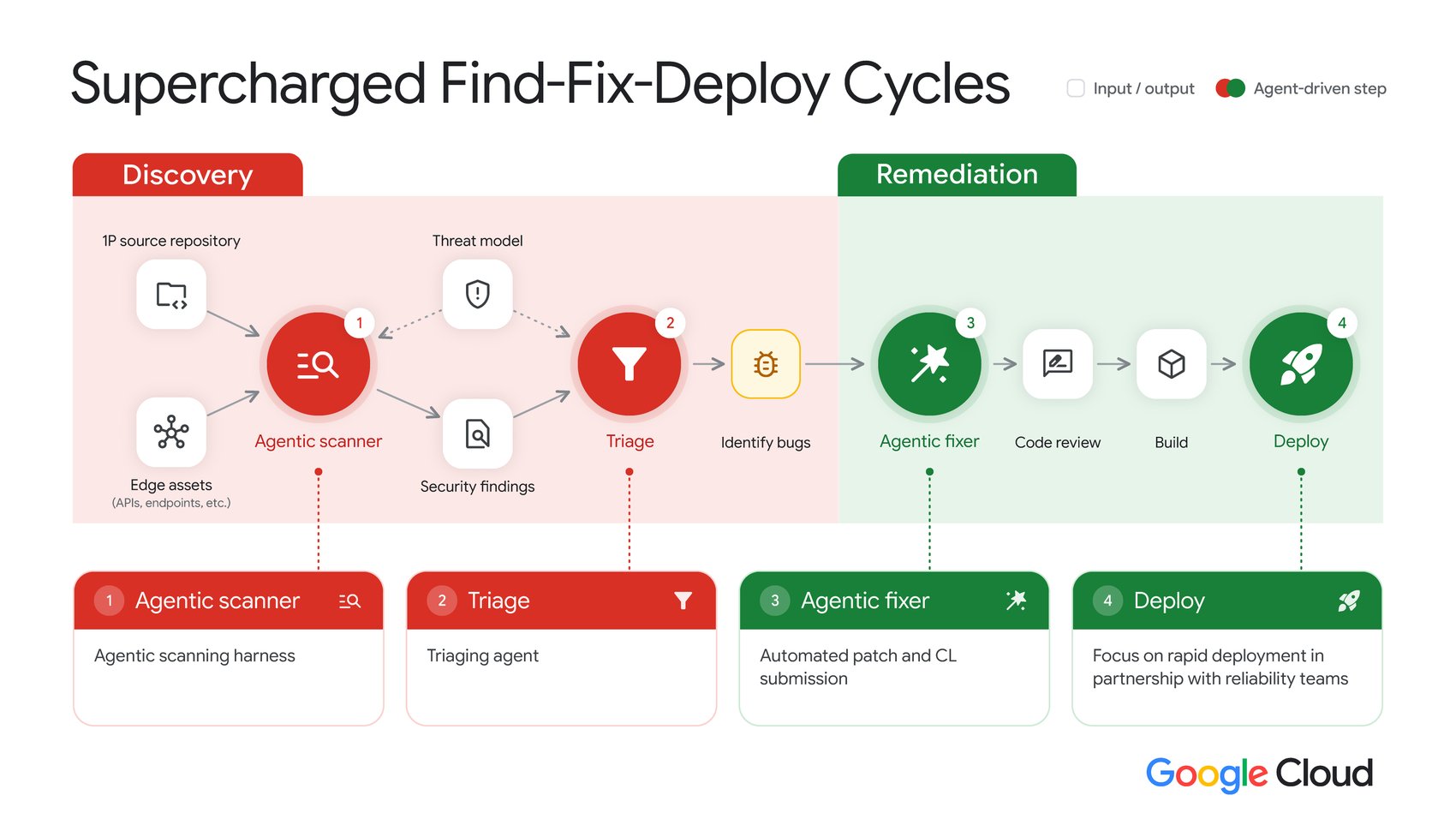
How we designed our find-fix-deploy pipeline.
Our find-fix-deploy pipeline operates across four coordinated stages:
-
Discovery (agentic scanner): Autonomous scanning harnesses identify vulnerabilities using multiple scanners, including PageBreak and Mantis. These harnesses are built around Gemini.
-
Validation (triaging agent): An autonomous triaging agent evaluates findings against the actual runtime environment to separate exploitable vulnerabilities from noise.
-
Remediation (agentic fixer): Powered by agentic solutions like CodeMender, our automated remediation capability analyzes the root cause, generates and validates a fix in a sandbox environment, and proposes a ready-to-review changelist directly into developer workflows.
-
Deployment (SRE partnership): Human engineers review and merge the change, which then deploys rapidly through safe canary stages monitored by Site Reliability Engineering (SRE) teams.
"For decades, we have assumed we had time to patch after a vulnerability became known. That assumption is no longer true. We must move to a world where we use agents to find and fix vulnerabilities, ideally when software is developed, and as close to real-time as possible so we can keep pace,” said Heather Adkins, vice-president, Security Engineering, Google.
Balancing precision and recall with trust models
Automating patches changes the math for scale. When an agent writes code that developers will review, high precision — the share of flagged issues that are real — is essential. If an agentic system proposes patches for false alarms, developers quickly lose trust.
To protect engineering focus, we established a precision-first trust model. For the vast majority of application code, our triage filters require a high-precision threshold before filing an issue and initiating patch generation. This standard ensures that when a developer receives an automated pull request or changelist, it addresses a verified, high-confidence flaw.
In 2026, defensive success requires running autonomous systems that operate at the speed of the threat.
At the same time, different systems carry different risks. For critical infrastructure, core identity services, and perimeter proxies, product areas can adjust the scanners to favor high recall, capturing the widest possible share of real vulnerabilities, even if that includes more false positives. On these critical assets, teams accept a higher rate of manual review to ensure no potential vulnerability goes unexamined.
By assigning parameters to this risk model, security teams can retain local control over their risk tolerance while using shared central automation.
What we have deployed and open-sourced
Scaling autonomous security required building new systems, and we’re committed to sharing these tools with the broader community:
-
Mantis open-source scanner: A multi-agent framework for security auditing that combines codebase summarization and automated sandbox validation.
-
Chrome rapid patch cadence: The Google Chrome security team shortened its security update cadence to deliver browser fixes within days of discovery.
-
Open-source maintainer support: Google collaborates with the OpenSSF to fund infrastructure and triage tooling for critical upstream libraries.
-
CodeMender in OSS-Fuzz: We added CodeMender to OSS-Fuzz, offering CodeMender patches at no cost to open-source maintainers whose projects are enrolled in fuzzing.
Looking beyond find and fix
Automating the find-fix-deploy cycle is necessary, but patching vulnerabilities after they are found is only part of the solution. Google continues to invest in advancing defenses beyond reactive patching:
-
Memory safety transitions: Expanding use of memory-safe languages like Rust across Android, Chrome, and our core infrastructure.
-
Architectural invariants: Enforcing secure frameworks at the platform layer to make common bugs impossible to introduce.
-
Continuous agentic assurance: Moving toward autonomous agents that verify security guarantees on every commit.
In 2026, defensive success requires running autonomous systems that operate at the speed of the threat. Compressing the find-to-fix-to-deploy timeline elevates developers and security engineers from manual triage to supervising the autonomous engines that keep the enterprise safe.
To learn more about how Google Cloud approaches modern threat management, please check out our CISO Insights Hub.