A manufacturing blueprint for secure agentic AI
Vinod D’Souza
Director, Manufacturing & Industrial, Office of the CISO, Google Cloud
Sri Gourisetti
AI Architect and Outcome Delivery Lead, Google Cloud
Get original CISO insights in your inbox
The latest on security from Google Cloud's Office of the CISO, twice a month.
SubscribeAI and agents have arrived on the factory floor, reasoning through unforeseen operational anomalies, planning multi-step tasks, and executing authorized actions across the shop floor. The challenge facing today’s industrial CISOs and business leaders is all about balancing AI innovation and scale with foundational priorities: precision, physical safety, and operational resilience.
Deloitte’s AI in Manufacturing 2026 study reveals a defining market shift: 84% of industrial organizations now report measurable ROI from AI, moving the technology beyond proof of concept. Yet a significant execution bottleneck remains, with only one in five uses scaled across the business.
To close this gap, and capture gains greater than 20% in throughput and machine availability, manufacturers must shift their focus from standalone pilots to secure, industrial-grade data architectures that protect the plant-floor without disrupting live production.
As you identify high-value ways to use AI in manufacturing, it’s crucial to craft a coherent strategy that accelerates business performance without introducing unmanageable cyber-physical risk. Here’s a strategic blueprint for governing, deploying, and securing AI capabilities across manufacturing.
Three domains of action
Today, multimodal models help engineers review engineering schematics, evaluate architectural designs, and synthesize complex machine documentation. However, AI agents have changed the game, shifting from passive analysis to agentic action.
Embedding purpose-built software agents directly into industrial workflows with Model Context Protocol (MCP) and Agent-to-Agent (A2A) can autonomously orchestrate data, assist human operators, and streamline complex industrial processes within secure parameters. To help manufacturing leaders structure their AI strategy, we have mapped the industrial opportunity space around three core operational domains, designed with security and resilience as foundational requirements.
1. Enterprise business operations: High-performing manufacturing and industrial operations rely on efficient handling of enterprise and back-office workflows. While they may seem removed from the factory floor, their efficiency dictates the speed and profitability of the entire organization.
Transitioning to an intelligent, agent-enabled operating model requires a disciplined, phased roadmap.
For example, an autonomous procurement agent can cross-reference vendor contracts, verify delivery logs against bills of lading, and validate payment terms to streamline approvals. By resolving discrepancies early, these systems eliminate administrative bottlenecks that often delay capital projects and plant supply deliveries.
2. Engineering and industrial operations: This is where digital intelligence meets physical machinery. Deployed within quality control systems, digital twins, and plant execution platforms, these agents are purpose-built to anticipate operational issues.
Instead of waiting for a machine sensor to trigger an alarm after a failure has begun, a predictive maintenance agent can evaluate historical wear trends alongside real-time production schedules. It then proposes an optimal maintenance window to prevent unplanned downtime, moving from simple reporting to recommending actions. The human operator remains firmly in control of the final decision.
3. Unified cybersecurity and resilience: As adversaries increasingly misuse AI to advance their tradecraft, maintaining a defender's advantage requires a proactive approach — and should be an operational imperative. CISOs need to secure the convergence of corporate IT networks and plant-floor operational technology (OT), where specialized security agents can act as a force multiplier for resource-constrained teams.
These agents analyze telemetry across both environments to filter out noise, instantly triage thousands of daily alerts, and isolate credible threats. By running continuous threat simulations against virtualized plant models, they can validate cyber-physical defenses without risking plant safety, equipment integrity, or production uptime.
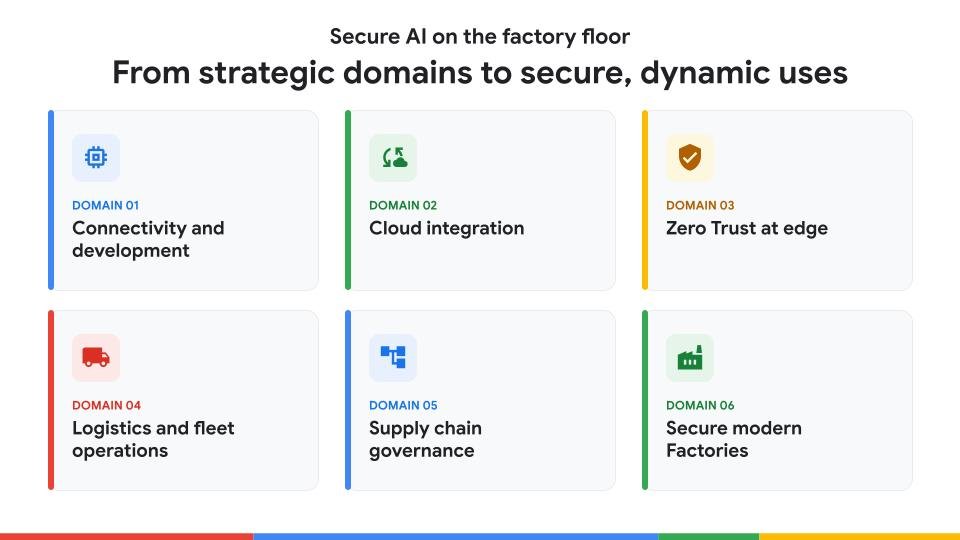
Six high-impact manufacturing use-case clusters.
From strategic domains to dynamic uses
To translate those domains into action that you can get started with today, we’ve organized the manufacturing landscape into six high-impact use-case clusters. Each cluster demonstrates how autonomous and human-in-the-loop agents operate across the enterprise to drive operational velocity and strengthen cyber-physical defenses.
1. Secure-by-design product connectivity and development. Security should be engineered into connected machinery from inception, not retrofitted after deployment.
By embedding autonomous security agents directly into firmware development pipelines and digital twins, engineering teams continuously audit third-party code libraries, validate API surfaces, and enforce cryptographic baselines in real time. These agents ensure that smart industrial products are secure by design, protecting proprietary IP while enabling safe, friction-free data exchange across the product lifecycle.
2. Secure cloud integration of enterprise and industrial systems. Agentic workflows can securely enable predictive analytics and safe AI use across IT and OT environments.
Integration agents monitor secure operational enclaves and manage encrypted, unidirectional data pipelines connecting plant-floor controllers to cloud platforms. These agents allow teams to aggregate telemetry and use cloud-scale intelligence without exposing physical machinery to inbound network threats.
Gemma 4 can run agentic workflows completely on-premises, which is a must have for OT operators who aren’t able to connect to the cloud.
3. Zero Trust edge and application migration. Virtualizing industrial applications unlocks massive scalability, but it should never compromise deterministic, real-time physical control.
Identity governance agents continuously enforce Zero Trust policies from the enterprise cloud down to shop-floor PLCs, analyzing behavioral telemetry and operational context in real time. This ensures human operators, robotic controllers, and autonomous software operate strictly within verified, least-privilege boundaries.
4. Secure logistics and connected fleet operations. Agents can help protect the expanding perimeter of globally-distributed logistical chains and connected transport nodes.
Fleet-monitoring and telematics agents operate in a specialized fleet security operations center (Fleet-SOC) to continuously analyze real-time data from vehicles, cargo containers, and transport nodes. These agents autonomously detect cyber-physical anomalies such as GPS spoofing, route deviations, and unauthorized firmware modifications, while validating asset-tracking data to guarantee an authentic, verifiable chain of custody for critical shipments.
5. Transparent, multi-tier supply chain governance. Unseen upstream vulnerabilities can pose immediate risks to production continuity and product integrity.
Supply-chain risk agents continuously evaluate dynamic digital bills of materials (BOMs) — spanning hardware, software, and firmware — across multi-tier vendor ecosystems. By correlating real-time vulnerability disclosures with active plant inventories, these agents autonomously trace component dependencies and isolate critical security flaws before parts ever reach the assembly line.
6. Deploy secure modern factories. Agents can help establish unified physical and digital security defenses to protect localized smart factory environments.
Adversarial simulation agents use high-fidelity digital twins to conduct continuous stress-testing and simulate real-world cyberattacks. Rather than running intrusive tests on live equipment that could disrupt operations, these agents perform safe exploitability analysis in an isolated digital sandbox by validating emergency kill-switches and closing security gaps before threats reach physical plant machinery.
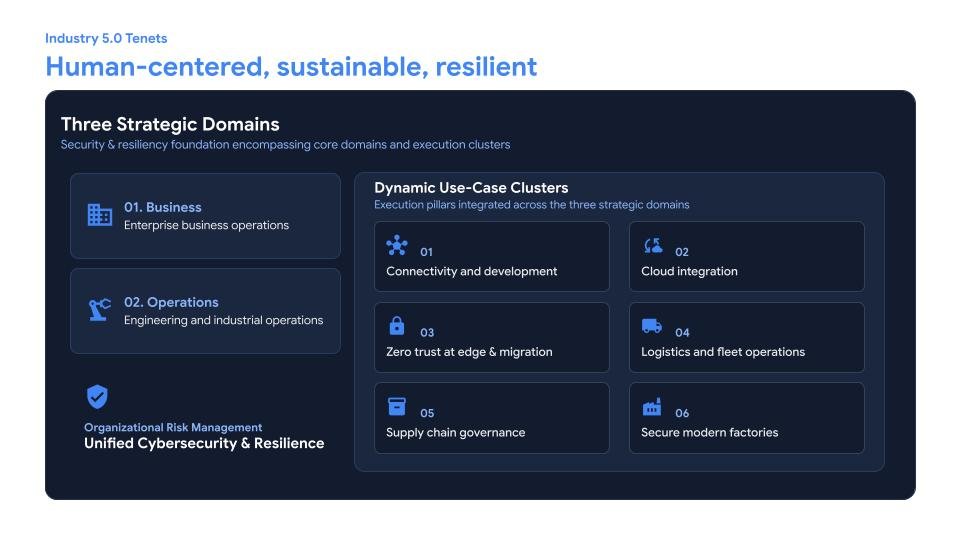
A new approach that is human-centered, sustainable, and resilient.
Transitioning to an intelligent, agent-enabled operating model requires a disciplined, phased roadmap. Gemini Robotics can also be integrated into these environments to orchestrate complex physical tasks with high-precision reasoning, ensuring that autonomous actions remain secure and aligned with plant safety policies and standard operating procedures (SOPs).
Moving toward an autonomous, secure manufacturing enterprise is not about deploying every technology at once, but rather embedding security into every layer of the agent lifecycle. That way, industrial leaders can build facilities that are both globally competitive and intrinsically resilient.
How to operationalize your industrial agent strategy
Secure, agent-powered manufacturing is a strategic response to the increasing complexity of global supply chains and shrinking margins of error in modern production.
Transformation does not require implementing every capability at once. The most successful organizations will identify a specific operational bottleneck, whether a gap in quality inspection, alert fatigue in OT security, or delay in procurement reconciliation, and deploy a targeted agentic solution to address it.
Manufacturing and Industrial enterprises can take immediate, pragmatic steps to operationalize this roadmap:
-
Target high-impact bottlenecks and opportunities: Select one discrete operational process where manual friction, latency, or alert fatigue currently slows down your plant operations or security teams.
-
Audit data readiness: Choose one critical process or a workflow and verify that the underlying data streams are clean, accessible, and structured to power an autonomous reasoning. Use Agent Studio to rapidly build low-code agents, and Agent Development Kit (ADK) to build more complex and high-code, multi-agent systems.
-
Define your guardrails: For security leaders and executives, define the governance framework necessary to transition from human-in-the-loop to human-on-the-loop oversight. Treat agents as first-class non-human identities with role-based access control (RBAC), strict API boundary limits, monitoring controls, and automated fallback triggers for human intervention. Use Gemini Enterprise as an enterprise agentic governance system, and use Agent Gateway to define security policies and guardrails.
-
Run a targeted pilot: Instead of attempting a broad rollout, execute a targeted pilot in an isolated operational enclave or virtualized digital twin to validate performance and safety against real-world baseline metrics.
-
Assess IT/OT visibility: Ensure your security and engineering teams have a unified view of both enterprise IT and plant-floor OT networks, as effective agents require unified context to detect and mitigate cyber-physical risks. You can use Agent Identity and Agent Registry to assign and track agents across the enterprise, and Wiz to detect the presence of unauthorized agents.
Ready to take the next step in protecting your smart manufacturing operations? Connect with the Google Cloud team live at IMTS 2026 in Chicago, at booth #236709, to see how we protect active shop-floor networks from emerging cyber-physical threats.
You can learn more about how our built-in protections keep your industrial assets resilient and secure at the Google Cloud Security website.