New capabilities to power agents at scale with Google's Agentic Data Cloud
Sirish Chandrasekaran
VP, Product Strategy & Growth, Data Cloud
Raj Pai
VP, Product Management, Databases
Not long ago, we were entering the agentic era; today, organizations are deriving significant value from running agents in production. The opportunity to capture new revenue streams, improve efficiency, and manage risk makes reimagining operations with agents top of mind for enterprise leaders.
That is why we built the Agentic Data Cloud — a System of Action designed to activate all your data by breaking down walled gardens, deliver high accuracy and trust, and operate proactively at low cost. Leading organizations such as PayPal, Siemens, Telus, Vodafone, Walmart, and more are already achieving business impact with us today.
Today, we’re sharing key updates to Google’s Agentic Data Cloud. We’re empowering your agents everywhere, grounding them in your enterprise context to deliver accurate, trusted answers, and providing elevated agentic-first experiences for both practitioners and business users.
Activate all your data for agents with the borderless Lakehouse
Enterprise data lives everywhere — across multi-cloud environments, on-premises systems, and SaaS platforms like Confluent, SAP, Salesforce, and Workday. The borderless Lakehouse, built on the open Apache Iceberg format, lets you activate all of your data, wherever it lives, so that your agents have one governed foundation. Instead of moving data, stitching together connectors, or paying surprise variable egress fees, you get a stack tuned at every layer, from the infrastructure to the model. In fact, Apache Iceberg data under management has more than tripled over the past year.
Today, we are announcing several new enhancements for the borderless Lakehouse. Gemini now works directly on your borderless Lakehouse allowing business users to use natural language to query records that live across clouds while agents ground their reasoning and drive business workflows. With cross-cloud interconnect and caching for AWS and Azure, now generally available, you can query data across clouds with a private, secure connection and zero variable egress fees. And when you query remote cloud data, Lakehouse automatically caches retrieved data blocks locally within Google Cloud. Additionally, customers can use the open Iceberg catalog federation with Databricks Unity, Snowflake Horizon, and AWS Glue as well as zero-copy integrations with SAP, Workday, and Salesforce.
To deliver context for AI, the borderless Lakehouse integrates directly with Knowledge Catalog, to automatically index your distributed and unstructured data, in cloud storage, giving agents the right context to be accurate, while controlling token costs for an intelligent and sustainable agentic strategy.
"By implementing the borderless Lakehouse that federates single-copy Apache Iceberg data from Amazon S3 tables to BigQuery, Delivery Hero's talabat reduced data-movement costs by approximately 40% while making streaming transactional events queryable across both clouds within minutes of production." - Harish Ramesh, Staff Data Engineer, Delivery Hero talabat
To take action in the moment, agents need simultaneous access to both your historical analytical data, and real-time transactional data. That’s why today we're announcing new AlloyDB integrations with the borderless Lakehouse. With direct Iceberg access in AlloyDB, you can now directly query Iceberg tables stored in cloud storage, without any ETL pipelines or copies, and join live operational data with historical lakehouse data in a single PostgreSQL query. By combining AlloyDB's transactional capabilities with direct Iceberg table access, systems can efficiently bridge transactional and analytical data to meet rigorous demands from agents. It is fully integrated with the Lakehouse runtime catalog, allowing you to register Iceberg tables in AlloyDB alongside the rest of your tables. Everything automatically shows up in Knowledge Catalog — so your agents get the same governed context. AlloyDB direct Iceberg access is up to 7x faster on aggregation queries than Amazon’s comparable PostgreSQL-compatible service.
And completing this borderless strategy, Spanner Omni, which is generally available, brings Google-grade consistency, scale, and multi-model capabilities to hybrid agentic applications across on premises, edge nodes, and multi-cloud environments.
Deliver accurate, trusted answers by grounding every agent in enterprise context
Agents are only as accurate as the business context they are grounded in. Knowledge Catalog is Google Cloud’s universal context engine that turns raw data into shared business context for agents to answer and act with higher accuracy, trust, and token efficiency. Today, we’re taking Knowledge Catalog to the next level by extending our AI-driven context curation capabilities with self-learning, reusable context sets, and a reimagined user experience so your context layer is built and evolved automatically with your business while keeping humans in full control of their data governance. Based on our internal benchmarks, Knowledge Catalog makes AI agents nearly 4x more accurate, with up to 33% lower latency, and using up to 75% fewer tokens.
Much of an enterprise’s institutional knowledge lives outside their databases in operational playbooks, documents, and tickets, and context for agents must be curated around the questions people actually ask. With the new self-learning enrichment in Knowledge Catalog, available in preview, agents take on the heavy lifting of context curation. Knowledge Catalog learns from user intent and every human and agent interaction by continuously mining unstructured sources like Google Workspace, GitHub, Jira, Confluence, and SharePoint to close context gaps and evolve context automatically. It also packages domain knowledge into reusable Open Knowledge Format (OKF) context sets, allowing context engineers and data stewards to govern this enriched context effortlessly. For data stewards and data teams, we also introduced, a new studio experience in Knowledge Catalog, in preview, which provides a conversational user interface where you can explore context in natural language, visualize your entire data estate across cloud environments and SaaS applications, and review, audit, and approve proposed enrichment updates with full versioning and rollback.
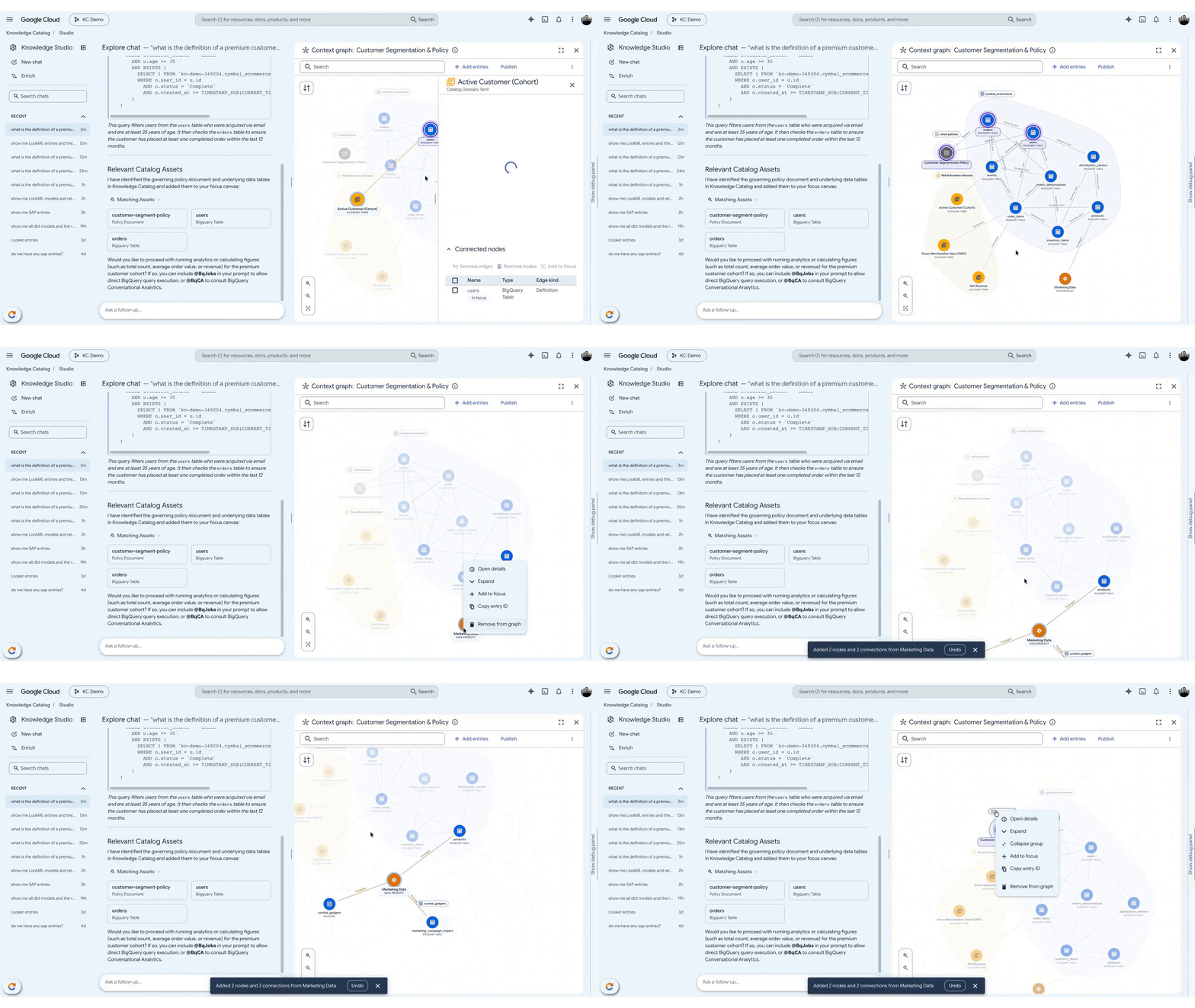
New studio experience in Knowledge Catalog showcasing conversational context exploration and an interactive graph
Additionally, we announced that Knowledge Catalog is now on by default in Gemini, in preview. Every data question is now grounded in a governed business context automatically. When you connect BigQuery, AlloyDB, Cloud SQL, or Spanner, Knowledge Catalog resolves business terms, locates trusted tables, and determines join paths before generating SQL — under each user’s own access permissions. This gives organizations the confidence to deploy agents at enterprise scale because your agents draw from shared, registered context sets for consistent accuracy, lower latency, and reduced token costs.
Finally, because critical business definitions cannot be left to an LLM’s guesswork, Knowledge Catalog grounds agents in trusted semantic models, now generally available, from BigQuery, Looker (LookML), Databricks, Snowflake, dbt, and SAP, without moving data. Whether an agent is calculating net revenue for finance or customer churn for operations, it applies the exact same governed formulas your business teams rely on. Knowledge Catalog also extends metadata discovery and federation to Oracle AI Database@Google Cloud, Snowflake, Databricks Unity Catalog, and third-party catalogs like Atlan and Collibra — building on the catalog investments you’ve already made so your entire data estate is universally understood by every agent.
Transforming practitioner experiences with agents
We are reimagining how data professionals and business teams work — elevating practitioners from individual contributors supported by co-assistants, into orchestrators of autonomous agents that drive intent-driven business outcomes.
For both technical teams and everyday business users, we introduced two new purpose-built capabilities in Gemini, at the recent Gemini at Work event. For Data and ML engineers, we are extending Gemini with machine learning skills and tools that back every data scientist and data engineer with a team of agents. Engineers describe the outcome they want in plain language, and Gemini generates PySpark code, provides notebooks to edit and test it, trains models, and troubleshoots and fixes pipeline issues on its own. And for business users, anyone in your organization can generate reliable, real-time operational reports simply by asking. Gemini uses operational reporting skills integrated with BigQuery and the Knowledge Catalog to construct and save the query. Once saved, teams can run reports on demand without incurring token costs, guaranteeing consistent, verified answers every time.
Now, for developers who'd rather stay in their own tools, we recently announced the general availability of the Data Agent Kit. It eliminates console hopping and ETL boilerplate by integrating Google Data Cloud tools directly into your developers' preferred IDEs and CLIs — like VS Code, Claude Code, and Antigravity. Armed with native MCP tooling, practitioners define business intent and let agents generate, tune, and test data pipelines.
Engineering a data infrastructure built for agent scale
As organizations scale to millions of agents collaborating across workflows, traditional database architectures break down. We’re introducing tailored infrastructure engineered specifically for agent scale.
To accelerate rapid testing and prototyping, today we’re announcing AlloyDB Express, in preview. This is a new edition of AlloyDB designed for builders and coding agents who need extreme development velocity. It offers sub-2-second instant provisioning, scale-to-zero pause and resume, secure private IP connectivity, integrated observability, and a small footprint with 1–2 vCPUs and 20GB of storage. AlloyDB now provides a developer-first, PostgreSQL environment for agent development and testing.
For production environments, we recently announced PostgreSQL for agents in AlloyDB, in preview, which enables thousands of collaborating AI agents to query live transactional data with complete workload isolation. With the agentic database architecture, agents achieve sub-millisecond I/O, and terabit-per-second aggregated scan throughput, supporting over 3 million queries per second. Compute scales automatically based on active reasoning sessions and scales back to zero when idle without affecting production systems.
For running open-source data infrastructure, Managed Service for Apache Spark extends its price-performance advantage compared to market alternatives by over 3x through further improvements to Lightning Engine. Recent enhancements for Spark 4.0 include faster startup at no additional cost, beneficial for interactive workloads and small batch ETL jobs. In addition, the premium tier provides performance boosts by pairing upgraded hardware with software acceleration from the Lightning Engine, and this is on by default.
Finally, we’ve continued to enhance BigQuery for agent scale. In the past year alone, we've made queries over 40% faster while cutting query processing cost by more than 50% through intelligent optimizations like fluid scaling and built-in workload acceleration. BigQuery Graph is now generally available, bringing petabyte-scale graph analytics directly on relational tables with zero ETL. It allows organizations to model data as nodes and edges to uncover complex, hidden relationships without moving data into a separate graph database. And today, two new models from Google Research run natively in BigQuery. The first is TimesFM 3.0, now in preview, which lets you generate forecasts directly in SQL with no custom models to train or manage and TabFM, also now in preview, which brings predictive machine learning directly into BigQuery.
Get started today
In addition to these announcements, we continue to enhance core performance, cost management, and operational resilience across our broader data ecosystem.
Ready to transform your data estate into an active System of Action? Explore our Agentic Data Cloud page, sign up for a Data Strategy Workshop and start building your agentic enterprise, at no cost, with Google Cloud.
You can also head over to our Trusted Agents, Real Outcomes digital event to catch our Agentic Data Cloud vision and the latest innovations. See the portfolio in action, learn from Yahoo’s real-world blueprint, and unpack deep-dive sessions with product leaders across Databases, Data Analytics, and BI.