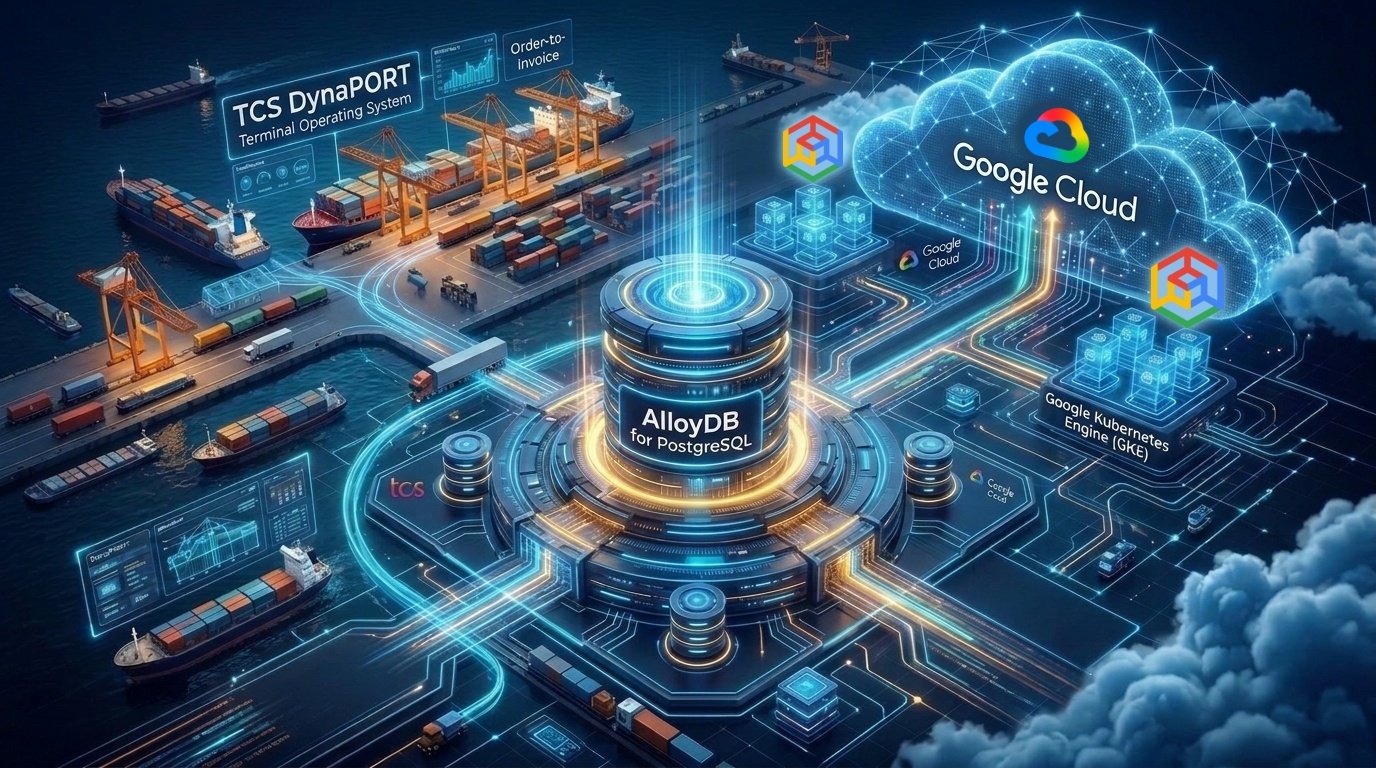
DynaPORT modernization on Google Cloud with AlloyDB for PostgreSQL and GKE
Trushar Borse
Practice CE, Data Management
Himanshu Shekhar
Ports & Cargo Business, TCS
In global maritime logistics, Marine Ports and Terminals play a significant role in the movement of container and cargo, within and beyond. Marine ports and terminals world-wide use a Terminal Operating System (TOS) which acts as the central nervous system managing port operations 24 hours a day, 365 days a year. A modern TOS plans, automates and orchestrates every physical and digital activities, resources and events across Order-to-Invoice processes of a marine terminal.
Developed by Tata Consultancy Services (TCS), DynaPORT is a field-proven next-generation Terminal Operating System that provides a single, integrated operating backbone for multimodal and multipurpose terminals. It orchestrates the complete order-to-invoice lifecycle across vessel, rail, truck, and barge operations, while supporting containers, general cargo, dry and liquid bulk, break-bulk, and roll-on/roll-off cargo. By automating end-to-end terminal workflows, DynaPORT delivers real-time operational visibility into operations while optimizing assets and resources to drive improvement of key business performance indicators.
One of India’s largest commercial port developers and operators has relied on DynaPORT for more than two decades across its cargo terminals, supporting the management of bulk, break-bulk, and liquid cargo. To modernize the platform’s architecture, TCS partnered with the customer to achieve a landmark milestone: migrating DynaPORT to a modern, cloud-based architecture.
The Port Operator & TCS partnered with Google Cloud to execute an ambitious cloud modernization journey. Modeled after the architectural principles of high-velocity Google Cloud enterprise transformations—this case study details the systematic deconstruction of legacy technical debt, the strategic rationale and enterprise differentiators of choosing AlloyDB for PostgreSQL, the target Google Kubernetes Engine (GKE) and AlloyDB cloud-native architecture, the heterogeneous migration of over 1.2 million lines of code using Google Cloud Database Migration Service (DMS).
1. The Legacy Technical Debt: Deconstructing the Monolith
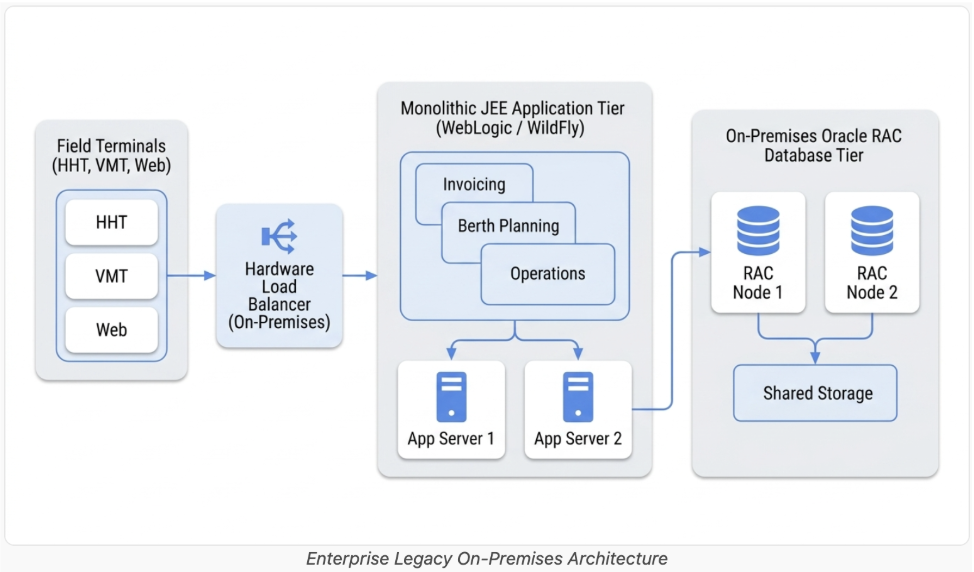
Enterprise logistics platforms that evolve over decades inevitably accumulate architectural debt, particularly through tightly coupled components. DynaPORT Cargo followed this pattern: successive releases and architectural transitions gradually transformed the platform into a classic multi-tier monolith, with its components carrying significant technical debt.
The Procedural Stored-Procedure
Over years of optimization for sub-millisecond on-premises database round-trips, fundamental business logic had been progressively migrated out of the application tier and embedded directly into the database engine. In the DynaPORT Cargo module alone, the core schema contained:
-
2,760 Tables and 555 Sequences
-
262 Packages containing over 1.2 million lines of code
-
54 Stored Procedures, 53 Functions, and 63 Database Triggers
-
Cross-schema User-Defined Types (UDTs)
-
Critical business operations—such as multi-tiered marine invoice tariff calculations, dynamic slab rating, berth allocation planning, yard truck assignments, and autonomous error logging—were entirely governed by complex, multi-thousand-line PL/SQL procedures. The database was no longer merely a relational persistence store; it was the primary execution engine of the enterprise.
Monolithic JEE Middleware and Packaging
The application tier was hosted on monolithic WebLogic and WildFly application servers running on static on-premises virtual machines. The application relied on legacy Java Enterprise features, including Enterprise JavaBeans (EJBs), custom Object-Relational Mapping (ORM) dialects, and heavy configuration state. Modules including Revenue Management, Berth Planning, Gate Operations, and Reporting shared common JVM heaps across application servers. A performance spike in batch invoice generation could starve memory from real-time Handheld Terminals (HHT) used by container crane operators on the quayside.
Absence of Modern Automation and Fragile Release Cycles
Because business logic was fragmented across Java application binaries and raw database packages, continuous delivery was practically non-existent:
-
Manual Deployment Runbooks: Releases required multi-hour maintenance windows involving manual execution of sequential SQL scripts, package recompilations, and server restarts.
-
High Regression Risk: In the legacy schema with 262 interdependent packages, modifying a single package specification frequently invalidated dozens of dependent functions, views, and synonyms, triggering cascading runtime failures.
-
Environment Drift: Development, testing, and production environments suffered from configuration divergence, requiring lengthy manual reconciliation before any production cutover.
Commercial Licensing Penalties and Vertical Limits
Licensing fees scaled linearly with physical CPU core counts, penalizing the business whenever hardware was scaled to accommodate peak cargo vessel traffic. Furthermore, high-availability setups required complex shared storage arrays, specialized interconnects, and heavy administrative overhead from dedicated database administrators (DBAs).
2. Strategic Evaluation: Why Google Cloud and AlloyDB for PostgreSQL?
When architecting the cloud transformation, the joint architecture teams from the customer, TCS, and Google Cloud evaluated two fundamentally different modernization strategies:
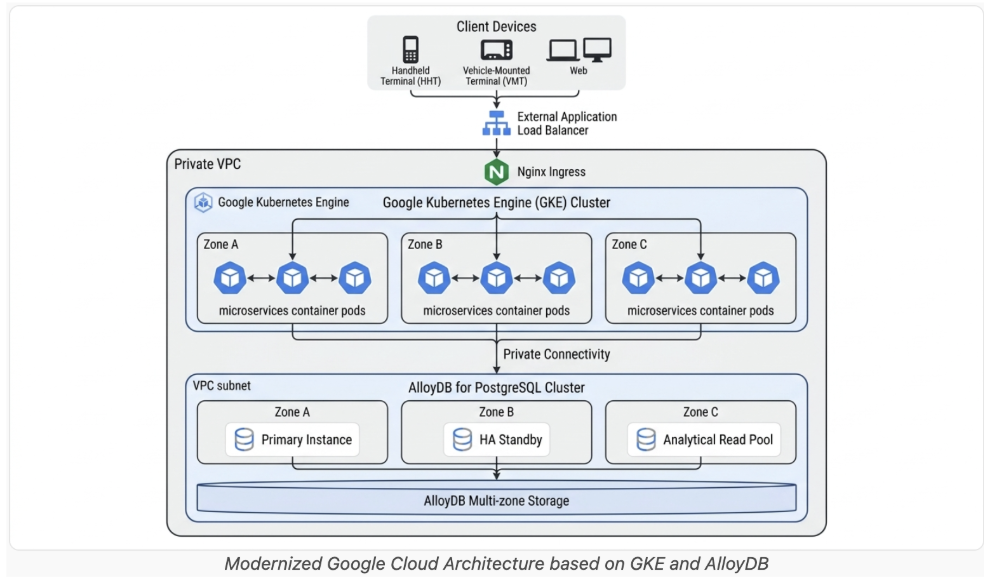
3. The Modernized Architecture: AlloyDB + GKE Based Architecture
The target cloud architecture was designed according to the Google Cloud Architecture Framework, transforming the monolithic JEE middleware into modern containerized microservices orchestrated on Google Kubernetes Engine (GKE), coupled with an enterprise AlloyDB for PostgreSQL cluster.
4. Migration Execution & Code Remediation
The cornerstone of the migration was converting over 1.2 million lines of deeply intertwined Oracle PL/SQL procedural logic into PostgreSQL PL/pgSQL. The team utilized Google Cloud Database Migration Service (DMS) with its built-in Conversion Workspaces and Gemini-assisted AI code refactoring to accelerate bulk transformations.
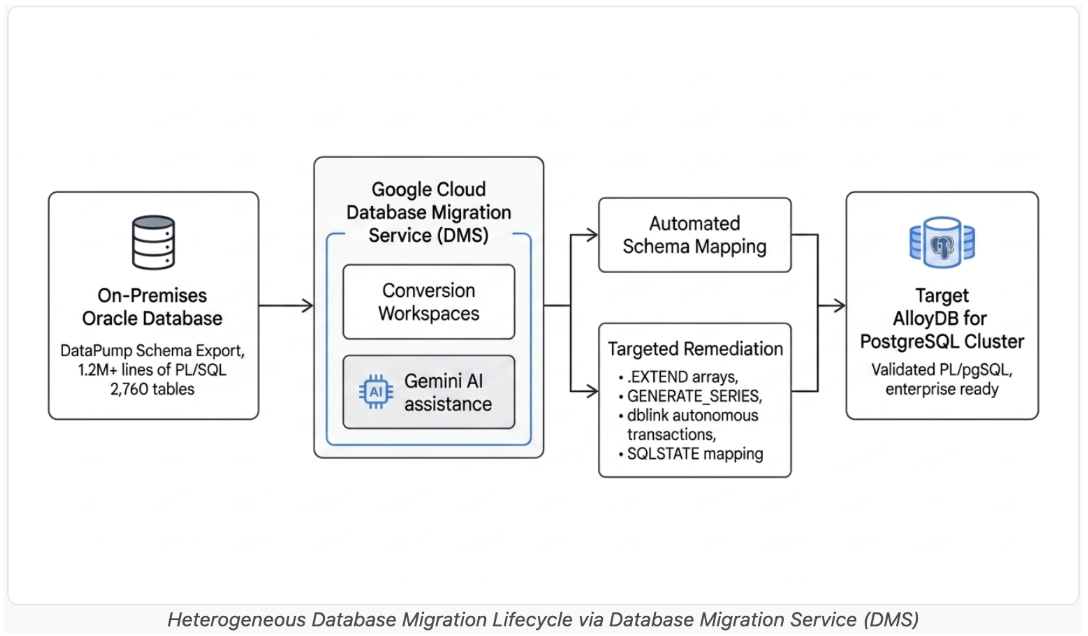
While DMS automatically converted the majority of standard DDL constructs, functions, and queries, the remaining (~15%) involved complex Oracle proprietary idioms that required targeted engineering remediation. Couple of examples of the manual intervention.
5. Business Outcomes & The Future of Smart Ports
In April 2026, the modernized DynaPORT platform on Google Cloud went live in production at one of the newest ports in India, achieving a seamless, low downtime cutover. By Aug’26, 3 more terminals have gone live on this.
Quantifiable Operational and Financial Impact
Conclusion: Key Lessons for Enterprise Modernization
The successful cloud migration of DynaPORT yields three fundamental architectural lessons for enterprise IT leaders:
-
Do Not Throw Away Proven Intellectual Property: Fully rewriting mission-critical procedural logic into application code is often a high-risk anti-pattern. Migrating from Oracle PL/SQL to open PL/pgSQL on an accelerated engine like AlloyDB preserves decades of tested business rules while modernizing the infrastructure platform.
-
Select Database Engines Built for Cloud Realities: Standard open-source relational engines often struggle with extreme enterprise throughput without extensive tuning. AlloyDB’s disaggregated storage architecture, columnar acceleration, and built-in ML intelligence provide the enterprise muscle needed to replace legacy commercial database engines.
-
Containerize Application Workloads on GKE: Decoupling the application tier into independently scalable container pods on Google Kubernetes Engine provides the elasticity and resilience necessary to absorb rapid operational surges without affecting core database stability.
Ready to modernize your legacy enterprise applications?
Schedule a Google Cloud Architecture Blueprint Workshop with your Google Cloud Account Field team today. We will engage as an important stakeholder to evaluate your current legacy setup and help design a low-risk, high-performance migration pathway using Google Cloud services like AlloyDB and Google Kubernetes Engine.