Modeling a digital twin of a food supply chain using BigQuery Graph
Guru Rangavittal
Cloud Transformation Technical Lead, Google Cloud
Candice Chen
Product Manager
The example of a growing restaurant
Imagine you are running a restaurant chain. You just can't physically feel and touch things to know how your business operates. You need tools and a digital replica of your business to sense the health of the business for you.
The friction of growth
Growth creates a unique kind of friction that spreadsheets simply weren't built to solve:
-
The bullwhip effect: Small downstream demand shifts swell into upstream inventory tidal waves.
-
SOP drift: Tiny departures from standard prep work eventually erode the entire brand vibe.
-
The food safety blast radius: One contaminated ingredient creates a messy, complex map of risk across the network.
-
Maverick spend: The "million-dollar leak" caused by local managers purchasing ingredients off-contract.
The digital twin
Digital models empower us to ask more insightful questions about the world, but they also force a critical choice in how we structure data. While traditional relational tables have been the standard, we must ask: are they still the right tool for everything? Given that our world is inherently interconnected, perhaps shifting to graph-based models is the natural evolution for capturing reality.
When managing thousands of assets, complex supply chains, or global logistics networks, traditional relational databases require massive, resource-intensive SQL joins to trace dependencies. This architecture creates a latency gap between physical events and operational awareness.
Modeling with BigQuery Graph
BigQuery Graph allows you to build a digital twin of your entire supply chain within your existing data platform. By turning your physical world—items, recipes, and locations—into a searchable map of nodes and edges, you gain a new level of clarity.
1. Defining the Semantic Layer
Instead of moving data to a new database, you create a Graph View over your existing tables. This tells BigQuery exactly how your tables relate to one another.
Query Language:
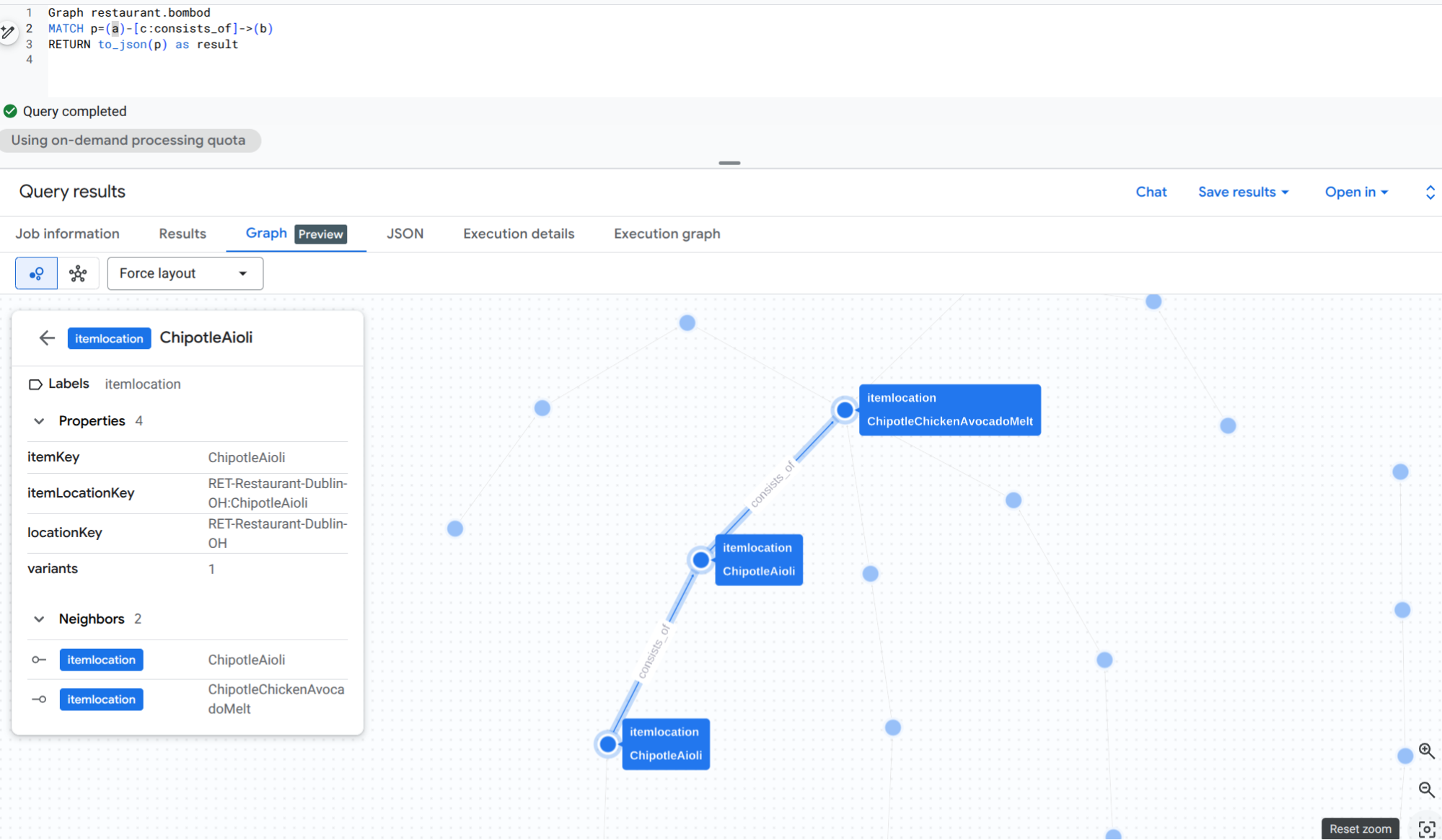
Image of a fictitious restaurant supply chain modeled using BigQuery Graph
Precision in practice
How does this change daily operations? It moves the business from panic to precision.
-
Surgical recalls: If a supplier reports a Listeria breakout, you walk the graph forward to find exactly which menu items in which specific restaurants are affected.
-
Weather risk analysis: When a hurricane threatens a distribution center, you don't see a list of stores; you see the blast radius. You identify the locations critically dependent on that hub and reroute supplies.
2. Executing the search
Graph Queries are a new tool for modelers and data scientists to query their data - it simplifies complex multi-domain data concepts and simplifies querying and makes data analysis a simpler more natural representation of problem articulation. For example: If I want to know which all locations handle chicken I could run a graph query as shown below:
To investigate a specific complaint or risk, you run a search on the model using graph query language.
Graph Query Language
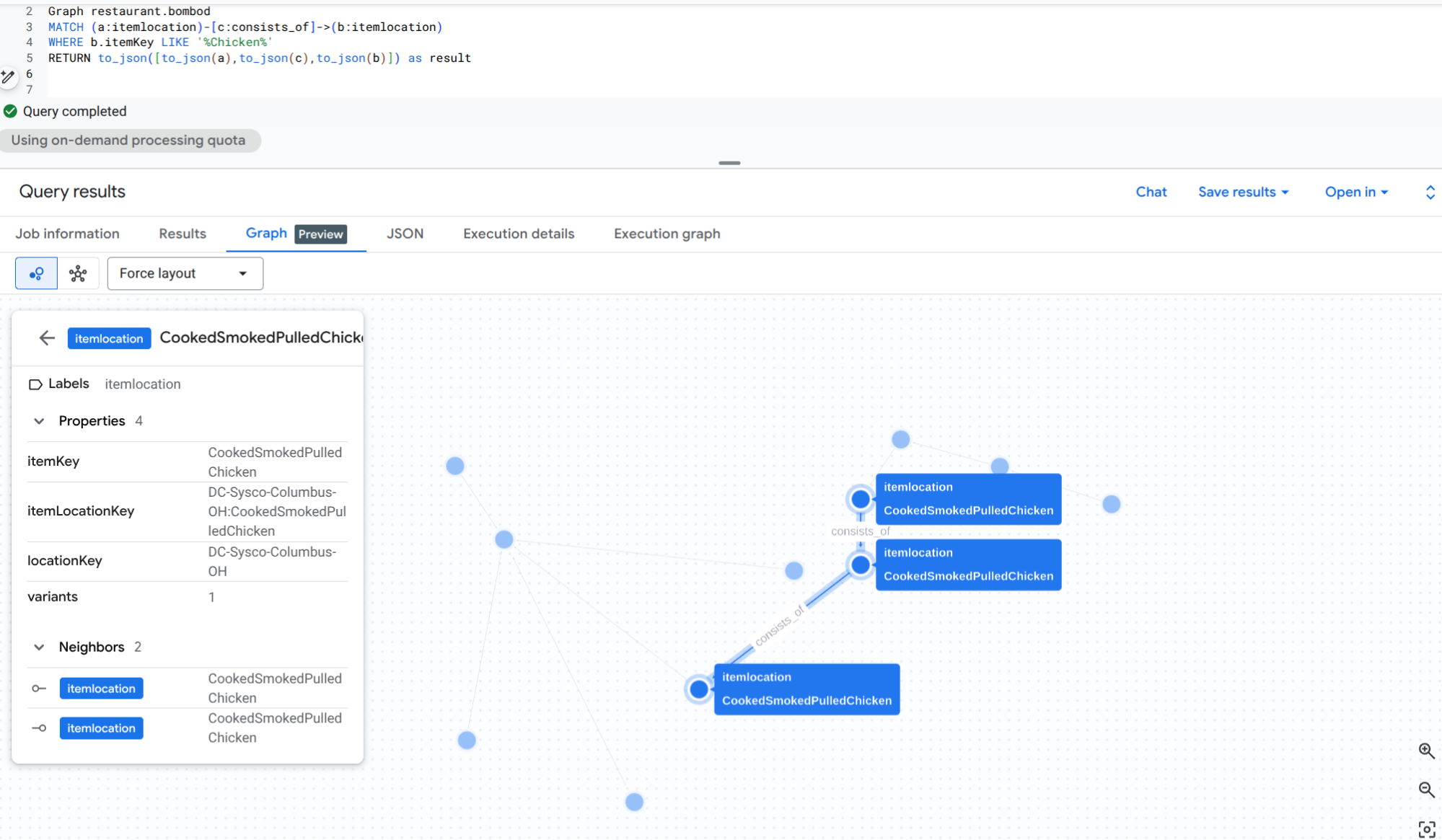
Source of a foul odor - modeled as a graph
Building for the future
To get the most out of your digital twin, follow these guiding principles:
-
Focus on structure: Use graphs for relationships and dependencies; keep daily sales totals in relational tables.
-
Clean your keys: Spend time on data engineering; a graph is only as strong as its connections.
-
Capture edge properties: Store metadata like lead times or shipping costs directly on the edges to increase the model's utility.
Conclusion
The restaurant industry has outgrown the relational way of treating business data only as a list. By building inter-domain relationships as a digital twin with BigQuery Graph, you move from reactive problem solving to proactive modeling. It’s time to stop managing your network with a list and start seeing the connections in seconds.
Get started today
-
Check out the tutorial here
-
Visit the BigQuery documentation: find overview and quickstart guide.
-
Share your feedback: join our community, and get your questions answered via bq-graph-preview-support@google.com.
- Related blog: Introducing BigQuery Graph