How to modernize Apache Hive using Google Cloud’s Lakehouse runtime catalog
Vinod Ramachandran
Product Manager
Pratibha Suryadevara
Vice President
For over a decade, the Apache Hive Metastore (HMS) has served as the de facto metadata authority for big data analytics. Whether it was deployed on Hadoop clusters, self-managed Compute Engine VMs backed by MySQL or PostgreSQL, HMS provided the central schema registry that let Apache Spark, Presto, and Hive query raw .parquet and .orc files.
However, as enterprise data architectures scale to petabytes and span multiple query engines (such as Google Cloud Managed Service for Apache Spark, BigQuery, and Trino), legacy Hive Metastores often become critical operational bottlenecks.
In this blog, we explore why legacy metastores struggle in modern cloud environments at agent scale, and show you how the serverless Google Cloud Lakehouse runtime catalog that we introduced last year can help: Built on the open Apache Iceberg REST catalog specification, it is a runnable, zero-data-copy migration solution to help you transition your production Hive tables in minutes.
The challenges of legacy Hive Metastores
When speaking with data engineers and infrastructure leads running production analytics at scale, three core pain points consistently emerge with standalone Hive Metastores:
Architectural and scaling bottlenecks
Standalone HMS deployments rely on relational database backends (such as MySQL or Postgres) to track table schemas, partitions, and storage locations. As data lakes grow to hundreds of thousands of partitioned tables, partition pruning and bulk listing operations lead to key performance bottlenecks on the relational database. A complex Spark job requesting partition metadata can spike metastore CPU to 100%, causing cluster-wide query delays or out-of-memory (OOM) failures.
Siloed identity and security governance
Legacy metastores were designed around perimeter-based Hadoop security models. Enforcing modern granular data governance — such as table-level access control lists (ACLs) — across both Apache Spark compute jobs and enterprise SQL engines like BigQuery requires maintaining fragmented, duplicated security policies across two distinct control planes.
Operational overhead and total cost of ownership (TCO)
Managing high-availability MySQL/Postgres instances, patching HMS daemons, tuning JDBC connection pools, and paying for idle instance-based metastore servers creates unnecessary operational toil for data platform teams, whose time is better spent building high-leverage data products for agents.
The solution: Lakehouse runtime catalog
To solve these architectural bottlenecks without forcing data engineers to rewrite petabytes of existing storage payloads, we built the Lakehouse runtime catalog with support for Iceberg Rest Catalog and Hive Catalog.
The Lakehouse runtime catalog is a fully serverless, highly available, and unified metadata registry designed from the ground up to support both legacy Hive/Parquet tables and modern open table formats like Apache Iceberg. By natively implementing the Apache Iceberg REST Catalog specification, the Lakehouse runtime catalog decouples metadata discovery from compute engines. This decoupling of the catalog and compute engines ensures multiple Iceberg compatible engines can access the same data in a zero copy fashion thereby reducing the need for customers to maintain multiple copies of the data and enables them to take their workloads to production sooner.
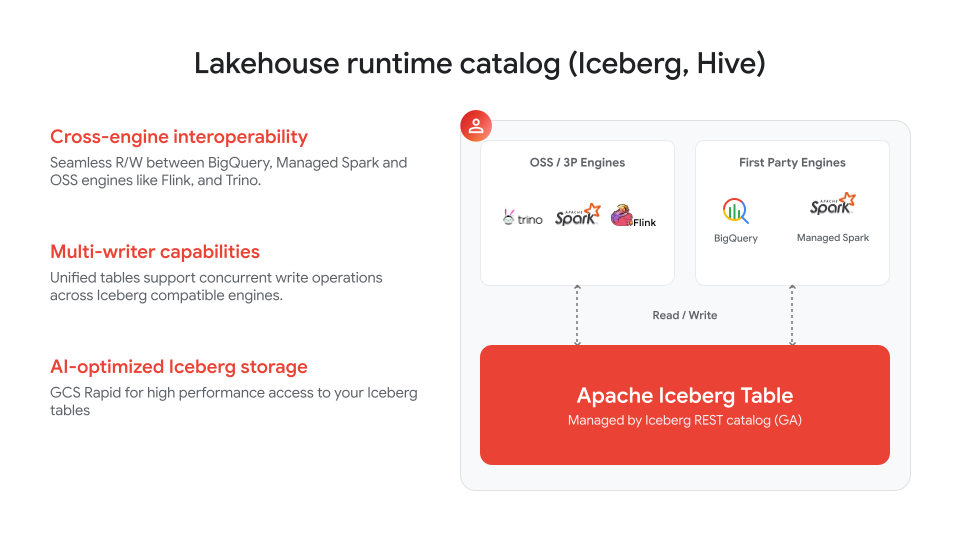
This approach offers a number of architectural benefits:
- Multi-engine interoperability: Once registered, tables are immediately discoverable and queryable across Google Cloud Managed Spark, BigQuery, and open-source engines via standard REST interfaces.
- Open APIs: Supports Iceberg Rest Catalog and Hive Catalog which enables different teams to use their preferred analytics tools on a single, unified dataset.
- Zero-data copy: Table definitions point directly to your existing data in Google Cloud Storage. You do not move, rewrite, or duplicate your underlying data.
- AI-powered governance, security and trusted context: The Lakehouse runtime catalog integrates directly with Knowledge Catalog and Cloud IAM, allowing you to define trusted context for your agents and table-level security that apply consistently across all compute engines. Further it supports key authorization mechanisms, such as credential vending. This means you can access your tables without needing direct access to the files in the underlying Cloud Storage bucket.
- Enterprise-readiness, scale and reduced TCO: Backed by Google’s planet-scale infrastructure and Spanner, enabling your metadata to scale with your data. Support for Cloud Storage dual-region and multi-region buckets enables failover use cases. It also provides reduced TCO due to serverless and no-ops environments, and scalability for any workload size.
Zero-copy migration from legacy Hive Metastore in action
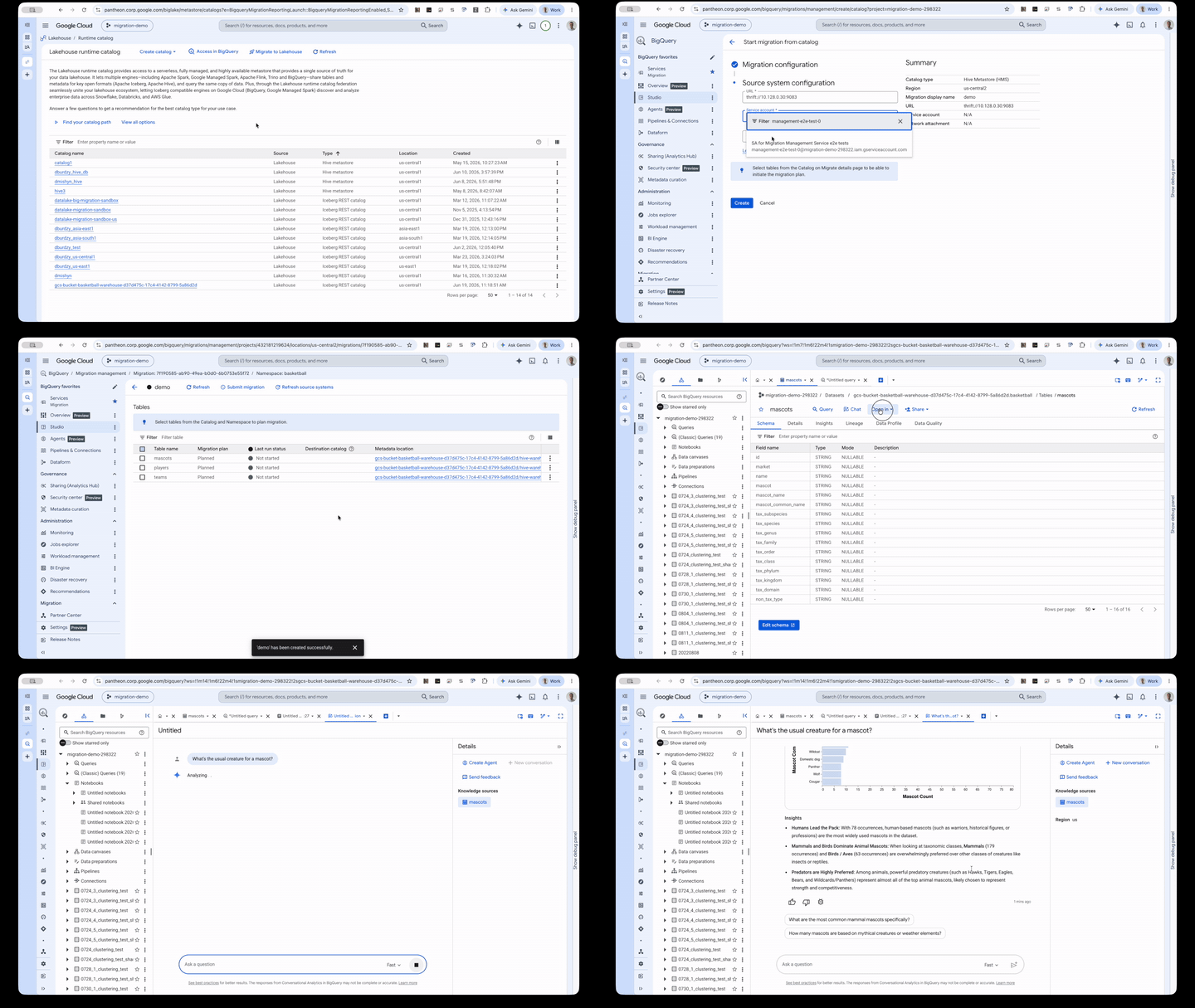
To demonstrate how smooth cutover is in practice, we have provided a capability that lets you modernize your legacy self-managed Hive Metastore to the Google Cloud Lakehouse. This capability connects directly to your legacy Hive Metastore, extracts external table definitions and partition maps, and registers them cleanly into the serverless Lakehouse catalog and then start using the data in Google Managed Spark, BigQuery and Conversational Analytics agents with Gemini.
Modernize to the Lakehouse and immediately tap your data in key agentic journeys
Ready to modernize your data architecture?
Modernizing from a legacy Hive Metastore to Google Cloud’s Lakehouse minimizes data silos across analytics engines and agents, unifies multi-engine governance, provides trusted context to your agents and slashes operational TCO. In other words, it helps prepare your modern cloud environments to operate at agent scale.
Get started and migrate your Apache Hive Metastore tables to Google Cloud today, and get ready for the agentic era. Learn more about Google Cloud Lakehouse here.