Google is a Leader in the 2026 Gartner® Magic Quadrant™ for Cloud-Native Application Platforms
Ines Envid
Sr. Director, Product Management
Lisa Shen
Product Manager, Google Cloud
We are thrilled to announce that Google has been recognized as a Leader for the third year in a row in the 2026 Gartner® Magic Quadrant™ for Cloud-Native Application Platforms (CNAP). We believe this placement in the Leaders quadrant validates our commitment to providing an accessible, developer-centric platform that accelerates onboarding and supports rapid prototyping across modern workloads.
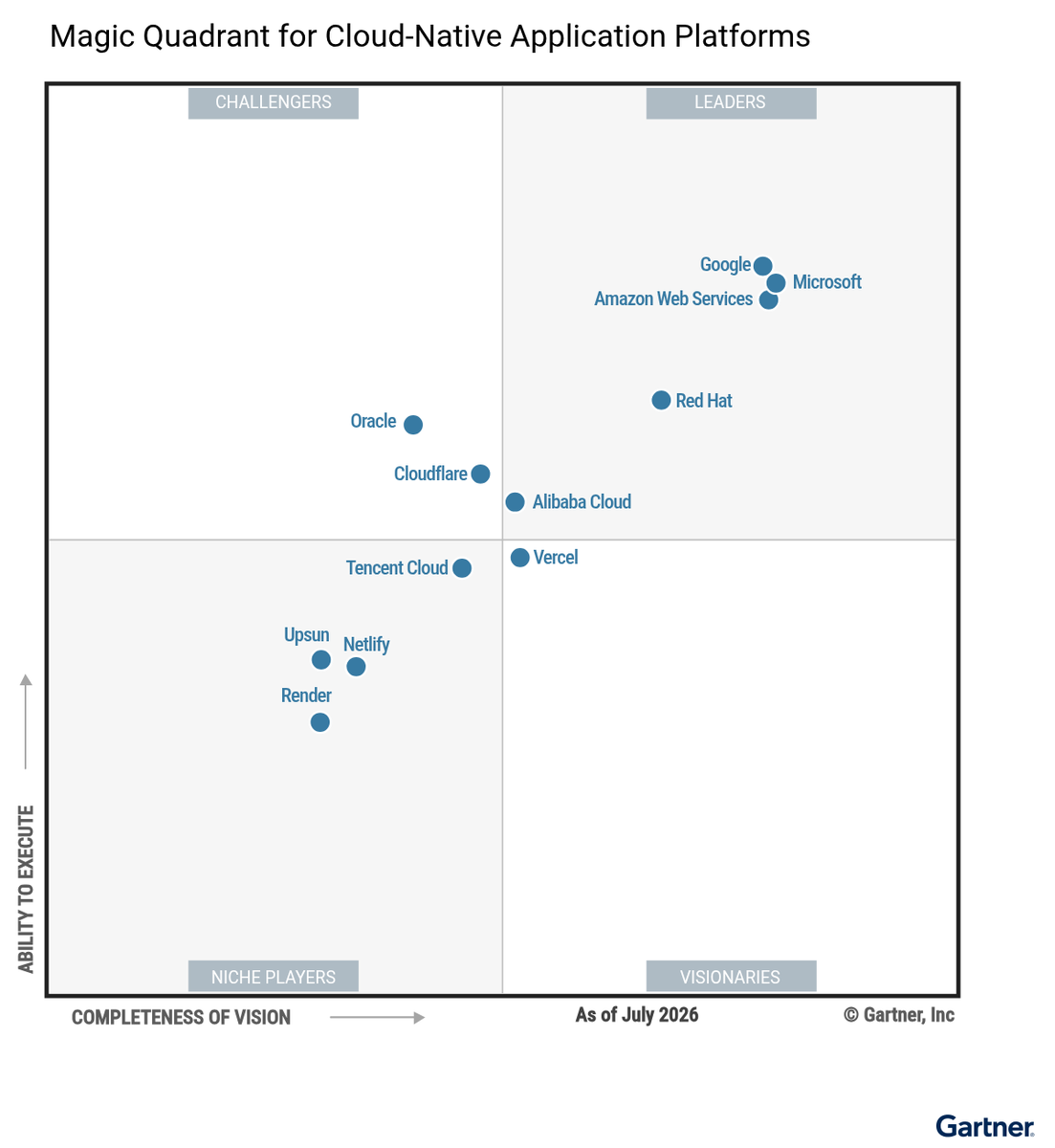
Our vision for an application-centric cloud focuses on enabling developers to prioritize writing code and building agents or traditional apps by removing infrastructure complexity. Google Cloud provides a unified execution environment supporting serverless, containerized, and agentic deployment options. We believe our placement highlights Google's unique readiness to power both standard enterprise microservices and the next generation of autonomous AI applications.
Some key features and capabilities of our platform are highlighted below.
From idea to implementation
Generative AI has ushered in a wave of vibe coding, allowing anyone to go from an idea to a deployed application in a fraction of the time it used to take. To make this even smoother, Google Cloud integrates its serverless infrastructure with AI vibe-coding and prototyping tools. We also simplify access to Google Cloud resources with tools like managed MCP servers and agentic skills — packaged sets of instructions, scripts, and resources to teach an AI how to complete specialized, multi-step workflow.
-
One-click prototyping in Google AI Studio: Developers can build and deploy full-stack applications directly within Google AI Studio, making it a great environment for prototyping and experimentation. With a single click, you can instantly package and publish your vibe-coded applications to Cloud Run.
-
Google-managed MCP servers: To enable AI agents to interact with cloud resources, we support official, fully managed remote MCP servers. An example is the Cloud Run MCP server (via run.googleapis.com/mcp), which allows developers to easily launch endpoints and deploy server-side logic. The MCP tools are deployed with a simple config, skipping cloud builds to launch code in seconds, saving valuable developer time. These fully managed servers are integrated with IAM and VPC Service Controls, and they leverage Model Armor for content security.
-
Google's official Skills Repository: Level up your agents with additional, condensed expertise on various Google Cloud technologies. Published and available in Agent Registry, the repository includes skills for Cloud Run, the Well-Architected Pillar (security, reliability, and cost optimization), and more.
Ready to try vibe coding yourself? Get hands on with this codelab to build a vibe-coded app and deploy it to Cloud Run.
From implementation to enterprise-ready
Translating prototypes into production-grade, secure, and cost-effective enterprise software is where Google Cloud excels, with a full suite of developer, architect, and platform engineering tools. From designing your application to optimizing day 2 operations, we offer the services and tools to help you build, operate, and deploy applications across their entire lifecycle, and you have the freedom to build with any language, any library, and any framework.
Build
-
Build with Google Antigravity: At Google, we’re simplifying and expanding our development ecosystem behind the Antigravity harness, collapsing developer silos into a unified orchestration layer. By integrating multi-step AI reasoning directly into the developer workflow, Antigravity natively brings local codebase development to our cloud-native application platforms (e.g., Cloud Run).
-
Design and deploy with Application Design Center (ADC): Now, you can bridge the gap between developer velocity and enterprise control, using Application Design Center to eliminate manual Terraform and YAML configuration. This platform engineering component helps teams design, standardize, and deploy template-driven applications on Google Cloud. It is also integrated as part of Gemini Cloud Assist design agent and published as an MCP server. With ADC, you can visually design your architecture using Cloud Run services, databases, and event brokers backed by automated Gemini Cloud Assist security templates. Beyond human-guided design, ADC enables programmatic orchestration at the time of no HITL (Human-in-the-Loop), allowing automated pipelines to provision policy-governed Terraform configurations directly and autonomously.
Operate
-
Intelligent investigations: Integrating Gemini Cloud Assist with native telemetry creates an AI-driven framework for Day-2 incidents. When alerts fire, operators engage Gemini Cloud Assist to instantly synthesize logs and metrics, pinpoint root causes, and generate remediations — context that can be handed off to accelerate support escalations. Crucially, IAM permissions strictly govern all AI recommendations, and help to ensure explicit human-in-the-loop approval are required before any infrastructure changes occur.
-
Cost analysis and optimizations: Machine learning algorithms learn natural seasonal traffic cycles to detect cost anomalies within minutes, triggering notifications to protect your bottom line without risking destructive infrastructure shutdown.
Deploy
-
Reliability and high availability: Cloud Run is a regional service by default, but you can deploy an app to multiple regions via a single gcloud command. Integrated with service health, Cloud Run automates cross-region failover and failback. If a service in one region becomes unhealthy, traffic is automatically routed to the next-closest healthy region, failing back once the issue is resolved.
-
An open platform: As a long-time and top contributor to the Cloud Native Computing Foundation (CNCF), we operate with an open-source-first strategy. By integrating foundational, community-driven technologies, we help enable application portability for enterprise customers who are increasingly demanding multi-cloud flexibility
Ready to start deploying your apps to Google Cloud? Get hands on with these codelabs:
From enterprise-ready to autonomous
AI agents are software’s next frontier. They offer more than just increased productivity and efficiency; they can unlock exponential growth. To provide enterprises with robust agentic deployment options, Google Cloud provides a dedicated infrastructure stack tailored specifically to host, govern, and secure autonomous agent fleets. This stack seamlessly integrates with our Agent Development Kit (ADK) as well as other leading agentic frameworks to give developers maximum flexibility.
Gemini Enterprise Agent Runtime
At the core of this stack is Gemini Enterprise Agent Platform and its dedicated Agent Runtime, which delivers the serverless and containerized deployment options you need for enterprise-scale agent development, including the following capabilities:
-
Native personalization: Built-in sessions and memory banks manage context and long-term state, preventing costs from ballooning.
-
Agent observability and tracing: Built on OpenTelemetry (OTel) standards and agentic schemas, turnkey dashboards feature agent topology graphs and interactive trace logs that detail sessions, tool calls, and reasoning paths.
-
Agent evaluation and simulation: Automated simulation tools allow developers to test agents against golden sets with side-by-side comparisons and simulate thousands of interactions to test edge cases.
Hosting agents on Cloud Run
For customers requiring additional flexibility, granular control, or specific regulatory compliance, Cloud Run serves as an excellent serverless alternative to host your agents. Some of its latest features include:
-
Cloud Run instances (coming soon): This primitive manages individual, addressable, long-running singleton resources with integrated Cloud Storage volume mounts, allowing persistent background agents to be deployed cost-effectively.
-
Cloud Run sandboxes: Hard-isolated environments spin up in under 500 milliseconds to safely execute untrusted, model-generated code, protecting the host system from unauthorized access.
Agent security, governance, and auditability
To securely deploy AI agents and prevent unmanaged shadow AI, enterprises need an ironclad governance framework. Google Cloud delivers this through Agent Identity (non-human IAM with cryptographic IDs) to provide an auditable trail of all actions and reasoning; a centralized Agent Registry to manage approved agents, skills, tools and application artifacts, and prevent unauthorized tool integrations; and an Agent Gateway to proxy traffic, enforce Model Armor policies, and actively block destructive actions. These features are available on Agent Runtime today and will be available soon on Cloud Run and Google Kubernetes Engine (GKE).
Ready to start deploying agents? Check out various codelabs featuring Gemini Enterprise Agent Platform here.
Build the future of cloud-native applications
Whether you’re a vibe coder deploying your first full-stack application, a software architect standardizing production microservices, or an enterprise team scaling a fleet of secure AI agents, Google Cloud delivers the simplicity, elasticity, and security you need. Read the full report: Download your complimentary copy of the 2026 Gartner® Magic Quadrant™ for Cloud-Native Application Platforms (CNAP).
Magic Quadrant for Cloud-Native Application Platforms, By Mukul Saha, Alex Coqueiro, Prasanna Lakshmi Narasimha, Richard Watson, 3 August 2026
Gartner and Magic Quadrant are trademarks of Gartner, Inc. and/or its affiliates. This graphic was published by Gartner, Inc. as part of a larger research document and should be evaluated in the context of the entire document. The Gartner document is available upon request from Google.
Gartner does not endorse any company, vendor, product or service depicted in its publications, and does not advise technology users to select only those vendors with the highest ratings or other designation. Gartner publications consist of the opinions of Gartner’s business and technology insights organization and should not be construed as statements of fact. Gartner disclaims all warranties, expressed or implied, with respect to this publication, including any warranties of merchantability or fitness for a particular purpose.