Using Google Cloud AI to measure the physics of U.S. freestyle snowboarding and skiing
Google Cloud Team
Nearly every snowboard trick carries a number. A 1080 means three full rotations. A 1440 means four. The convention is simple: add up every rotation around every axis and count in 180° increments. For decades it's served as the sport's universal shorthand for difficulty. Judges, coaches, and athletes all speak this language fluently.
It's also, by necessity, an over-approximation. Without sensors on the athlete's body, there was never a way to measure what happens mid-flight. The trick name counts planned rotations and assigns each one a full 360°. That was the best available approach — until now.
Working with U.S. Ski & Snowboard ahead of the Olympic Winter Games Milano Cortina 2026, we built an AI tool on Google Cloud that extracts full 3D biomechanical data from ordinary video. Using Gemini and frontier computer vision research from Google DeepMind, it turns any camera into a motion-capture system that can help with athlete training and analysis.
We built the tool to track rotational speeds, body posture, airtime, and more. The results were easily understandable to athletes and coaches. But when we started tracking the actual geometric rotation of athletes' bodies from takeoff to landing — across dozens of elite riders — we found a consistent gap between trick names and physical reality.
Consider U.S. Olympian Shaun White's Cab Double Cork 1440 from the 2017 U.S. Open in Vail — the trick famously dubbed the "YOLO flip,” because back then you'd have to be crazy to try it. The name breaks down like this: two off-axis inversions plus two horizontal rotations, each assigned a clean 360°, totaling 1,440°. White had been working on it for years before stomping it in competition, and it helped him win a seventh U.S. Open title by nearly ten points. When we measured the true geometric rotation of his 3D pose through space, the number came back at an estimated 1,122°. That 318° gap is a measure of mastery. The fewer degrees an athlete needs to complete a trick, the more precisely they've controlled the axis — and the more margin they have for style, amplitude, and a clean landing.
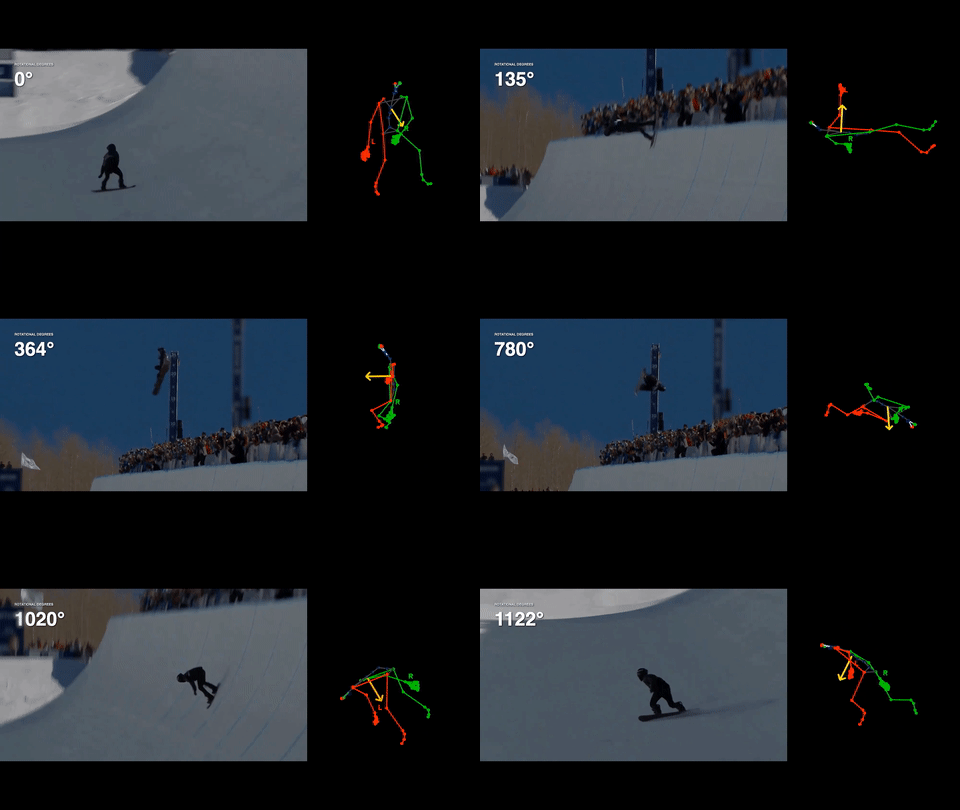
Cab Double Cork 1440 deconstructed: Side-by-side with the extracted 3D pose. Note that we utilized the athlete's shoulders as a proxy for board rotation.
The diagonal is always shorter
Two of the most common rotations in snowboarding are a flatspin and a cork. A flatspin keeps the rider mostly upright, spinning around a vertical axis. A cork tilts that axis 45°–60° from vertical, sending the athlete through a diagonal spiral. The naming convention treats both the same: it assigns 360° per rotation regardless of axis orientation.
The physics works differently. When an athlete rotates around multiple axes at once, the body traces a diagonal path across the sphere of possible orientations, which is a shorter path through space. Same principle as great-circle flight routing: the diagonal across a curved surface beats the sum of its straight-line components.

Visualizing the efficiency gap: While the Flatspin (Blue) travels the long way around, the Rodeo (Pink) takes the diagonal shortcut. Both land a "540," but the corked rodeo requires significantly less physical rotation to get there. (Simulated with coding assistance from Gemini.)
A peer-reviewed study in Sports Biomechanics (Merz et al., 2024) confirmed this across 149 tricks: corks showed a median shortcut of 25°, while flatspins showed a median detour of 21° — riders actually rotating more than assumed. The researchers hypothesized multi-cork tricks would amplify the effect. Our findings across elite riders confirm it.
How we measure it
The system powered by Google Cloud AI begins by extracting a 3D skeleton from video to determine body orientation at every frame. To get a stable reference through the chaos of a spinning athlete, we define a rigid Body Frame: a coordinate system built from the spine and shoulder axes, from which we derive an orthogonal torso axis. This frame tracks the athlete's core orientation independent of limb movement.
We represent that orientation using quaternions — a mathematical framework that handles multi-axis rotation cleanly, avoiding the singularities that make standard angle-based approaches break down when an athlete is corking through three axes at once.
From this foundation, two calculations:
Rotational Degrees. To measure total physical rotation, we treat the Body Frame's orientation as a quaternion at each frame and sum the angular displacements between them, from takeoff to landing:
This captures every degree the body actually travels through space — the full diagonal spiral of a cork, adjustments during grabs, deceleration into the landing.
Axis Tilt and the Cork Ribbon. To visualize the style of that rotation, we measure the angle between the Body Frame's instantaneous rotation axis and global vertical at each frame, weighted so the fastest-spinning phases dominate the measurement. The result is what produces the Cork Ribbon: a continuous surface tracing the athlete's rotational plane through the entire trick, making axis consistency — or drift — visible at a glance.
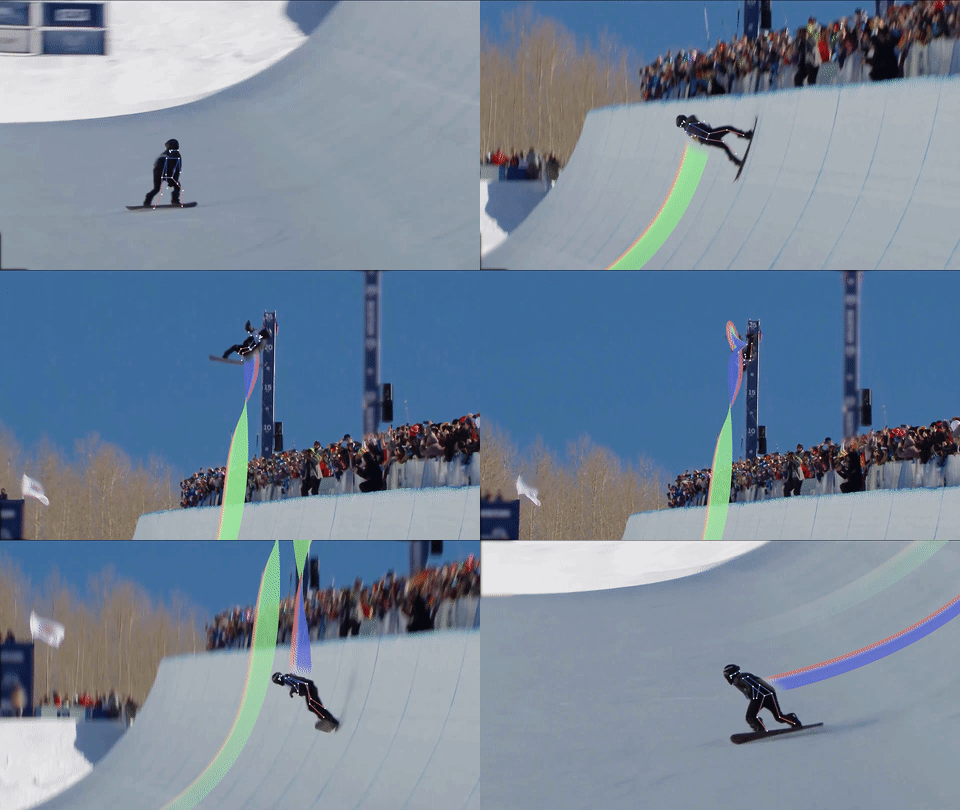
Introducing “Rotational Degrees”
If we labeled this "Rotation," a viewer seeing "1,270°" next to a trick called a "1440" would assume under-rotation. The two numbers just measure different things: the trick name captures convention; Rotational Degrees (or Rotational Magnitude) captures geometry.
Based on consultation with snow sports experts, we adopted Rotational Degrees for broadcast graphics and coaching tools — language the community can recognize as distinct from the trick name. It adds a layer of insight alongside the existing system.
In pursuit of rotational efficiency with Google Cloud AI
If corks create shorter routes, an athlete who masters axis tilt can reach higher-scoring trick names with fewer degrees of actual body rotation. And with less airtime needed, athletes have additional margin for style and clean landings. Coaches have sensed this for years. Now they can see if one rider's 1080 might measure 940° while another's measures 1,020°, and pinpoint where the efficient path diverges.
As athletes push toward quadruple corks and higher, Rotational Degrees may help answer which tricks are physically possible within the limits of airtime and human reaction. The trick name tells you what the athlete set out to do. Rotational Degrees tells you what physics is required to land it.
A huge credit to the Google Cloud team that delivered these insights: Alejandro Ballesta Rosen, Noah Bassetti-Blum, Hemanth Boinpally and Mike Santoro.