The innovator’s dilemma in travel: How leaders move from pilots to ROI

Joff Romoff
Global Market Lead for Travel & Hospitality
To keep up with consumer expectations, travel leaders must move beyond cautious pilots and embed AI across guest experiences and core operations.
In his classic 1997 book, The Innovator’s Dilemma, Clayton Christensen explained why market leading companies naturally tend to stagnate. Inertia sets in, he wrote, not because organizations lack vision, but because they’re incentivized to protect current revenue streams. Further, even as they languish, their most agile competitors are innovating dynamically, redefining the playing field, and capturing their market share.
The AI era has ushered in a new kind of innovator’s dilemma: invest in first-mover innovations or wait and try to copy winning strategies? This tension is not necessarily between established and new companies, but between organizations ready and willing to adopt bold and transformational efforts and those cautiously waiting on the sidelines.
In the fast-moving travel industry, where consumer preferences, economic conditions, and capital needs are always shifting, I’ll let you guess which is likely to be the better approach. Now let’s take a look at why.
The dilemma for travel and hospitality
Today, 92% of organizations are increasing their AI spend, according to McKinsey estimates, but many remain trapped in pilot purgatory. In the travel and hospitality industry, the innovators are the ones accelerating quickly beyond pilots and reinventing operations, guest experiences, frontline support, and advertising.
These industry leaders are setting the pace across travel and hospitality by embedding AI directly into their core business strategies. This aggressive approach demands more than novel ideas — companies must resolve to disrupt established models, even while they’re still profitable. Those that wait to see what works may well soon find themselves left behind with little chance to catch up.
That’s why the most forward-thinking travel brands are now focusing on four high-impact domains to help them move from experimentation to measurable return on investment:
Scaling personalized advertising
The days of legacy ad campaigns that take months to produce are quickly coming to an end. To reach travelers where they are, brands are increasingly taking their ad dollars to visually rich media platforms like YouTube and Google Maps, which travelers widely use for trip research, discovery, and planning.
By harnessing generative media, brands can craft contextual, hyper-personalized visual collateral and video content at scale. For example, by adopting BigQuery and the Gemini developer platform, LATAM Airlines dramatically cut the high production costs and multi-week turnaround times of personalized video marketing. And by leveraging Google’s Veo video generation model, the airline reduced video creation lead times by 95% and production costs by 99%.
At the same time, online travel agencies and lodging companies are leveraging generative media to compose high converting, personalized imagery and video on the fly. By capturing a traveler's immediate intent, these ads inspire them right at the moment of discovery.
Similarly, innovative hotel brands are extending these capabilities to their property partners, building generative media platforms that make it easy for just about anyone to create high-quality, automated content while helping individual properties showcase the unique guest experiences they offer.
Modernizing the operational core
Innovation can’t thrive on a fragile foundation. That’s why more and more market leaders are shedding legacy technical debt and migrating core infrastructure to the cloud. By doing this, they ensure they can handle extreme demand spikes without sacrificing performance or speed.
Migrating mission-critical reservation engines, loyalty databases, and core transaction systems to modern Google Cloud infrastructure helps operators eliminate many of the rigid data silos and on-premises constraints that traditionally bottlenecked growth. And the industry’s most innovative companies are also leveraging efficiencies like these to unblock product development pipelines.
By embedding agentic workflows into its daily operations, AirAsia Next developed more than 50% of its production-ready code using Google Antigravity Agent Manager alongside the Gemini developer platform. This helped the carrier shorten its iteration cycles and bring new features to market faster.
Modernizing the operational core does more than guarantee zero-downtime reliability and enterprise-grade security. Doing so also establishes the unified, real-time data backbone that’s necessary to deploy advanced AI models and power the next generation of seamless guest experiences.
Reimagining the guest experience
Another major shift is happening at the customer level. The most forward-thinking travel providers are moving beyond basic chatbots and deploying conversational agents that act as true brand ambassadors, handle complex inquiries, and directly drive commerce.
With these in place, guests can use natural language queries to discover curated property amenities. The agents can also proactively deliver rebooking alternatives during a weather event, or help manage requests guests make from their mobile devices.
Virgin Voyages deployed Rovey, a virtual crew member that acts as a personalized concierge for Virgin Voyages sailors at home or at sea. When someone first starts planning a dream cruise, Rovey provides a curated list of destinations and excursions that align with their known interests. During the voyage, Rovey continues to provide custom support, such as suggesting a snorkeling excursion on a clear day or booking a spa session if guests would rather relax.
Project Ruby and Google Cloud fundamentally shift how we handle service so it’s not just reactive. With AI, we’re anticipating what a sailor needs before they’ve even thought to ask and helping our crew better connect with guests. It’s a compounding benefit for better efficiency and outstanding experiences.
Nirmal Saverimuttu, CEO, Virgin Voyages
Powering all of this is AI that bridges conversational reasoning and real-time operational execution. Using both Gemini Agent Builder and advanced Gemini models, travel companies can deploy agents capable of understanding complex, nuanced requests and taking immediate action across live reservation and booking systems.
These agents securely connect to real-time streaming data and enterprise search tools, ensuring that every recommendation, price quote, and schedule adjustment is grounded in up-to-the-minute availability.
Empowering frontline workers
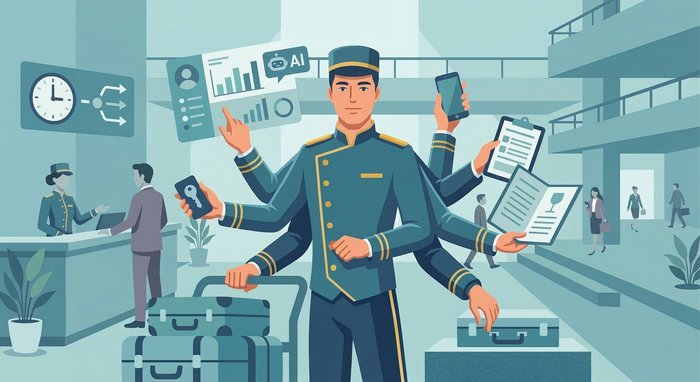
AI is also increasingly serving as an intelligent digital partner on the frontlines — from airport tarmac crews to hotel front-desk staff. Instead of leafing through dense technical manuals, maintenance crews can get hands-free help from digital agents for diagnosing equipment issues and accelerating turnaround times.
No matter whether they’re in hotel corridors or ship cabins, staff can receive real-time room readiness updates and automated task prioritization, while in-flight crews can gain instant, offline visibility into passenger connection anxieties and special service requests. Rather than replacing the human touch, these tools strip away complexity so frontline teams can simply focus on safety, empathy, and high-impact guest care.

This operational empowerment is supported by Google Cloud’s distributed AI and workspace intelligence platforms, which are designed to function reliably in dynamic, fast-paced physical environments. Multimodal models powered by Gemini allow field technicians to analyze photos or sensor telemetry on mobile devices for instant diagnostics, while edge computing solutions and lightweight on-device models keep critical guest data accessible even at 40,000 feet or in the open ocean.
By placing enterprise-grade intelligence directly into the hands of the people running daily operations, travel organizations are cultivating more agile, confident teams that can deliver safer journeys and truly memorable guest moments.
Key lessons for the road ahead
As the travel and hospitality sector accelerates its AI transformation, the winning playbook will come down to three imperatives:
- Build platforms, not one-offs: Instead of conducting isolated experiments, invest in internal systems that allow your entire organization to rapidly deploy, scale, and secure production-grade agents.
- Connect data to the edge: Maximize impact by directly linking core enterprise data to both guest-facing touchpoints and frontline staff, giving operations and customer teams real-time intelligent capabilities.
- Focus on unit economics: Ground every AI initiative in clear financial metrics and ROI, and measure success through concrete outcomes like lower cost per interaction, higher direct conversion rates, and reduced operational cycle times.
In the AI era, innovation is a given. The leaders who are unafraid to invest in the latest advances are the ones seeing the greatest gains and charting the path ahead.
To discover Google Cloud's suite of offerings customizable for the needs of travel leaders, please visit our industry solutions page or contact an industry specialist today.